

Turkish citizenship by government bonds requires a minimum $500,000 investment in state-issued debt instruments, held for three years under Ministry of Treasury and Finance oversight, but most rejections come from instrument misclassification, not the investment amount itself. Our Istanbul-based lawyers confirm eligibility before you purchase, coordinate Certificate of Conformity issuance, and manage the full process remotely, so a bond that looks “government-backed” on paper actually qualifies for citizenship in practice.
What actually makes this route different from a bank deposit, if both require the same USD 500,000 and the same three-year hold? The instrument itself. A deposit is a bank-verified balance; a government bond is a registered, tradeable debt instrument with the Ministry of Treasury and Finance standing behind it rather than a commercial bank alone, a distinction that shapes both the verification process and the risk profile of the investment.
This option is particularly attractive for global investors who prioritize liquidity, predictability, and state-backed financial instruments over the operational complexity of real estate ownership or active business management. When does this route actually go wrong for investors? Almost never at the investment stage itself. It goes wrong quietly, in the gap between what a bank markets as “government-backed” and what the citizenship framework actually recognizes as a qualifying instrument, a gap that only becomes visible once the Certificate of Conformity is requested and, sometimes, refused.
Governed by the Turkish Citizenship Law and its subsequent amendments, this route represents not merely a financial transaction, but a strategic reallocation of capital within an emerging market supported by sovereign guarantees. Which investors actually benefit most from this route? Investors who value institutional transparency over asset appreciation, for whom a predictable, government-verified instrument is worth more than the upside a property or a business might offer, a genuinely conservative choice dressed up, at times, as a simple one.
Who actually verifies that a bond purchase qualifies for citizenship? Not the bank that sold it. The Ministry of Treasury and Finance issues the Certificate of Conformity independently of the selling institution’s own classification, which is precisely why a bank’s marketing language, “government-backed,” “sovereign-guaranteed,” is a starting point for due diligence, not a substitute for it.
⚖️ What Is the Minimum Investment for Turkish Citizenship by Government Bonds?
The minimum threshold for acquiring Turkish citizenship through government bonds is set at USD 500,000, or its equivalent in foreign currency. This investment must be made in state-issued debt instruments under the authority of the Turkish Ministry of Treasury and Finance.
A legally binding three-year no-sell annotation must be registered, preventing the transfer or liquidation of the investment during the holding period. Bond valuations are calculated using the official exchange rates of the Central Bank of the Republic of Türkiye on the transaction date, ensuring transparency and regulatory certainty throughout the eligibility assessment.
At this stage, professional legal representation plays a decisive role. While the legislation provides a clear framework, the administrative process requires precision to secure the Certificate of Conformity, which serves as the formal confirmation that the investment qualifies for citizenship purposes.
It is worth noting what the Certificate of Conformity actually confirms and what it does not. It confirms that the specific instrument purchased, at the amount and currency declared, satisfies the citizenship framework’s threshold and classification requirements at the time of issuance. It does not retroactively validate future changes to the instrument, a restructuring, an early partial redemption, or a transfer between accounts, each of which can require the certificate to be reconfirmed or reissued depending on the nature of the change.
Who This Route Suits
Government bonds suit investors who want a more institutionally transparent instrument than a bank deposit, without taking on the market and liquidity considerations that come with real estate or the operational demands of fixed capital investment. It suits less well an investor seeking capital appreciation, a bond is a fixed-income instrument, not a growth asset, and the appeal here is predictability rather than upside.
It also tends to suit investors already familiar with fixed-income instruments from their home market, treasury bills, sovereign debt, government-backed securities, for whom the underlying logic of the investment requires little translation. That familiarity, however, can create a false sense that Turkish government bonds are verified for citizenship purposes the same way a comparable instrument would be recognized in a more established market, an assumption that overlooks the specific classification step this framework requires independently of the instrument’s general market reputation.
⚖️ How to Apply for Turkish Citizenship Through Government Bonds
The application process follows a structured legal sequence. It begins with the opening of a dedicated investment account at a Turkish banking institution, followed by the execution of the bond purchase in compliance with citizenship regulations.
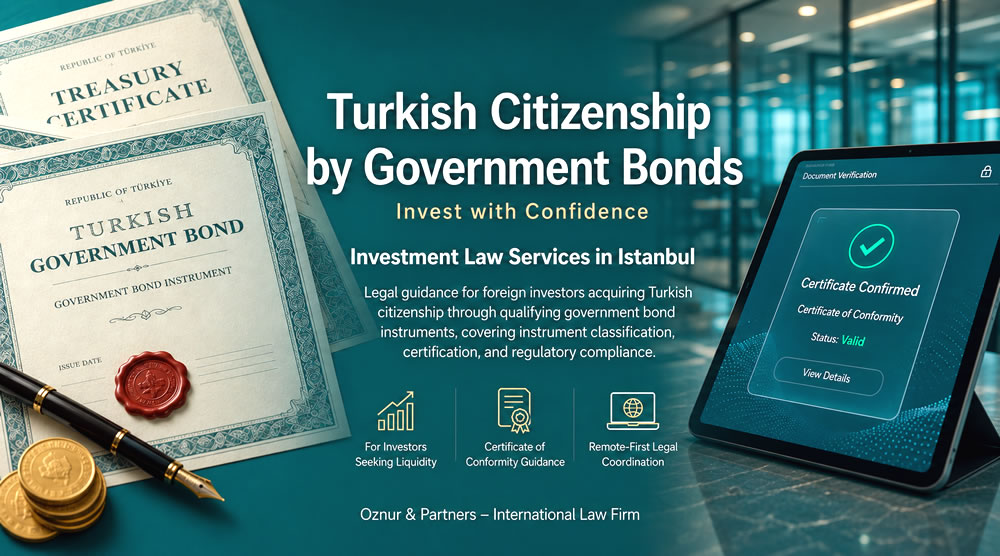
Once the investment is completed, the investor applies for the Certificate of Conformity from the Ministry of Treasury and Finance. This document validates that the investment meets the statutory criteria and provides a clear pathway toward the citizenship application.
Subsequently, the investor applies for a short-term residence permit under Article 31/j of Law No. 6458, a category specifically reserved for foreign investors. This permit does not impose a minimum physical residence requirement in Turkey. The final stage involves submitting the citizenship application to the General Directorate of Population and Citizenship Affairs, where security and public order assessments are conducted.
Each of these five stages, account opening, bond purchase, Certificate of Conformity, residence permit, and citizenship filing, involves a different institution with its own documentation standard. An investor who assumes a single office or a single point of contact manages the entire sequence end to end is, in our experience, the investor most likely to discover a coordination gap partway through, typically at the exact moment two institutions’ records fail to reconcile with each other.
Throughout this multi-layered process, legal coordination ensures procedural continuity and institutional alignment at every stage.
In practice, the documentation an applicant should expect to assemble across these stages includes:
- A valid passport and Turkish tax identification number, obtained before the investment account is opened.
- Proof of funds transferred from the investor’s own account for the bond purchase.
- The Ministry’s written confirmation that the specific instrument purchased qualifies, obtained before or immediately after purchase.
- The Certificate of Conformity confirming the investment satisfies the citizenship framework’s threshold and instrument requirements.
- Short-term residence permit documentation under Article 31/j of Law No. 6458.
- Citizenship application documentation for the principal applicant and any family members included.
Where the Timeline Actually Slows Down
Investors often assume the bond purchase itself is the slowest stage. In practice, it is usually the fastest, opening the investment account and executing the purchase can be completed within days once documentation is in order. The stages that actually consume time are the Certificate of Conformity review, which depends on the Ministry’s confirmation that the specific instrument purchased qualifies, and the final citizenship application review, which commonly adds several months on top of the underlying three-year hold.
Considering government bonds for your citizenship application?
A short consultation can confirm which instruments actually qualify before you purchase, avoiding a refused Certificate of Conformity later.
⚖️ Why Choose Government Bonds Over Real Estate Investment?
Many investors favor government bonds due to their high liquidity and minimal administrative burden. Unlike real estate investments, bond-based citizenship does not involve title deed risks, property management obligations, or exposure to localized market volatility.
Government bonds provide a fixed-income structure with a predictable exit strategy upon completion of the three-year holding period. From an administrative standpoint, verification of a bank-held sovereign bond is often more straightforward for public authorities than property valuation and title registration processes. As a result, this route is frequently perceived as more efficient for investors seeking clarity and speed.
What “Sovereign Guarantee” Actually Means Here
The phrase “sovereign guarantee” is worth unpacking rather than taking at face value. It means the debt instrument is issued and backed by the Turkish state itself, rather than a commercial bank or corporate issuer, which is a meaningful distinction for credit risk. It does not mean the instrument is automatically shielded from currency depreciation, the bond is typically denominated in Turkish lira, and its lira-equivalent value moves with the currency the same way a bank deposit’s does. Sovereign guarantee addresses who stands behind the debt, not what happens to its value in foreign-currency terms, and conflating the two is a common source of misplaced confidence in this route.
The comparison most worth making, though, is against the bank deposit route, since the two share an identical threshold and holding period. A deposit is verified by the banking regulator as a bank-held balance; a bond is a registered debt instrument verified by the Ministry of Treasury and Finance, with its own documentation trail and, in many cases, more established institutional transparency around instrument classification than a deposit account offers. Neither route offers currency protection since the 2025 changes to Turkey’s currency-protected deposit mechanisms, both carry lira-denominated exposure for the full holding period.
Compared to real estate, government bonds trade potential appreciation and rental income for the absence of title, valuation, and zoning risk entirely. An investor who has weighed the two and finds the property market’s illiquidity or the ongoing management burden of a physical asset unappealing tends to find a bond’s structural simplicity a genuine relief rather than a compromise. An investor whose priority is a tangible, potentially appreciating asset, however, will find a bond’s fixed-income character offers nothing to compensate for the upside they are giving up.
⚖️ Common Legal Risks in Government Bond Citizenship Applications
Despite the apparent clarity of the legal framework, citizenship applications based on government bond investments may fail due to procedural errors rather than substantive deficiencies. In practice, most rejections do not arise from the investment amount itself, but from administrative misalignment between financial institutions, regulatory authorities, and the citizenship assessment process.
One of the most frequent issues involves the incorrect classification of investment instruments by banks. Not all debt products marketed as “government-backed” automatically qualify under citizenship regulations. If the investment is recorded under an ineligible category or lacks proper annotation, the Ministry of Treasury and Finance may decline to issue the Certificate of Conformity.
The Instrument Classification Trap
This is worth dwelling on because it is the single most consequential risk on this route, and the one investors are least equipped to catch on their own. A bank relationship manager marketing an instrument as “government-backed” is describing its commercial character, not confirming its citizenship eligibility, and the two descriptions do not always align. An investor who purchases based on the bank’s marketing language, without an independent confirmation that the specific instrument satisfies the citizenship framework’s exact classification requirements, is taking on a risk that only surfaces months later, when the Certificate of Conformity application is filed and the Ministry disagrees with the bank’s characterization.
The safest practice, in our experience, is to treat instrument selection as a legal question first and a banking question second. Confirming eligibility with the Ministry’s own classification standards, before the purchase rather than after, converts a risk that would otherwise surface at the worst possible stage, after capital is already committed and the three-year clock has started, into a resolved question before any money moves.
Another critical risk concerns the blocking period. Errors in recording the exact start date of the three-year holding obligation, particularly in cases of incremental or multi-bank investments, can result in the mandatory period being miscalculated. Even minor discrepancies may lead authorities to consider the investment non-compliant, effectively resetting the eligibility timeline.
This risk compounds for investors who build their USD 500,000 position across multiple purchases rather than a single transaction, a reasonable approach for managing market timing, but one that requires each purchase to be documented against a single, consistent blocking period rather than treated as independent transactions with independent start dates. An investor who purchases USD 300,000 in one transaction and USD 200,000 a month later, without clear documentation tying both to a single qualifying blocking period, may find the Ministry treating the two purchases as separate holdings with separate timelines, neither of which independently satisfies the framework.
The safest practice for staged purchases is to document the intended aggregate investment from the outset, before the first transaction, rather than treating each purchase as a standalone decision and hoping the documentation reconciles cleanly later. A single letter of intent or investment plan filed alongside the first purchase, confirming the total planned commitment and the instruments intended to satisfy it, gives the Ministry a coherent record to verify against rather than a series of disconnected transactions it must piece together after the fact.
Coordination failures between banks and public institutions also pose a significant risk. Delays or inconsistencies in notifications to the Ministry, incomplete documentation, or discrepancies between banking records and official submissions can interrupt the administrative chain required for citizenship approval.
This coordination risk is structural rather than incidental. The bank executing the purchase, the Ministry issuing the Certificate of Conformity, and the citizenship authority reviewing the final application are three separate institutions with three separate documentation standards, and none of them is responsible for confirming that the other two received consistent information. An investor assuming that a smooth bond purchase automatically means smooth Ministry notification, or that Ministry certification automatically means the citizenship file will read consistently, is assuming a coordination that does not happen automatically and needs to be actively managed.
For these reasons, government bond investments for citizenship purposes require more than financial execution. They demand precise legal structuring, continuous verification, and institutional coordination to ensure that every procedural requirement aligns with the expectations of the approving authorities.
⚖️ Tax and Reporting Considerations
Interest income generated by the bond during the holding period, and any currency conversion involved in eventually redeeming or reinvesting the position, may carry tax and reporting consequences both in Turkey and in the investor’s home jurisdiction. This is worth resolving before the purchase rather than treating as a matter to sort out once the three-year period concludes.
A foreign national holding a Turkish government bond of this size is not invisible to their home tax authority in most cases. Turkey participates in international financial account information exchange frameworks, meaning the existence and approximate value of the holding may be reported to the tax authority of the investor’s country of residence, independent of any Turkish tax obligation on the interest earned.
⚖️ Required Documents for the Application Process
The documentation phase requires meticulous preparation. Applicants must submit a valid passport (translated and notarized), official investment confirmation documents, and the Certificate of Conformity issued by the relevant ministry.
For family members included in the application, apostilled or consularly legalized birth and marriage certificates are required. A clean criminal record certificate from the country of origin, along with biometric photographs, forms part of the mandatory submission package. Accuracy and consistency across documents are essential to prevent administrative delays.
Family Inclusion Across the Holding Period
The investor’s spouse and dependent children under eighteen may be included in the same citizenship application, provided family relationships are properly documented through apostilled or legalized civil status certificates. This extends a single qualifying bond investment to the full family unit rather than requiring separate investments per family member.
Because this route requires no ongoing operational involvement, family circumstances that change during the three-year holding period, a birth, a marriage, a change in residence, generally do not affect the underlying investment’s compliance the way they might on a route requiring continuous business operation. What does require attention is ensuring that any family member added to the application after the initial filing has documentation that aligns cleanly with what was originally submitted for the principal applicant.
This makes the route particularly attractive to families weighing multiple citizenship options simultaneously, since the passive nature of the investment means a spouse or adult child added later in the process introduces a documentation task rather than a structural change to the underlying qualifying asset.
What Our Review Covers Before You Invest
Before any bond purchase is executed, we confirm with the receiving bank, in writing where possible, that the specific instrument being purchased satisfies the citizenship framework’s exact eligibility criteria, rather than relying on the bank’s own marketing classification. We also structure the purchase timing to avoid the multi-transaction ambiguity that most commonly disrupts the blocking period calculation, ensuring the three-year clock starts on a single, clearly documented date.
Our approach coordinates instrument selection, Ministry notification, and citizenship filing as a single continuous engagement rather than separate handoffs between a bank, a government office, and an immigration filer. This continuity is what prevents the classification and blocking-period risks described above from ever reaching the citizenship application stage as unresolved questions.
⚖️ What Happens at the End of the Three-Year Hold
Once the three-year no-sell restriction expires, the investor is generally free to redeem, sell, or restructure the bond position without affecting citizenship already granted. This is a cleaner exit than real estate, which requires finding a buyer and completing a resale transaction, and comparable in simplicity to a bank deposit reaching the end of its own holding period.
Investors approaching the end of the holding period should confirm, well in advance, whether the specific instrument they hold has a maturity date that aligns with or falls short of the three-year citizenship requirement. A bond that matures before the three-year holding period is satisfied introduces a gap the investor needs to plan for, either through reinvestment in a qualifying instrument or through advance coordination with counsel about how the maturity affects the underlying citizenship timeline.
What happens after redemption is, at that point, a personal financial decision rather than a citizenship compliance question, reinvest domestically, repatriate the funds, or hold the proceeds in Turkish lira. The citizenship outcome, once granted, does not depend on what the investor does with the capital afterward.
⚖️ Institutional Coordination and Remote-First Process
Citizenship by investment is inherently a cross-border legal process. Investors benefit significantly from working with an international law firm in Istanbul that understands both domestic regulatory mechanisms and international compliance standards, coordinating between banks, the Ministry of Treasury and Finance, and the citizenship authority as a single continuous process rather than three disconnected handoffs.
Most of our government bond clients manage this process remotely. There is no minimum residence requirement for this route, and account opening, instrument selection, and Certificate of Conformity coordination can be handled through power of attorney and digital documentation. The one stage that consistently requires physical presence is biometric data collection during the final stages of the citizenship application.
In practice, this means an investor based in the Gulf, Europe, or East Asia can complete instrument selection review, account opening, and Certificate of Conformity coordination entirely through video calls and secure document exchange, with our team handling the in-country coordination, bank liaison, Ministry submission, notification tracking, that would otherwise require the investor’s continuous presence. Properly drafted and apostilled power of attorney is the legal instrument that makes this model function without compromising the investor’s control over their own transaction.
Foreign investors face not just a language barrier, but a legal maze, expert guidance is the bridge between a compliant instrument on paper and a citizenship application that actually clears review.
Schedule a Legal Consultation
For investors seeking a secure and structured route to Turkish citizenship through government bonds, professional legal coordination ensures instrument eligibility, procedural compliance, and institutional alignment throughout the process. Our Citizenship and Investment Lawyers in Istanbul are available for an initial consultation.
A government bond and a bank deposit look, on paper, like the two simplest routes in this framework. Neither is simple once the instrument classification question is asked, only precise legal coordination turns a state-backed debt instrument into a citizenship outcome rather than a Certificate of Conformity refused for a reason the investor never saw coming.
Of the six routes within Turkey’s investment-based citizenship framework, government bonds offer the closest thing to institutional predictability, a sovereign instrument, a clear holding period, and a documentation trail maintained by the state rather than a single commercial counterparty. That predictability is genuine, but it depends entirely on the instrument actually satisfying the citizenship framework’s specific classification, a step that sits outside the bond’s ordinary market character and requires independent legal confirmation rather than the bank’s own assurance. Investors who treat that confirmation as a formality, rather than the single most consequential decision in the entire process, are the ones who discover the gap between “government-backed” and “citizenship-qualifying” at the most expensive possible moment.
This pathway forms part of the broader legal framework governing investment-based citizenship routes, examined in full in our overview of the paths to Turkish citizenship by investment.