

A lawyer in Turkey is a bar-registered legal professional authorised to advise, draft and represent clients before Turkish courts and public authorities.
That definition is short, and almost every problem foreign clients experience in Turkey begins with a person who does not meet it. Turkey has a large, formal and well documented legal profession. As of 31 December 2025, 206,678 lawyers were registered with bar associations across the country, and 67,463 of them with the Istanbul Bar alone. The system is not opaque. What is opaque, to someone arriving from abroad, is the space around the system: the consultants, agencies, translators, intermediaries and helpful acquaintances who operate next to the profession without belonging to it.
International clients usually arrive at this page with a specific unease rather than a legal question. Someone has been recommended to them. The recommendation came quickly, from a person with a commercial interest in the transaction, and something about the speed of it does not sit right. That instinct is worth listening to.
Foreign investors and expatriates researching the Turkish market regularly ask, “what does it actually mean to say that a lawyer in Turkey is licensed?” It means the person holds a licence (ruhsat) and is entered on the roll of a regional bar association, with a registration number that anyone can check in under a minute through the official directory of the Union of Turkish Bar Associations. Nothing else confers the title. Not a business card, not a company registered as a consultancy, not a website with a courthouse photograph on it.
The follow-up question is the harder one, and clients who have already been burned once tend to ask it first: “how do I know the lawyer is working for me and not for the person who introduced us?” The most expensive lawyer in a cross-border transaction is rarely the unqualified one. It is the properly qualified one whose loyalty was arranged before the client ever landed. Turkish law treats this as a serious matter rather than a matter of etiquette: under Article 48 of the Attorneyship Law No. 1136, paying or receiving a fee or benefit in exchange for channelling work to a lawyer is a criminal offence, punishable by imprisonment, for the intermediary and for the lawyer who uses one.
Timing is the third thing clients get wrong, and they usually notice it too late. “Which comes first, choosing the property or choosing the lawyer?” The transactions that close fastest in Turkey are the ones that begin slowly. Legal review before a deposit costs a fraction of what legal review after a deposit costs, because before signature a lawyer can still change the terms, and after signature a lawyer can only argue about them.
And finally, the practical version of the same instinct: “when should I contact a lawyer in Turkey?” Before money moves, before a power of attorney is signed, and before any document in Turkish is signed on the basis of a verbal summary. Those three moments account for the majority of disputes that reach our office already formed.
Oznur & Partners is an Istanbul based law firm advising foreign investors, expatriates and international families on Turkish law. The firm was selected as the Legal 500 Exclusive Contributor for 2025, the only Turkish firm featured in the relevant Country Comparative Guides, and as a Chambers Exclusive Contributor for Corporate Immigration 2026. Those are third party editorial selections, which is the only kind of credential worth weighing when you are trying to assess a firm from another country.
This page explains what a lawyer in Turkey is legally permitted to do, how to verify one in a few minutes, how fees are regulated, where foreign clients most often lose money, and how to work with Turkish counsel without being physically present in the country.
⚖️ What does a lawyer in Turkey actually do for a foreign client?
A lawyer in Turkey advises on Turkish law, drafts and negotiates the documents that create your legal position, and represents you before courts, land registries, tax offices, migration authorities and banks. Under Article 35 of the Attorneyship Law No. 1136, drafting legal documents on behalf of others and appearing in court on their behalf are reserved to bar-registered lawyers. You may always act for yourself. You may not appoint a consultancy to act for you.
That reservation matters more in Turkey than in some other markets, because a great deal of the work foreign clients need is transactional rather than contentious. Buying an apartment, forming a company, opening a corporate bank account, applying for a residence permit, structuring a citizenship application: none of these begins in a courtroom. All of them create documents that will be read in a courtroom if something goes wrong. The value of Turkish counsel at the transactional stage is not procedural assistance. It is the drafting of a position that survives scrutiny later.
The practical scope of work usually falls into five groups.
- Advisory work. Written opinions on Turkish law, structuring options, regulatory exposure, tax consequences of a chosen structure, and the risk profile of a specific transaction before it is entered into.
- Due diligence. Title deed and encumbrance searches at the Land Registry, municipal zoning and occupancy checks, corporate searches at the Trade Registry, litigation and enforcement searches against a counterparty.
- Drafting and negotiation. Sale and purchase agreements, shareholder agreements, lease agreements, employment contracts, escrow arrangements, articles of association, and the powers of attorney that authorise everything else.
- Representation before authorities. Land Registry Directorates, the Presidency of Migration Management, the Trade Registry, tax offices, and banks where documentary compliance is required.
- Litigation and enforcement. Civil, commercial, family, inheritance and administrative proceedings, arbitration, and enforcement of foreign judgments and awards in Turkey.
A question that comes up constantly in first consultations is “do I actually need a lawyer to buy property in Turkey?” Legally, no. Nothing in Turkish law requires a buyer to instruct counsel, and a title transfer can be completed at the Land Registry without one. Practically, the title transfer is the last five minutes of a process whose risk is concentrated in the ninety days before it, in the searches nobody ran and the clauses nobody read. The registry officer checks that the transfer is procedurally valid. Nobody in that room is checking whether it was a good idea.
There is one further distinction that catches international clients, particularly those used to common law jurisdictions. Foreign lawyers and foreign law firms may operate in Turkey under Article 44 of the Attorneyship Law, but only to advise on foreign law and international law. They cannot advise on Turkish law or appear before Turkish courts. A London or Dubai firm can sit beside you competently on the deal architecture. Only a Turkish bar-registered lawyer can tell you what the Land Registry will do with the document.
⚖️ How can you verify that a lawyer in Turkey is genuinely licensed?
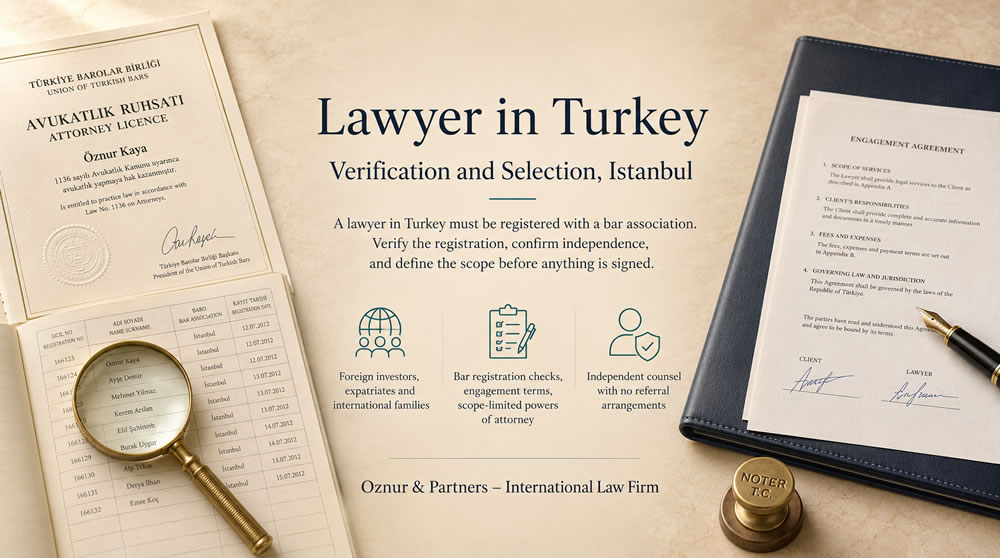
You verify a lawyer in Turkey by obtaining their full legal name and bar registration number, then confirming both against the official roll of the bar association they claim to belong to. The check takes about a minute and requires no Turkish. A lawyer who hesitates to provide the number has already answered a different question.
The verification sequence, in the order that produces the fewest surprises:
- Ask for the full name as registered and the bar registration number (sicil numarası), and the name of the bar association. Not the firm name. Individuals hold licences; firms do not.
- Search the national directory. The Union of Turkish Bar Associations lawyer search covers registered lawyers nationally and returns the bar of registration.
- Cross-check the regional roll. Most bars publish their own roll. For Istanbul, where the largest share of international legal work is handled, the Istanbul Bar roll allows searches by name or registration number.
- Confirm the person matches the record. Names repeat. Match the registration number to the individual you have actually spoken to, not to a similar name in the same city.
- Ask whether the licence is active and unrestricted. A lawyer can be registered historically and currently suspended. Bar associations answer this question directly if asked in writing.
Two things are worth understanding about what verification does and does not prove. It proves authority. It does not prove suitability, and it does not prove independence. A properly licensed lawyer with fifteen years of criminal practice is fully authorised to handle your commercial real estate acquisition and is very probably the wrong choice for it. Verification is the floor, not the assessment.
The table below sets out what to ask, what a legitimate answer looks like, and what should stop the conversation.
| What you ask | Legitimate response | Warning sign |
|---|---|---|
| Bar registration number and bar association | Given immediately, in writing, without explanation | Deflection, “our firm is registered”, or a promise to send it later |
| Who introduced us, and is there any fee arrangement between you? | A direct answer, and a written confirmation that no referral fee is paid | Vagueness, or “we work together often” without further detail |
| Will there be a written engagement and fee agreement? | Yes, before work begins, in a language you read | Verbal terms only, or a fee described as “included” in someone else’s package |
| Who exactly will do the work, and who will sign? | Named lawyer, with the registration number that matches | The person you meet is a “consultant” or “case manager” and the lawyer is never present |
| What is the scope of the power of attorney you need? | A specific, limited scope tied to defined transactions | A broad general power of attorney requested at the first meeting |
| Are you also acting for the seller, developer or agency? | No, with a written conflict confirmation | “It is normal here”, or the question is treated as offensive |
That last row deserves emphasis. Under Article 38 of the Attorneyship Law, a lawyer is required to decline instructions where a conflict exists, including where they have previously advised the opposing party in the same matter. This is not a courtesy standard. It is a professional obligation with disciplinary consequences.
Not sure whether the lawyer you were introduced to is actually acting for you?
Send us the name and registration number. We will tell you what the public record shows and what questions to put in writing before anything is signed.
⚖️ Independence: the referral chain most foreign clients never see
The single most common structural problem in foreign legal matters in Turkey is not incompetence. It is a lawyer who was selected by someone other than the client. The transaction looks ordinary from the outside. A buyer contacts an agency, the agency recommends a lawyer, the lawyer is licensed, the paperwork is clean, and the file closes. What the buyer never sees is who the lawyer was economically accountable to during the ninety days when the terms were negotiable.
Turkish law addresses this directly. Article 48 of the Attorneyship Law No. 1136 criminalises the payment or receipt of any fee or benefit in exchange for bringing work to a lawyer. The intermediary who takes the commission and the lawyer who uses the intermediary are both within the scope of the provision, with imprisonment of six months to one year (and a higher floor where a public official is involved). The profession does not treat referral commissions as a grey area. The market around the profession sometimes does.
This is where the perception gap opens. The client sees a favour: a busy agent saving them the trouble of finding counsel in an unfamiliar country. The structure underneath is a distribution channel. And a lawyer inside a distribution channel is not free to give the one piece of advice that matters most, which is: do not do this deal.
None of this means an introduction is automatically compromised. Lawyers are recommended by satisfied clients, accountants, embassies and colleagues every day, and those recommendations are clean. The test is not whether someone recommended the lawyer. The test is whether the person who recommended the lawyer earns money if you sign.
Clients often ask at this point, “can I simply ask the lawyer whether they are being paid a referral fee?” Yes, and it should be asked in writing rather than in conversation. A written question produces a written answer, and a written answer that later proves false is evidence. Verbal reassurance produces nothing at all.
Independence has a practical signature that is visible even to someone who does not read Turkish. An independent lawyer sends you a fee agreement in their own name. They ask questions about your objectives before discussing the specific property or company. They tell you what they cannot do. And at some point early in the relationship, they say something you did not want to hear.
⚖️ Where foreign clients actually lose money in Turkey
Foreign clients in Turkey lose money in a small number of recurring situations, and almost all of them are documentary rather than dramatic. The loss is not usually a stolen deposit. It is a clause, an omission, or a signature given on a document that was summarised rather than translated.
The pattern below reflects the matters that most frequently reach our office already in difficulty.
| Situation | What goes wrong | What prevents it |
|---|---|---|
| Off-plan and under-construction purchases | Payments made against a promise of sale with no registered security, delivery dates without remedies, and a developer whose corporate position was never checked | Trade Registry and litigation searches on the developer, registered pre-emption or mortgage security, staged payments tied to construction milestones |
| Title deed assumptions | Buying property with annotations, easements, zoning restrictions or occupancy problems that do not appear in the sales presentation | Full Land Registry and municipal search before any deposit, in the buyer’s own name |
| Deposit and escrow | Funds released to the seller or an intermediary before conditions are satisfied, with no mechanism to recover them | A structured escrow arrangement with defined release conditions |
| Citizenship by investment valuation | Valuation reports that do not support the threshold, or resale restrictions that are discovered after purchase | Pre-purchase valuation review and confirmation of the property’s eligibility history |
| Power of attorney scope | A general power of attorney used for transactions the client never approved | Narrow, matter-specific powers of attorney with defined expiry |
| Contracts signed in Turkish only | The signed Turkish text differs materially from the verbal summary given at signature | Bilingual execution, or sworn translation reviewed by the client’s own lawyer |
| Company formation without structure | Shareholding, management authority and exit terms left to the default position of the Turkish Commercial Code | A shareholder agreement drafted alongside the articles of association |
| Tax position assumed rather than checked | Residency and withholding consequences discovered after the structure is fixed | Tax analysis before incorporation or acquisition, not after |
What links these is a sequencing error rather than a knowledge error. In every one of them, the legal review that would have prevented the loss was available, affordable and skipped, because at the moment it mattered the transaction did not yet feel risky. Risk in Turkish property and corporate matters is not felt at the point it is created. It is felt at the point it becomes visible, which is usually eighteen months later when someone tries to sell, inherit or refinance.
Detailed treatment of the property side of this sits in our note on legal due diligence for property acquisitions, and disputes that have already crystallised are addressed by our property dispute lawyers in Turkey.
⚖️ How to find a lawyer in Turkey safely
The safest way to find a lawyer in Turkey is to start from sources that have no financial interest in your transaction, then verify, then assess suitability, and only then discuss your matter in detail. Reversing that order is how most clients end up committed to counsel they never actually chose.
Sources worth starting from, in descending order of independence:
- Official bar directories. The Union of Turkish Bar Associations and regional bar rolls list every licensed lawyer. They confirm authority but say nothing about specialisation.
- Independent editorial directories. Legal 500, Chambers and similar guides research firms through client and peer interviews rather than paid listings. They are imperfect but they are not advertising.
- Your embassy or consulate in Turkey. Most maintain lists of English-speaking lawyers. The lists are not endorsements, but they are compiled without commercial interest.
- Professional referral from your own advisers at home. Your accountant, private banker or solicitor has a reputational stake in the referral and no stake in the Turkish transaction.
- Other foreign clients who have completed a similar matter. Ask specifically what went wrong and how it was handled. Anyone whose answer is “nothing went wrong” either had a simple file or was not told.
Sources that require more caution are the ones with the shortest path to a commission: property agencies, relocation consultancies, developers’ in-house teams, and social media groups where the most active contributors are frequently the least disinterested.
The first contact matters more than most clients realise, because it is also your first sample of how the firm works. A useful first message includes what you are trying to achieve, the deadline you are working against, the amounts involved, whether anything has already been signed, and whether you are in Turkey. What comes back tells you a great deal. A firm that responds with a fee quote before asking a single question about your objectives has told you what it sells.
Clients frequently ask, “how many lawyers should I speak to before deciding?” Two or three is enough, and speaking to more than four usually reflects anxiety rather than diligence. The information you gain from the fourth conversation is rarely worth the two weeks it costs in a market where deadlines are real. Broader guidance on the selection process sits on our page about finding a lawyer in Turkey.
⚖️ What legal fees in Turkey look like, and what the law fixes
Legal fees in Turkey are freely negotiated within statutory boundaries: they cannot fall below the Minimum Fee Tariff published annually by the Union of Turkish Bar Associations, and where a fee is agreed as a percentage of the value in dispute, that percentage cannot exceed 25 per cent. Both rules sit in Article 164 of the Attorneyship Law No. 1136.
Three further points in the same provision are worth knowing before you sign anything.
- Percentage fees cannot be taken in kind. An agreement giving the lawyer a share of the property or rights in dispute, rather than money, is not permitted.
- Where there is no written fee agreement, or the fee clause is invalid or unclear, the fee for the successful portion of a case is determined by the competent authority at between 10 and 20 per cent of the value of the claim, and never below the tariff.
- Court-awarded counsel fees belong to the lawyer. The fee the losing party is ordered to pay under the tariff is the lawyer’s own entitlement, which is separate from what you agreed to pay. Clarify at the outset how the two interact in your engagement.
In practice, foreign clients encounter four fee models.
| Model | Typical use | What to clarify before signing |
|---|---|---|
| Fixed fee | Company formation, residence permit applications, title transfers, standard contracts | Exactly which steps are inside the fee, and what triggers an additional charge |
| Hourly | Negotiations, structuring, advisory work of uncertain length | The rate per fee earner, billing increments, and whether an estimate cap applies |
| Percentage of value | Litigation and recovery matters | The 25 per cent statutory ceiling, and the basis on which value is calculated |
| Retainer | Ongoing corporate and compliance support | Monthly scope, what falls outside it, and notice period |
Costs that are not legal fees are routinely mistaken for them, which is how clients end up believing a quote was misleading when it was merely incomplete. Court filing fees and expenses, notary charges, sworn translation, apostille, Land Registry transfer duty, expert and valuation reports, and translation of official correspondence are all separate. A good engagement letter itemises them as estimates rather than folding them into a single number, precisely because they are the part nobody can fix in advance.
There is a version of this question that clients ask more quietly: “is a cheaper lawyer in Turkey a false economy?” Not automatically. Price tracks the complexity a firm is set up to handle, and a straightforward residence permit does not require the team that structures a cross-border acquisition. The false economy is narrower than that, and specific: paying for a signature rather than for judgement. A fee that covers attendance and filing but not analysis buys you a completed form, and completed forms are not what fails. Our detailed breakdown sits on the page covering the cost of hiring a lawyer in Turkey.
⚖️ How to choose the best lawyer in Turkey for your matter
The right lawyer in Turkey is the one whose regular practice already contains matters that look like yours. Specialisation is not formally certified in Turkey, so it has to be established by evidence rather than by title, and the evidence is specific: the type of matter, the counterparty type, the authority involved, and whether the lawyer has taken that type of matter through to conclusion rather than only to filing.
Four criteria carry most of the weight.
- Matter fit. Turkish practice is more generalist than in some markets, and a competent lawyer will tell you when your matter sits outside their usual work. That sentence is one of the strongest quality signals available to a foreign client.
- Cross-border experience. Foreign clients generate problems Turkish clients do not: apostille chains, sworn translation, foreign source-of-funds documentation, treaty questions, and enforcement of foreign judgments. A lawyer who handles these weekly moves faster and asks for the right documents the first time.
- Working language. Not translation, which any agency can supply, but the ability to explain a Turkish legal position in a language you can act on. The distinction is set out on our page about working with an English speaking lawyer in Turkey.
- Third party verification. Independent editorial recognition, published contributions to legal guides, and bar standing carry more information than self-description. The word “best” on a firm’s own website carries none.
Matching the matter to the practice area is straightforward once it is set out plainly.
| Your situation | What the lawyer should handle routinely |
|---|---|
| Buying residential or commercial property | Land Registry practice, municipal zoning, developer due diligence, escrow structuring |
| Applying for Turkish citizenship by investment | Valuation and eligibility review, Land Registry annotation, application file management before the authorities |
| Residence and work permits | Presidency of Migration Management practice, appeal routes, family reunification |
| Setting up or acquiring a company | Trade Registry, shareholder agreements, corporate banking, incentive certification |
| Divorce, custody or a cross-border family matter | Family courts, recognition of foreign judgments, Hague Convention practice |
| Inheritance with assets in Turkey | Succession certificates, applicable law analysis, partition proceedings |
| Recovering money or enforcing a judgment | Enforcement offices, interim attachment, recognition and enforcement of foreign awards |
Terminology causes avoidable confusion here. Clients from common law jurisdictions frequently ask whether they need a barrister or a solicitor in Turkey. Turkish law recognises a single profession, the avukat, who both advises and appears in court; the split does not exist. We set out the mapping between the terms on our page comparing the roles of lawyer, attorney, barrister and solicitor, and a comparative view of firm selection sits on our guide to the best lawyers in Turkey.
⚖️ Working with a Turkish lawyer from abroad
Almost every transaction a foreign client needs in Turkey can be completed without entering the country, through a notarised and apostilled power of attorney. Company formation, corporate bank account opening, property purchase and title registration, investment incentive applications, contract negotiation and signature, and litigation can all be conducted by Turkish counsel acting under a properly drafted mandate.
The power of attorney chain works as follows. The document is executed before a notary in the country where you are located, apostilled under the 1961 Hague Convention, translated into Turkish by a sworn translator, and submitted to the relevant Turkish authority. For countries outside the Apostille Convention, certification is obtained through the Turkish consulate instead. The chain is administrative rather than difficult, but it is unforgiving: an error at the notary stage is usually discovered at the Land Registry, weeks later, by which time a deadline has moved.
Scope is where the real decision sits. A general power of attorney is convenient and is precisely the instrument that appears in the worst cases we see. A matter-specific power of attorney, naming the transaction, the property or company, the permitted acts and an expiry date, costs nothing extra and closes the entire category of risk. Any lawyer who tells you that a narrow power of attorney is impractical is describing their own preference, not Turkish law.
One exception is worth stating clearly, because it is the question every remote applicant eventually asks: “is there anything I have to be in Turkey for?” For citizenship by investment, the principal applicant and spouse must attend in person once, for biometric registration, either at the Presidency of Migration Management or at a Turkish consulate. Every other stage of that process, and every stage of the other processes listed above, can be handled remotely.
Remote engagement also changes what good service looks like. Documents should arrive with an explanation of what each one does, not simply with a signature marker. Deadlines should be communicated with lead time that accounts for international courier and apostille schedules. And someone should be reachable in a time zone that overlaps with yours. Related practical steps are covered in our guidance on opening a bank account in Turkey and on escrow arrangements for cross-border payments.
⚖️ Why international clients work with Oznur & Partners
Oznur & Partners is an Istanbul based law firm whose practice is built around clients who are not in Turkey. That orientation is the substantive difference rather than a positioning statement: the firm’s standard workflow assumes apostille chains, sworn translation, foreign documentation standards, time zone gaps and clients who need to understand a Turkish legal position well enough to make a decision from another country.
Two external selections are worth stating because they were made by third parties rather than by us.
- Legal 500 Exclusive Contributor, 2025. The firm was the only Turkish firm selected to contribute to the relevant Legal 500 Country Comparative Guides, which are written for international counsel assessing Turkish law from outside.
- Chambers Exclusive Contributor, Corporate Immigration 2026. Selected to contribute the Turkish chapter on corporate immigration, an area where foreign employers and individuals rely most heavily on accurate local practice.
Practically, clients work with us in three situations. Before a transaction, where the objective is to structure it so that it does not generate a dispute. During a transaction that has begun without legal input, where the objective is to establish what has already been committed and what can still be changed. And after something has failed, where the objective is recovery, and where the first task is usually reconstructing a documentary record that was never properly created.
Fatih Oznur, Esq. advises international clients across investment structuring, corporate matters, real estate acquisition, citizenship and immigration files, and criminal defence for foreign nationals. His full attorney profile sets out practice areas and background.
We also say plainly what we do not do. We do not accept or pay referral commissions, we do not act for both sides of a transaction, and we decline matters that sit outside our practice rather than accepting them and learning at the client’s expense. Those three sentences are the operational content of independence, and they are considerably more useful to a foreign client than an adjective.
⚖️ Who we work with
Our clients are, with few exceptions, people making decisions about Turkey from outside Turkey. The profiles below cover the majority of the work.
- International investors and family offices acquiring real estate, entering joint ventures, or structuring holdings with a Turkish component, where the driving concern is exit and tax position rather than acquisition itself.
- Foreign companies entering the Turkish market, through subsidiary formation, acquisition or distribution arrangements, and needing corporate, employment and regulatory work handled as a single file.
- Citizenship and residence applicants, where the legal risk sits in eligibility and documentation rather than in the application form, and where a rejected file is expensive to rehabilitate.
- Expatriates living in Turkey dealing with employment, tenancy, family and administrative matters in a system operating in a language they do not read.
- International families with Turkish assets, typically in inheritance, matrimonial property or cross-border succession matters, where two legal systems have to be reconciled.
- Foreign nationals facing criminal or administrative proceedings, where speed and accurate procedural advice in the first days determine most of the outcome.
Geographically the practice is concentrated in Istanbul, which handles the largest share of international commercial, corporate and administrative work in Turkey, with matters conducted before courts and authorities elsewhere in the country as required. We describe the firm’s operational base rather than claiming presence in cities where we do not maintain one, and our Istanbul practice page sets out that scope.
⚖️ Related legal resources
🔹 Property and investment in Turkey
- Legal Due Diligence for Property Acquisitions, covering Land Registry encumbrance searches, municipal zoning and occupancy checks, and developer solvency review before a deposit is paid.
- Property Dispute Lawyer in Turkey, for title annotations, delivery failures in off-plan purchases, and partition or possession proceedings before the civil courts.
- Escrow Arrangements in Turkey, setting out how staged release conditions are documented so funds are not transferred before contractual conditions are satisfied.
- Asset Protection in Turkey, on holding structures, creditor exposure and the sequencing of protective measures.
🔹 Citizenship, residence and immigration
- Turkish Citizenship Law Firm, covering the investment routes, valuation and eligibility requirements, and the Land Registry annotation that supports the application file.
- Turkish Immigration Lawyers, for residence and work permit applications before the Presidency of Migration Management, and appeal routes following refusal.
🔹 Company formation and banking
- Company Formation Lawyer, on the choice between a limited şirket and an anonim şirket, Trade Registry procedure, and the shareholder terms that should be settled before incorporation.
- Opening a Bank Account in Turkey, covering the documentation and source-of-funds standards Turkish banks apply to non-resident individuals and foreign-owned companies.
- Business Lawyer in Turkey, for commercial contracts, distribution and agency arrangements, and ongoing corporate compliance.
🔹 Family and inheritance matters
- Custody Lawyer in Turkey, for cross-border custody, recognition of foreign family judgments and Hague Convention proceedings.
- Inheritance Dispute Resolution in Turkey, on succession certificates, applicable law where the deceased was a foreign national, and partition of Turkish assets.
🔹 Understanding the Turkish legal system
- Lawyer, Attorney, Barrister or Solicitor, explaining why Turkish law recognises a single unified profession and how the common law terms map onto it.
- Legal Guide for Foreigners in Turkey, a broad orientation to the courts, authorities and procedures foreign residents encounter.
- Cost of Hiring a Lawyer in Turkey, with the fee models, statutory limits and separately billed expenses set out in detail.
- English Speaking Lawyer in Turkey, on working in a second language across Turkish institutions and documentation standards.
Schedule a Legal Consultation
If you are preparing to instruct a lawyer in Turkey, reviewing a proposal you have already received, or dealing with a matter that began without independent legal advice, our lawyers in Istanbul are available for an initial consultation with international clients.
⚖️ The decision that comes before every other decision
Foreign clients arriving in Turkey tend to think of legal advice as a service attached to a transaction. It is closer to the opposite. The choice of lawyer is the first decision, and it silently determines the range of the others, because every subsequent option you are shown has already passed through the judgement, and the interests, of the person advising you.
This is why the verification steps on this page take a minute and matter more than a month of research into the property market. A registration number confirms authority. A written conflict declaration confirms independence. A matter-specific power of attorney confirms scope. None of it is difficult, none of it is expensive, and all of it is done before anything is at stake, which is the only period in which it can be done at all.
The unease that brought most readers to this page was accurate. In our experience it usually is. If a structure looks correct and something still feels unresolved, the thing to do is not to reassure yourself. It is to ask the question in writing, and to read the answer carefully.