
8 Eylül 2026
A law firm in Istanbul is, for most foreign clients, not a place they visit but a party that acts on their behalf while they remain abroad. The signing happens in one country, the consequences land in another, and the distance between the two is where nearly every avoidable problem begins.
The section below is written for that reality. It explains what an Istanbul law firm actually does for someone who lives outside Turkey, how to tell a licensed firm from a listing, and which parts of a legal matter can be finished without ever boarding a plane. Open it when you want the full picture rather than a brochure.
▶️ Choosing a law firm in Istanbul as a foreign client🔽
A law firm in Istanbul that works with foreign clients does something narrower and more precise than the phrase suggests. It does not simply explain Turkish law in English. It executes, under formal authority, the steps that would otherwise require the client to be physically present in Turkey: forming a company, opening a corporate bank account, buying property and registering the title, signing and enforcing contracts, and appearing before courts and administrative authorities. The law is the same for everyone; what changes for a foreign client is the distance the work has to travel.
That framing matters because it changes what you should be looking for. Most people searching for a law firm in Istanbul start by comparing size, rankings, or how fluent the English on the website sounds. Those signals are not useless, but they answer the wrong question. The question that decides your outcome is whether the firm can act correctly on your behalf from a distance, and whether the person acting is legally allowed to.
What does a law firm in Istanbul actually do for a client who lives abroad? It gives you a working presence in a country you are not standing in. Through a power of attorney, a Turkish law firm can complete transactions, file applications, and represent you before authorities as if you were there, which is precisely why the wording of that authority, and the licence of the person holding it, deserve more attention than the firm’s brochure.
Who is legally allowed to act for a foreign client before Turkish authorities? Only a lawyer, an avukat, registered with a Turkish bar association and acting under a properly executed power of attorney. This is where a quiet contradiction lives: a power of attorney can be entirely valid and still refused at the counter. An unlicensed consultant, agent, or “facilitator” cannot file a case, sign a title deed, or appear in court for you, regardless of what they promise, and a document that looks complete on paper can be turned away by a bank or a notary for reasons that never appear in the marketing.
⚖️ What a law firm in Istanbul actually does for a foreign client
A law firm in Istanbul serving international clients operates across two roles at once: adviser and agent. As adviser, it tells you what Turkish law requires and where the risk sits. As agent, it carries out the steps on the ground. For a client who lives in Dubai, London, or Frankfurt, the second role is usually the reason to retain a firm at all, because advice you cannot act on from abroad solves nothing.
In practice, the work concentrates in a handful of areas. Company formation and corporate structuring, including the choice between a limited liability company and a joint stock company, and the registrations that follow. Real estate: due diligence on a property, drafting and reviewing the sale contract, and completing the title deed transfer at the Land Registry. Citizenship and residence, where investment routes intersect with immigration procedure. Contracts, disputes, and enforcement, where a document signed years ago is tested for the first time. Each of these can be handled for a client who never leaves home, but only if the legal authority behind the firm is set up correctly at the start.
There is a difference worth naming early. A firm that is genuinely useful to a foreign client is not the one that promises the most; it is the one that tells you what will not work before you commit to it. That instinct, declining the matter that does not fit rather than taking every fee that walks in, is one of the few reliable signals of a serious practice. You will not see it advertised, because advertising it would defeat it.
⚖️ Why Istanbul, and why the firm matters more than the city
Istanbul is where most of Turkey’s cross-border legal work happens, because it is where the capital, the courts of commercial gravity, the corporate registries, and the international banking relationships concentrate. For a foreign investor, this means the relevant expertise, the counterparties, and the institutions are usually within the same city. It does not mean every firm in the city is the right one for your matter.
A common and costly assumption is that geography settles competence: that a firm in Istanbul is by definition equipped for anything Turkish. The Turkish legal market has specialised meaningfully. A criminal defence practice is not the right home for a citizenship-by-investment transaction. A property lawyer is not the counsel you want for a contested administrative appeal. The city gets you into the right country; the firm, and specifically the right practice area within it, gets you the outcome. When people compare options, this is where the real decision lives, and you can read more about the practice areas a full-service firm covers on the practice areas overview.
The other reason the firm matters more than the postcode is continuity. Istanbul is a large market with high practitioner turnover; a matter that spans company formation, a bank account, a property purchase, and later a dispute is better held by a single accountable firm than passed between unconnected specialists. Structure, not address, is what carries a cross-border matter to its end without pieces falling out along the way.
Not sure whether your matter needs a specialist or a generalist in Istanbul?
A short conversation is usually enough to tell you which practice area your situation falls under, and whether it can be handled without you travelling to Turkey.
⚖️ The real problem is distance, not language
English is the entry ticket, not the qualification. A firm that speaks fluent English but cannot execute a Turkish procedure while you sit abroad has solved the easy half of the problem. The hard half is distance: authorities that require an original signature, institutions that accept only documents formatted a particular way, deadlines that run on Turkish court calendars, and offices that answer to their own internal practice rather than to what a foreign client reasonably expects.
Distance produces a specific kind of failure. It is rarely dramatic. A document arrives without the right authentication, a bank quietly declines to open the account, a filing misses a window by a week. Nothing announces itself; the transaction simply stops moving, and by the time the client notices from abroad, the cost of fixing it has multiplied. A firm built for international clients is one that has learned where these silent stalls happen and closes the gap before the client ever sees it.
This is also why the “closest lawyer to the property” instinct so often disappoints. Proximity to the asset is not proximity to the procedure. What a foreign client needs is someone positioned close to the institutions, the notaries, the registries, the courts, and able to move documents across the border correctly the first time.
When does a foreign client genuinely need to travel to Istanbul? Almost never for a standard transaction. Company formation, bank account opening, property purchase and title registration, and most filings are completed remotely under a power of attorney. The single recurring exception is Turkish citizenship by investment, where the main applicant and spouse must appear once for biometric enrolment; the rest of that process, too, is handled from abroad.
⚖️ Practice areas an Istanbul law firm covers for foreign clients
Cross-border practice is broad, but for foreign clients it clusters into a few recognisable groups. The grouping below shows where a Turkish law firm’s work concentrates and links, where relevant, to a focused treatment of each area. Foreign clients rarely arrive with a matter that sits neatly in one box; a property purchase touches tax, a company formation touches immigration, an inheritance touches both, which is another reason continuity under one firm tends to matter more than depth in any single silo.
🔹 Investment and corporate
Company formation, corporate structuring, mergers and acquisitions, shareholder agreements, and legal support for investment funds. This is the backbone of most foreign business activity in Turkey, and the area where getting the structure right at the outset saves the most later. See Turkish law for foreign investors and businesses and business formation and licensing.
🔹 Real estate
Property due diligence, sale and lease contracts, and title deed transactions at the Land Registry, all of which a foreign buyer can complete without being present. The guidance on property purchase legal assistance in Istanbul covers the process step by step.
🔹 Citizenship and residence
Turkish citizenship by investment, residence permits, and the immigration procedure that runs alongside them. For an overview of the routes and the legal groundwork, see Turkish citizenship legal guidance.
🔹 Contracts, disputes, and compliance
Contract drafting and review, commercial litigation, arbitration, and regulatory compliance. These are the matters where the quality of the earlier documentation is finally tested, and where a foreign client most needs local representation.
🔹 Family, inheritance, and personal matters
Cross-border inheritance, family law, and the personal legal questions that arise when a foreign national holds assets or family ties in Turkey. Inheritance in particular follows Turkish rules that surprise many foreign heirs, as the note on inheritance law for foreigners explains.
⚖️ When a power of attorney is valid but still not enough
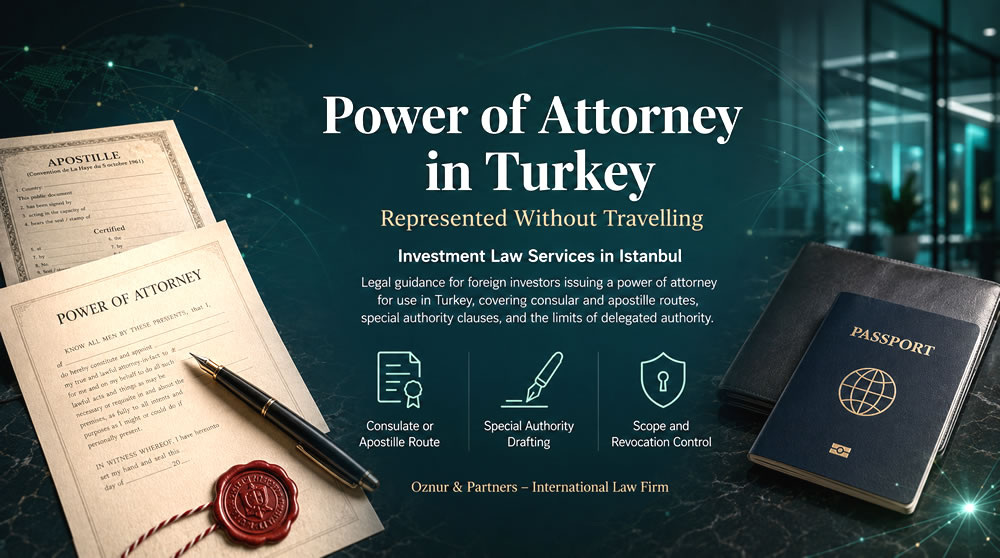
The power of attorney, vekaletname in Turkish, is the instrument that lets a law firm act for a client who is abroad. Foreign clients can issue one in three legally recognised ways: before a Turkish notary while in Turkey, before a Turkish consulate abroad, or before a local notary in their own country followed by an apostille under the 1961 Hague Convention. In every case, a document issued abroad must be translated into Turkish by a sworn translator to be accepted.
Here is the part most guides leave out. Why would a notarised, apostilled power of attorney be rejected in Turkey? Because validity and usability are not the same thing. An apostilled foreign power of attorney is legally valid, but it carries no Turkish notarial journal record, no yevmiye number that a Turkish official can look up and confirm. For consultation, file review, and general advice, that is fine. But for a bank account, a title deed transfer, or formal representation, some institutions will refuse a document they cannot verify against their own records, and they will do so without much explanation. The client, abroad, is left holding a paper that is technically correct and practically inert.
The strongest power of attorney, then, is not the broadest one. It is the one whose route, scope, and wording are matched to the exact task before it is signed. A general “do everything necessary” authority feels safer to a nervous client but is often the version most likely to be challenged, because Turkish authorities frequently require express authorisation for specific acts. Getting this right at the drafting stage, before the client signs abroad and before the apostille and translation are commissioned, is one of the quietest and most valuable things a good firm does.
⚖️ What can be handled without travelling to Turkey
For most foreign clients the practical question is simple: how much can be done without me getting on a plane. How much of a Turkish legal matter can be completed without ever entering the country? Nearly all of it. With a correctly drafted power of attorney in place, the following are routinely completed while the client stays abroad:
- Company formation, including limited liability and joint stock companies, and the trade registry filings that follow.
- Opening a corporate bank account and preparing the foreign exchange documentation banks require.
- Buying property: due diligence, contract signing, and registration of the title deed at the Land Registry.
- Applying for an investment incentive certificate and related permits.
- Negotiating, signing, and where necessary enforcing contracts.
- Filing and conducting litigation or administrative applications, with the lawyer appearing on the client’s behalf.
There is one recurring exception, and it is worth stating plainly rather than hiding it. In Turkish citizenship by investment, the main applicant and spouse must appear in person once, for biometric enrolment, either at the migration authority in Turkey or at a Turkish consulate. Every other stage of that process, from structuring the qualifying investment to filing the application, is handled remotely. Beyond this single step, the remote-first model holds. For the operational detail of how a matter runs when the client is abroad, see the legal support for foreign investors page.
⚖️ The mistakes foreign clients make when choosing a firm
Most problems foreign clients bring to an Istanbul law firm did not start as legal problems. They started as choices made before any legal work began, and they share a pattern: the client optimised for the wrong thing. Naming these early is more useful than another list of what a good firm does, because avoiding a single one of them tends to save more than a careful comparison of credentials.
The first is hiring on price alone. A quote that undercuts every other is not usually a bargain; it is often a quote that omits the disbursements, the court and notary fees, the apostille, the sworn translation, that will arrive later regardless. The meaningful comparison is not the headline fee but the total cost of reaching the outcome, and a firm that will not put that in front of you is telling you something.
The second is signing a broad power of attorney abroad before anyone has scoped it. It feels efficient to authorise “everything necessary” in one visit to a local notary. In practice it produces the document most likely to be challenged, and once it is apostilled and translated, correcting it means starting the whole authentication chain again from another country. Scope first, sign second.
The third is treating a listing as vetting. A place on a consulate’s roster of English-speaking lawyers, or a profile in a legal directory, confirms a language and a registration. It does not confirm that the practitioner handles your kind of matter, and it is not a recommendation. The fourth, related, is mistaking proximity to the asset for proximity to the procedure: the lawyer nearest the apartment you are buying is not necessarily the one best placed before the registry that will transfer it.
The last, and most consequential, is using an unlicensed intermediary for work that only a licensed lawyer can lawfully perform. A “consultant” or “fixer” can introduce and translate, but cannot hold a litigation power of attorney, file on your behalf, or appear before a court or authority. When the intermediary reaches the limit of what they are permitted to do, the client is often already committed, and abroad. The legal guide for foreigners in Turkey sets out these traps in more detail.
⚖️ How to choose and verify a law firm in Istanbul
Choosing well is less about finding the “best” firm, a claim no serious practice makes about itself, and more about confirming a few concrete things in the right order. Verification comes first, because it is the one step that is binary: either the person is licensed or they are not.
Only a lawyer registered with a Turkish bar association may hold a litigation power of attorney and appear before the courts. You can confirm registration through the Union of Turkish Bar Associations or the relevant local bar, such as the Istanbul Bar Association. This distinction also separates three things that look alike online: a law firm, an independent licensed lawyer, and a directory or referral listing. A consulate’s list of English-speaking lawyers, for example, is a starting point, not an endorsement of fit. The step-by-step method is set out in the guide on how to verify a lawyer in Turkey.
After verification, the substantive questions decide quality: does the firm practise in your specific area, does it set out fees and likely disbursements, the court fees, notary and apostille costs, sworn translation, at the outset rather than after the engagement begins, and does it put scope in writing, including what is excluded. A firm that discusses cost and scope openly before you commit is showing you how it will behave when the matter gets difficult.
Which matters more when choosing a law firm in Istanbul, its size or its fit to your case? Fit, in almost every situation. A large firm brings depth and cross-border coordination; a focused practice brings direct partner attention and speed. Neither is superior in the abstract. What decides the outcome is whether the firm’s actual expertise matches your actual matter, and whether it is licensed to act.
⚖️ What a proper engagement with an Istanbul law firm looks like
Once verification is done and the firm fits the matter, the engagement itself should be written down before work begins. A proper engagement agreement identifies the parties, defines the scope of work with explicit inclusions and exclusions, sets out the fee basis, lists the expected disbursements, and states how and when the relationship can end. For a foreign client, the exclusions matter as much as the inclusions, because they mark where a matter might later need additional authority or a separate engagement.
Fees usually take one of three shapes. A fixed fee suits defined transactions such as a company formation or a title deed transfer, where the work is predictable. An hourly basis suits advisory work and disputes, where it is not. A staged fee, tied to milestones, suits longer matters like a citizenship application, where the client pays as the file advances. None of these is inherently better; the right one depends on how predictable the matter is, and a firm should be able to explain why it proposes the structure it does.
Disbursements are separate from the fee, and they surprise clients who were quoted only the fee. They typically include court filing fees (the harç), notary charges, apostille costs, sworn translation, expert witness fees in litigation, and government application fees in matters such as citizenship or incentive certificates. A serious firm sets these out at the start as estimates rather than presenting them after the fact. The difference between a professional engagement and an improvised one is almost always visible here, in whether cost was made clear before the client committed.
There is also the question of what you are owed in communication. Because the client is abroad and cannot walk into the office, the engagement should establish who the point of contact is and how often the matter will be reported on. Silence between a foreign client and a Turkish firm is where anxiety grows, and it is avoidable. The legal FAQ for foreign clients addresses the recurring questions about engagement, cost, and process.
⚖️ How Oznur & Partners works with clients abroad
Oznur & Partners is an Istanbul-based firm whose practice is substantially built around foreign nationals and internationally operating companies. The client base is global, so the working model is remote-first by design rather than as an afterthought. Most clients complete an entire matter, from the first consultation to a registered title deed or an incorporated company, without a single trip to Turkey.
The mechanism behind this is the power of attorney, prepared and scoped before the client signs, coordinated through the correct route (Turkish consulate or apostille), and translated by a sworn translator so that Turkish institutions accept it without friction. From that point the firm handles the notaries, registries, banks, and authorities directly, and reports back at each stage so the client abroad always knows where the matter stands.
In sequence, a typical remote matter moves through a recognisable order. It begins with an assessment of the matter and a written scope, so the client knows what is included before anything is signed. The power of attorney is then drafted to that scope and its route decided by the client’s location and the acts required: a client in a Hague Convention country usually issues it before a local notary with an apostille, while a client who needs banking or title actions may be better served issuing it at a Turkish consulate, where the record it carries avoids later refusal. Once the authenticated and translated authority reaches Istanbul, the firm executes: registrations are filed, the bank account is opened, the property is checked and the title transferred, the application is submitted. Throughout, documents that need the client’s wet signature are the only thing that crosses the border again, and even those are kept to a minimum. The client is updated at each completed stage rather than left to ask.
The clients this suits are recognisable: investors placing capital into Turkish real estate, companies, or citizenship routes; expatriates managing property, inheritance, or family matters from another country; and businesses that need Turkish counsel without opening a Turkish office. Across these, the common need is not translation but reliable execution across a border, which is the thing the firm is organised to deliver. Where a matter falls outside the firm’s expertise, clients are told directly, and pointed elsewhere.
❓ Frequently Asked Questions
✅ What is the difference between a law firm and a lawyer in Istanbul?
A law firm is an organised practice, often with several lawyers across different specialisations, while a lawyer is an individual licensed practitioner. For a foreign client, the practical difference is continuity and coverage: a firm can carry a matter that spans company formation, property, and later a dispute under one accountable roof, whereas a solo lawyer may need to refer parts of it out. Both must be registered with a Turkish bar association to represent you formally.
✅ Do I need to travel to Turkey to hire a law firm in Istanbul?
No. You can engage an Istanbul law firm and complete most legal matters entirely from abroad by granting a power of attorney. Company formation, bank account opening, property purchase and title transfer, and litigation are all handled remotely. The only common exception is Turkish citizenship by investment, where the main applicant and spouse must appear once for biometric enrolment.
✅ How do I verify that an Istanbul law firm is licensed?
Confirm that the lawyers are registered with a Turkish bar association, which you can check through the Union of Turkish Bar Associations or the Istanbul Bar Association. Only a bar-registered lawyer, an avukat, may hold a litigation power of attorney and appear before Turkish courts. A directory or consulate listing indicates the lawyer speaks a given language, not that they are the right fit for your matter.
✅ Can a foreign notary’s power of attorney be used in Turkey?
Yes, if it is apostilled under the 1961 Hague Convention and translated into Turkish by a sworn translator. However, an apostilled foreign power of attorney has no Turkish notarial journal record, so some banks, the Land Registry, and certain authorities may refuse it for transactions even though it is legally valid. A power of attorney issued at a Turkish consulate avoids this problem.
✅ What does an Istanbul law firm charge foreign clients?
Fees depend on the matter, but a professional firm sets out both its fee and the likely disbursements at the outset. Disbursements typically include court filing fees, notary fees, apostille costs, sworn translation, and government application fees. Be cautious of any firm that avoids discussing cost and scope before the engagement begins.
✅ Which practice areas do Istanbul law firms handle for foreign investors?
The most common are company formation and corporate structuring, real estate and title transactions, Turkish citizenship and residence, contracts and dispute resolution, and cross-border inheritance and family matters. Turkish legal specialisation is real, so matching the firm’s expertise to your specific matter is more important than the firm’s overall size.
✅ Can an Istanbul law firm open a Turkish bank account for me while I am abroad?
Yes. With an appropriately scoped power of attorney, the firm can open a corporate bank account and prepare the foreign exchange documentation on your behalf. The power of attorney must specifically authorise banking actions, and the route it is issued through matters, since some banks scrutinise the authentication of a foreign-issued document closely.
✅ Does engaging a law firm require a power of attorney immediately?
No. Engaging a firm for consultation, file review, or general advice does not by itself require a power of attorney. Authority becomes necessary only when the lawyer must act formally on your behalf, by signing documents, filing applications, completing transactions, or appearing before courts and authorities. It is best drafted and scoped once the specific task is clear.
✅ Can a law firm in Istanbul handle Turkish citizenship by investment remotely?
Almost entirely. Structuring the qualifying investment, preparing the file, and submitting the application are handled from abroad under a power of attorney. The one in-person requirement is biometric enrolment, which the main applicant and spouse complete once, either at the migration authority in Turkey or at a Turkish consulate abroad.
✅ Is a lawyer, attorney, solicitor, or barrister the same thing in Turkey?
In Turkey there is one regulated profession, the avukat, which corresponds to what English speakers variously call a lawyer, attorney, solicitor, or barrister. The same licensed avukat both advises clients and represents them before the courts, so the divisions drawn in some other legal systems do not apply here. What matters is not the English label a firm uses but whether the practitioner is registered with a Turkish bar association and holds the right expertise for your matter.
Schedule a Legal Consultation
Whether you are planning an investment in Turkey, buying property from abroad, or need an independent assessment of a matter already underway, our Istanbul lawyers work with foreign clients across investment, real estate, citizenship, and corporate law, and most matters are handled without you travelling to Turkey.
A law firm in Istanbul, for a foreign client, is finally judged by one thing: whether it can act correctly on your behalf in a place where you are not standing. The English on the website, the rankings, the size of the office, these are the visible surface. What decides your outcome sits underneath: a licence you can verify, an authority scoped to the exact task, and a firm that closes the quiet gaps distance creates before they ever reach you. The signing happens in one country and the consequences land in another; the work is making sure nothing is lost in between.
5 Eylül 2026
2 Eylül 2026

1 Eylül 2026

1 Eylül 2026

30 Ağustos 2026

28 Ağustos 2026

27 Ağustos 2026

27 Ağustos 2026

27 Ağustos 2026
26 Ağustos 2026

23 Ağustos 2026
23 Ağustos 2026

23 Ağustos 2026

22 Ağustos 2026

21 Ağustos 2026
9 Ağustos 2026

1 Ağustos 2026
31 Temmuz 2026

26 Temmuz 2026