

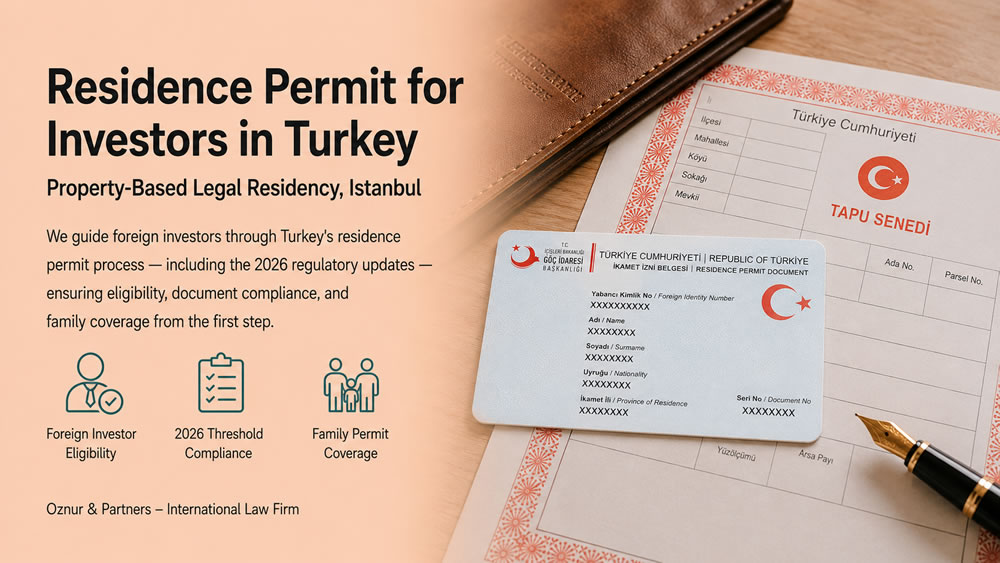
A residence permit for investors in Turkey is the legal status that allows foreign nationals to reside in the country on the basis of property ownership, capital investment, or business establishment, issued under Law No. 6458 on Foreigners and International Protection (YUKK). It is the first formal layer of legal presence in Turkey and, for many investors, the practical starting point for long-term financial and personal continuity in the country.
The process appears straightforward: purchase property, file documents, receive a permit. What foreign investors routinely underestimate is how much the regulatory environment has shifted. In 2026, three simultaneous changes reshaped the application landscape: the minimum property value threshold for metropolitan cities was raised to USD 200,000, physical residency verification at the registered address became a renewal condition, and all applications were migrated to a fully digital system requiring UETS registration. Each change is administrative in form. Each carries legal consequences that a poorly prepared application will encounter too late to correct.
This is precisely why experienced investors increasingly ask: which residence permit route is legally sound for my specific investment structure, and at what point in the process does legal counsel make a material difference? The answer depends on the investment method, family composition, and future plans. But the timing question has a cleaner answer: before the title deed is finalized, not after.
⚖️ Which Residence Permit Routes Are Available for Foreign Investors in Turkey?
Turkish immigration law, governed by YUKK, provides several permit categories available to foreign investors. Selecting the correct route at the outset determines the legal validity, renewal conditions, and long-term stability of the applicant’s status in Turkey.
Short-Term Residence Permit (YUKK Article 31-33) is the primary instrument for property-owning investors. It is renewable, typically issued for one-year periods, and requires continuous ownership of qualifying property. As of 2026, qualifying property in metropolitan cities (Istanbul, Ankara, Izmir, Antalya) must carry a minimum market value of USD 200,000 or its Turkish Lira equivalent. This threshold was previously USD 75,000 and was increased as part of the 2026 regulatory update. Smaller provinces retain different valuation standards, but physical residency verification now applies uniformly across all regions.
Family Residence Permit extends coverage to the spouse and minor children of the principal permit holder. Each family member files a separate biometric application. Documents must be notarized and officially translated into Turkish. Legal guardianship rules and age-related eligibility criteria apply strictly and are a frequent source of procedural delays when not prepared correctly.
Long-Term (Indefinite) Residence Permit becomes available after 8 years of uninterrupted legal stay in Turkey. Periods of absence exceeding 180 days per year are counted as interruptions and reset the qualifying period. This permit does not automatically follow from investment; it results from consistent legal presence over time.
Work Permit is a separate legal instrument and is not granted automatically with residency. Shareholders and company directors may apply through their corporate entity. Certain sectors including technology, manufacturing, and qualified service centers offer expedited processing. The work and residence permit systems operate on different legal tracks and must be coordinated from the outset to avoid conflicts in immigration records.
⚖️ What Are the 2026 Regulatory Changes That Affect Investor Residence Permits?
Three regulatory changes that took effect in 2026 collectively raise the legal bar for property-based residence applications in Turkey. Foreign investors who prepared their applications under earlier rules may find their existing structures no longer qualify without modification.
Property value threshold raised to USD 200,000 in metropolitan cities. The minimum market value required to support a short-term residence permit through real estate in Istanbul, Ankara, Izmir, and Antalya is now USD 200,000 or its Turkish Lira equivalent, as documented in the property valuation report. The previous threshold of USD 75,000 is no longer valid for new applications in these cities. Properties registered before the regulatory change are subject to transitional provisions; legal review of existing title deeds is advisable before renewal.
UETS registration is now mandatory for renewals. The National Electronic Notification System (Ulusal Elektronik Tebligat Sistemi) address registration, which entered a transition period in 2024, became a mandatory condition for residence permit renewals as of 2026. Applications submitted without a valid UETS-registered address are returned incomplete.
Physical residency verification applies at renewal. Immigration authorities now verify that applicants actually reside at the address registered on the title deed. Applicants who maintain a property for residency purposes but physically reside elsewhere face rejection or cancellation at renewal. This change has the most direct operational consequences for investors who purchase property as a legal foundation while living in a different location.
All applications migrated to e-Ikamet. Paper application forms are no longer accepted. Every application, initial or renewal, is submitted through the e-Ikamet digital system. Biometric appointments are scheduled online through ikamet.gov.tr prior to physical attendance at the Provincial Directorate of Migration Management.
⚖️ Application Process: Legal Steps and Timeline
The residence permit application process follows a defined sequence. Deviations from this sequence, incomplete documents, or incorrect formatting are the most common causes of procedural rejection. Foreign nationals who have never navigated the Turkish immigration system consistently underestimate the gap between submitting documents and having a legally valid application.
- Property acquisition and title deed registration. The Tapu must be registered in the applicant’s name at the Land Registry. The property must be fully constructed and designated as residential. Co-ownership arrangements that dilute individual ownership may disqualify the application.
- Valuation report. A valuation report prepared by a GEDAS-licensed appraiser confirms the property’s market value. This report is submitted with the application and cross-checked by immigration authorities against the USD 200,000 threshold for metropolitan cities.
- UETS address registration. Required before renewal applications. New applicants should complete this step in advance to avoid delays at the renewal stage.
- e-Ikamet application and appointment scheduling. The online application is submitted through ikamet.gov.tr. The system generates a biometric appointment date at the relevant Provincial Directorate of Migration Management.
- Biometric appointment and document submission. The applicant attends in person. Required documents: valid passport with notarized Turkish translation, four biometric photographs, Turkish health insurance, Tapu copy, proof of address, and proof of financial means.
- Processing and card issuance. Applications are typically processed within 30 to 60 working days. The residence card is sent by post to the registered address upon approval.
Renewal applications must be filed at least 60 days before expiry. Late renewals result in a gap in legal status, which carries immigration record consequences and may affect subsequent applications.
⚖️ Common Application Errors That Lead to Rejection or Delay
It is no coincidence that international investors compare Turkish immigration outcomes and ask: why do two investors with similar properties end up with different results? The divergence almost always traces back to application preparation, not to the property itself.
The most frequent structural errors in investor residence permit applications:
- Property below the 2026 threshold. Applicants relying on pre-2026 valuation reports or properties below USD 200,000 in metropolitan cities receive rejections that could have been anticipated with a current legal review.
- Co-ownership arrangements. Properties shared with a spouse or business partner in a way that dilutes individual ownership may not satisfy the residency basis requirement.
- Encumbered title deeds. Mortgages, liens, or other encumbrances on the property can disqualify the application or complicate renewal.
- Health insurance gaps. Turkish health insurance must be valid throughout the permit period. Policies that expire mid-permit or do not meet minimum coverage standards are a recurring issue.
- Address registration conflicts. The address on the Tapu, the UETS registration, and the physical residence address must be consistent. Discrepancies between business and immigration records create review flags.
- Missing or improperly formatted translations. All foreign-language documents must be notarized and officially translated into Turkish. Translations prepared by non-certified translators are rejected.
⚖️ Residence Permit vs. Turkish Citizenship by Investment: How They Relate
| Criteria | Residence Permit | Citizenship by Investment |
|---|---|---|
| Minimum property value | USD 200,000 (metropolitan) | USD 400,000 |
| Prior residency required | No | No |
| Physical presence required | Yes, verified at renewal | One biometric visit required |
| Holding period | Renewable annually | 3-year no-sale encumbrance on Tapu |
| Processing time | 30-60 working days | 3-6 months |
| Work authorization | Separate permit required | Full rights upon naturalization |
| Governing legislation | YUKK Article 31-33 | Turkish Citizenship Law No. 5901 |
The two tracks are legally independent. An investor who qualifies for citizenship does not need a residence permit first. Conversely, a property-based residence permit does not automatically progress toward citizenship. Investors planning to pursue both should structure the initial acquisition to satisfy both thresholds simultaneously, as the cost difference between a USD 200,000 and USD 400,000 property is lower than the cost of two separate transactions.
⚖️ Remote-First Legal Process: What Can Be Completed Without Traveling to Turkey
Oznur & Partners operates on a remote-first engagement model. The majority of the investor residence permit process can be managed without the applicant traveling to Turkey. Processes completed remotely include: property due diligence and contract review, title deed verification, valuation report coordination, document preparation and notarization guidance, and e-Ikamet application filing.
The one step that requires physical presence is the biometric appointment at the Provincial Directorate of Migration Management. This appointment cannot be delegated. For investors coordinating a property acquisition alongside a residence permit application, scheduling the biometric appointment to coincide with the title deed registration visit eliminates a second trip.
For investors located in jurisdictions that are parties to the Apostille Convention, a power of attorney executed before a local notary, apostilled, and officially translated into Turkish allows Oznur & Partners to represent the client in all other procedural steps. Investors from non-Apostille jurisdictions can complete the same process through a Turkish consulate in their country.
❓ Frequently Asked Questions
✅ Can I get a residence permit in Turkey by purchasing property?
Yes. Foreign nationals who purchase residential property in Turkey are eligible for a short-term residence permit under YUKK Article 31. As of 2026, the property must have a minimum market value of USD 200,000 in metropolitan cities including Istanbul, Ankara, Izmir, and Antalya. The title deed must be registered in the applicant’s name at the Turkish Land Registry.
✅ What is the minimum property value for a Turkish residence permit in 2026?
As of 2026, the minimum value is USD 200,000 or its Turkish Lira equivalent for metropolitan cities. This threshold was raised from the previous USD 75,000 requirement. The property value is confirmed by a valuation report prepared by a GEDAS-licensed appraiser and verified by immigration authorities at the time of application.
✅ How long does a Turkish residence permit take to process?
Processing typically takes 30 to 60 working days from the date of the biometric appointment. In high-volume offices such as Istanbul, processing may take longer. The residence card is delivered by post to the registered address upon approval.
✅ Can my family members get residence permits under my investment?
Yes. The spouse and minor children of the principal applicant are eligible for family residence permits. Each family member must complete a separate biometric appointment. All supporting documents, including marriage and birth certificates, must be notarized and officially translated into Turkish.
✅ What documents are required for a property-based residence permit?
Required documents include: valid passport with notarized Turkish translation, four biometric photographs, Turkish health insurance, title deed (Tapu) copy, proof of address, proof of financial means, and a UETS-registered address for renewal applications. Document formatting requirements are strictly enforced; non-certified translations are rejected.
✅ Does a Turkish residence permit allow me to work?
No. A residence permit does not grant work authorization. A separate work permit is required. Shareholders and directors of Turkish-registered companies may apply for work authorization through their corporate entity. Eligibility depends on the sector, company structure, and applicable Ministry of Labor criteria.
✅ When do I need to apply for renewal?
Renewal applications must be submitted at least 60 days before the permit expires. As of 2026, renewal requires a UETS-registered address and verified physical residency at the property. Applications submitted after expiry create a legal status gap that may affect future immigration records.
✅ Can a Turkish residence permit lead to citizenship?
Residence permits and citizenship by investment are legally separate tracks. Citizenship through property purchase requires a minimum investment of USD 400,000 and does not require prior residence. Investors who maintain uninterrupted legal residence for 8 years may apply for a long-term (indefinite) residence permit, which is distinct from citizenship.
⚖️ Related Legal Resources
🔹 Turkish Citizenship
- Turkish Citizenship Lawyer – Legal representation for citizenship by investment applications, including property and capital routes.
- Turkish Citizenship by Investment: 2026 Regulatory Updates – Current thresholds, documentation requirements, and processing timelines.
- Chinese Investors and Turkish Citizenship – Legal guide for Chinese nationals following the 2026 visa-free entry agreement.
🔹 Real Estate and Property Law
- Real Estate Lawyer in Turkey – Title deed verification, valuation report coordination, and property acquisition for foreign buyers.
- Foreign Property Eligibility in Turkey – Legal framework governing which foreign nationals can acquire which types of property.
🔹 Investment and Corporate
- Foreign Investment Advisory – Structuring investment for residence, citizenship, and tax optimization simultaneously.
- Company Formation in Turkey – Establishing a Turkish entity as the corporate basis for a work permit application.
Schedule a Legal Consultation
If you are evaluating a property acquisition in Turkey, planning a residence permit application under the 2026 regulatory framework, or coordinating permit coverage for your family, our Investment Lawyers in Istanbul are available for an initial consultation.
A residence permit is not the end of a legal process. For most foreign investors in Turkey, it is the beginning of one. The property is acquired, the permit is issued, and then the real legal work starts: renewals that require verified physical presence, work authorization that must be coordinated with the corporate structure, family permit extensions that depend on the principal applicant’s continued compliance, and eventually, a decision about whether to maintain residency or pursue citizenship. Each of those steps has a legal structure. The investors who navigate them with least friction are those who understood the architecture before they signed the title deed.