

Turkey’s Asset Repatriation Programme 2026 is a tax framework that enables individuals and entities to bring foreign-held wealth into the Turkish financial system at preferential tax rates and without retroactive inquiry into the source of funds. Announced on 24 April 2026 by President Recep Tayyip Erdoğan as part of the Türkiye Century Strong Center for Investment Program, and detailed the following day by Treasury and Finance Minister Mehmet Şimşek, the programme is positioned under the policy heading “Bring It Home” (Eve Getir). It is the eighth asset repatriation programme in Turkish history. Law No. 7582 was published in the Official Gazette dated 4 June 2026 (No. 33270) and entered into force on that date; the implementing communiqué (Series No. 1) was published in the Official Gazette dated 4 July 2026 (No. 33300) and is now in force. Its target audience is broad: from Turkish nationals abroad to dual-nationality investors, from Turkish-origin global business owners to foreign nationals considering relocation to Turkey under the parallel 20-year foreign income exemption.
As an Istanbul-based law firm advising international clients on cross-border wealth structuring, our team at Oznur & Partners has worked through what the programme means in practice. The questions arriving from clients are remarkably similar across jurisdictions: is this a tax amnesty, and what should be done now that both the law and the implementing communiqué are in force?
The figures, deadlines, and procedural conditions referenced in this article rest on Provisional Article 19 of Corporate Tax Law No. 5520, as enacted by Law No. 7582. The law was passed by the Grand National Assembly on 21 May 2026 and published in the Official Gazette dated 4 June 2026 (No. 33270). The procedural rules for implementation were set by the General Communiqué on Bringing Certain Assets into the Economy (Series No. 1), published in the Official Gazette dated 4 July 2026 (No. 33300). With that communiqué, the technical mechanics of notification, declaration, valuation, and conversion are now final.
Two questions arrive most frequently from clients seeking legal advice on the programme.
Question: If no retroactive inquiry will be made into the source of declared assets, is this a form of tax amnesty?
Answer: No. The 2026 Asset Repatriation Programme is not a tax amnesty; it is a regularisation and compliance framework that brings existing wealth into the formal Turkish financial system. The distinction is more than terminology: an amnesty cancels penalties for past wrongdoing, while a regularisation framework records the asset under a defined legal status in exchange for a low effective tax rate, integrating it into the Turkish financial system on a forward-looking basis. The 2026 programme therefore serves both the cleansing of the past and the securing of the future.
Question: The law and the communiqué are now in force. What is the most important next step?
Answer: The declaration window is open and the procedural rules are settled, but the investor who has already completed the most valuable steps is in the strongest position. Confirming the source-country tax position, reviewing the existing structure, coordinating with banks, and preparing company formation are all steps that could be started even before enactment; for those who have not yet completed them, acting now is critical. Because declarations filed by 31 December 2026 carry no rate surcharge, early notification delivers a direct rate advantage.
📌 Latest Development: 4 July 2026
The implementing communiqué has been published: the General Communiqué on Bringing Certain Assets into the Economy (Series No. 1) was published in the Official Gazette dated 4 July 2026 (No. 33300) and entered into force. The underlying Law No. 7582 had already entered into force through the Official Gazette dated 4 June 2026 (No. 33270); all provisions, including Provisional Article 19 governing the asset repatriation programme, together with the implementing procedures, are now in effect. The deadline for notification is 31 July 2027; this date may be extended by Presidential decree in successive periods of up to six months, for a total of up to one year. Declarations filed by 31 December 2026 apply the table rates without surcharge.
The rate structure, deadlines, valuation criteria, and procedural steps on this page rest on the enacted law and the text of the Series No. 1 Communiqué.
⚖️ Has the 2026 Asset Repatriation Programme been published in the Official Gazette? Status of entry into force
This section summarises the current legislative status. For the detailed legislative timeline, see the Legislative process and timeline section.
Law No. 7582 entered into force through the Official Gazette dated 4 June 2026 (No. 33270); the implementing communiqué (Series No. 1) entered into force through the Official Gazette dated 4 July 2026 (No. 33300). All provisions, including Provisional Article 19 governing the asset repatriation programme, together with their implementing procedures, are in force. In brief, the process unfolded as follows:
- 24 to 25 April 2026: President Erdoğan and Treasury and Finance Minister Şimşek set out the intent behind the package under the Türkiye Century Strong Center for Investment Program.
- 5 May 2026: The bill amending various laws was submitted to the Grand National Assembly. Its Article 10 contained the asset repatriation programme (Provisional Article 19 of the Corporate Tax Law); its Article 4 contained the 20-year foreign income exemption regime (Repeated Article 20/D of the Income Tax Law).
- 6 May 2026: The bill was debated and adopted in the Plan and Budget Committee and referred to the General Assembly. During the committee stage, four articles on the taxation of crypto assets, along with an article on special consumption tax on diamonds and other precious stones, were removed from the package.
- 14 to 15 May 2026 (overnight session): The first five articles of the bill were adopted in the General Assembly, including the provision governing the 20-year foreign income exemption regime (Repeated Article 20/D).
- 21 May 2026: All articles of the omnibus law were adopted in the General Assembly. The bill became Law No. 7582.
- 4 June 2026: Law No. 7582 entered into force through Official Gazette No. 33270. The declaration window opened.
- 4 July 2026: The General Communiqué on Bringing Certain Assets into the Economy (Series No. 1) entered into force through Official Gazette No. 33300. Acting on the authority granted by paragraph 11 of Provisional Article 19, it finalised the procedures for notification, declaration, valuation, and conversion.
Alongside asset repatriation, the omnibus law also contains: the 20-year foreign income exemption regime (Repeated Article 20/D), a corporate tax reduction for exporting and manufacturing companies, the extension of Istanbul Finance Center tax advantages to 2047, qualified service centre provisions, an increase in the deferral and instalment period for tradespeople’s tax debts from 36 to 72 months, and the simplification of digital company formation.
For a practical guide to which steps should be taken first, see the The law is in force: what to do now section.
⚖️ What is the 2026 Asset Repatriation Programme, and what does it change?
The 2026 Asset Repatriation Programme is a coordinated tax framework that allows cash, foreign currency, gold, securities, and other capital market instruments held abroad to be brought into Turkey and recorded in the formal financial system in exchange for a low effective tax rate. The defining features of the programme are that the source of the declared asset is not questioned and that no retroactive tax inspection, assessment, or penalty is applied in respect of the declared amounts.
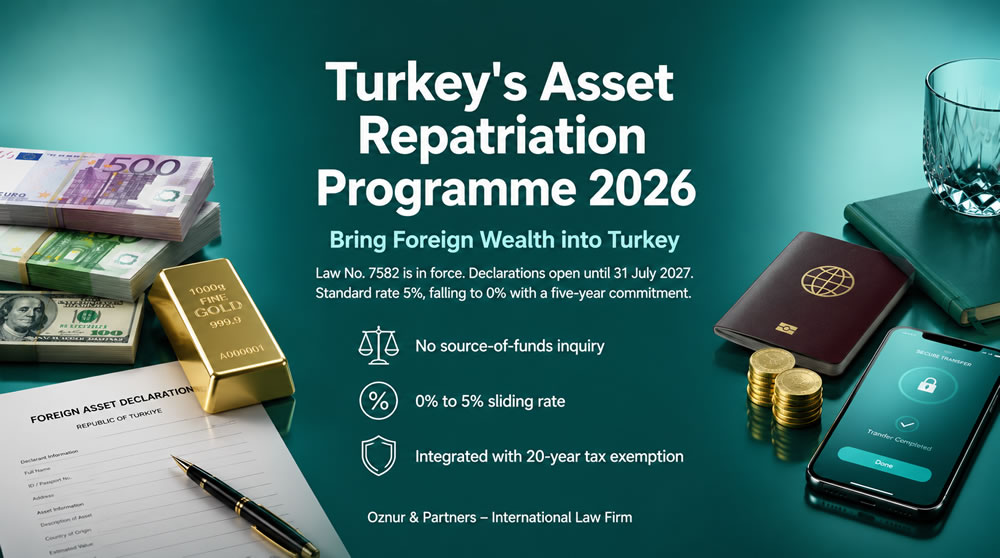
The investor pays a standard rate of 5% on the declared value, but where they commit to holding the asset in term deposits or in domestic government debt securities and lease certificates issued under Law No. 4749 for defined periods, the rate falls on a sliding scale to 0%. Once the tax is paid, the asset is transferred into Turkish bank or corporate accounts and formally integrated into the Turkish financial system.
The “Bring It Home” framing positions the programme as more than a tax measure; it is part of a broader capital attraction strategy. In his 25 April 2026 briefing, Minister Şimşek described the goal as drawing Turkish-linked wealth held abroad back into the country and consolidating Turkey’s position as a regional trade and finance hub. The framing is deliberate: the programme is not a one-off cash transfer mechanism but the first step in a coordinated structure encouraging long-term residency, tax integration, and forward-looking income planning through Turkey.
The substantive change operates on three layers. The first layer is the reduction in tax burden: the standard 5% rate, falling to 0% where assets are committed to qualifying instruments, represents a significant departure from the tax exposure that would ordinarily apply on declaration. The second layer is legal certainty: the absence of source-of-funds inquiry, the prohibition on retroactive tax inspection, and the protection against criminal tax assessment together address the structural uncertainty that has historically discouraged repatriation. The third layer is integration: read alongside the 20-year foreign income exemption in the same Law No. 7582, the asset repatriation programme is not a standalone tax benefit but the entry point to a multi-year wealth planning framework.
The statement of intent was shared publicly on 24 April 2026, the bill was submitted to the Grand National Assembly on 5 May 2026, all articles were adopted on 21 May 2026, Law No. 7582 entered into force through the Official Gazette dated 4 June 2026 (No. 33270), and the implementing communiqué was published in the Official Gazette dated 4 July 2026 (No. 33300).
⚖️ Which Turkish lawyers should someone living abroad consult for asset repatriation?
What most often challenges an investor in the 2026 programme is not the rate or the notification form; it is not knowing whether the person guiding them can see the whole table. From the outside the package looks simple: declare, transfer, pay the tax. The real complexity is invisible and lives at the point where two countries’ tax systems intersect. The right question is therefore not “what is the rate” but “who can read this process in its entirety.”
Turkish nationals who have lived abroad for many years keep arriving at the same question when they look for advice: whom should they consult? The answer is not a single specialism. A healthy process requires a view that can track three axes at once: the Turkish tax side (Provisional Article 19, the rate matrix, the two-month transfer window), the source-country tax regime (German exit taxation, the United Kingdom’s current residency regime, US citizenship-based taxation), and the Double Tax Treaties that connect the two. An adviser who looks only at the Turkish side may miss a source-country exit tax and claw back the Turkish advantage; an adviser who looks only at the source country may overlook the timing and procedural conditions on the Turkish side.
In practice, the selection criteria fall under a few headings. The first is bilingual working capacity: running the process in both Turkish and the language of the investor’s country of residence directly affects document flow and banking coordination. The second is experience handling international investor files not once but over years, because notification, transfer, company formation, and succession planning are links in the same file spread across different points in time. The third is the ability to run banking compliance and MASAK coordination, source-country steps, and notification timing as a single coordinated process. Given the two-month transfer window, this last point is not theoretical but intensely practical: a poorly sequenced preparation can forfeit the protection the package provides.
At Oznur & Partners we evaluate the 2026 programme at exactly this intersection of three axes. We run Turkish tax law, the source-country tax regime, and international double tax treaties not as parts collected from separate advisers but within a single coordinated process. The approach we have developed over years within our foreign investment advisory practice is built on letting the investor living abroad see their obligations in both countries on the same table.
Would you like a case-specific assessment before you file a declaration?
Speak directly with our Tax and Investment Law team in Istanbul: 📞 +90 (533) 948 6065 | 💬 WhatsApp
⚖️ Why now, and who is the programme designed for?
Turkey’s introduction of an asset repatriation programme in 2026 is not an isolated tax choice but the individual-side instrument of a broader economic strategy. The Türkiye Century Strong Center for Investment Program sets out a vision of positioning Turkey as a trade and finance hub at the intersection of Europe, the Middle East, and Central Asia. Drawing Turkish-linked wealth held abroad into Turkey is the personal-capital pillar of that vision; the parallel measures addressing exporters, service exporters, and Istanbul Finance Center investors form the corporate pillar.
Four distinct profiles cluster within the programme’s intended audience. The first is Turkish nationals living abroad for extended periods and integrated into the tax systems of their host jurisdictions: the diaspora population in Germany, the Dutch second generation, Turkish professionals in the United Kingdom, and Turkish business owners across the Gulf. The second is dual-nationality investors who hold Turkish citizenship alongside another passport and have distributed wealth across multiple jurisdictions. The third is Turkish-origin global business owners who structure assets through financial centres such as Switzerland, the United Arab Emirates, Singapore, or London, maintain ties to Turkey, but are legally tax resident elsewhere. The fourth, distinctively positioned in the 2026 package, is foreign nationals considering Turkish residency or citizenship by investment, for whom the programme functions as a tool to consolidate their wealth structure ahead of relocation.
These groups overlap in some respects but face different legal regimes and require differentiated planning. A long-term resident in Germany subject to the German social security system faces different exit-side considerations than a Turkish-origin investor managing a private banking relationship in Switzerland. The first must contemplate German exit taxation (Wegzugsbesteuerung); the second is more concerned with Swiss wealth tax disclosure. A British resident transitioning out of the United Kingdom’s reformed residency-based regime faces different timing pressures than a Gulf-based investor with no exit-side tax obstacle. For each profile, the practical effect of Turkey’s framework must be evaluated against the source-country regime and the individual’s personal status.
It is equally important to identify whom the programme is not primarily designed for. Lifelong Turkish residents who have built wealth within the Turkish tax system are not the architectural target of this package. Domestic assets that fall outside formal accounting records may still be declared under paragraph 3 of Provisional Article 19, but the broader economic logic of the programme is the attraction of foreign capital. For purely domestic readers, the more appropriate frameworks are general wealth structuring, succession planning, and corporate restructuring rather than asset repatriation per se.
This is precisely why international investors increasingly ask: which Turkish lawyers are best positioned to advise on cross-border asset repatriation? The answer is not a single specialism but a coordinated capacity: Turkish tax law, the source-country tax regime, and the relevant double tax treaties read together; bilingual or trilingual communication; and continuity in handling international files over time. Our team at Oznur & Partners works at this intersection and structures advisory engagements around all three dimensions in parallel.
⚖️ Eligible Assets Under the Programme
The 2026 programme distinguishes between two categories of declarable assets: those held abroad and those held within Turkey but not recorded in the taxpayer’s statutory accounting books.
The foreign-held category is the principal focus of the programme. Under paragraph 1 of Provisional Article 19, the following are within scope:
- Cash: Holdings denominated in Turkish lira or foreign currency
- Foreign currency: All foreign-currency deposits in non-Turkish banks and financial institutions
- Gold: Physical gold and gold accounts held abroad
- Securities and other capital market instruments: Shares, bonds, investment funds, and equivalent capital market instruments
The domestic category, governed by paragraph 3, covers the same asset classes where they exist within Turkey but are absent from the taxpayer’s statutory books:
- Cash held within Turkey, in lira or foreign currency
- Gold held within Turkey
- Foreign currency, securities, and other capital market instruments not recorded in formal accounts
On assets outside the scope, the point to note is that real estate and certain special high-value categories are absent from the statutory text. Paragraph 1 defines the scope as “cash, gold, foreign currency, securities, and other capital market instruments”; immovable property is not on that list. However, the Series No. 1 Communiqué expressly provides that assets outside the scope (such as immovable property) may be brought into Turkey within the framework of the Article by being converted into in-scope assets by 31 July 2027. In other words, an investor holding foreign real estate may sell the property by 31 July 2027 and include the resulting cash or securities in the package; this is now a route recognised by the communiqué. The source-country tax consequences of the sale (capital gains tax, exit taxation, and the like) must nonetheless be evaluated separately.
Valuation of the declared asset is also a procedurally critical step. For cash, valuation is made at the exchange rate on the declaration date; for gold, valuation at the Central Bank reference rate is a common method; for securities, market price or an independent valuation report may be used. The law granted the Ministry of Treasury and Finance authority over the form of notification and declaration and the information and documents to be used, and the Series No. 1 Communiqué has now fixed these valuation methods definitively (details are addressed in the communiqué section below).
⚖️ The position for investors holding crypto assets
The most notable of the articles removed during the committee stage were the four articles on the taxation of crypto assets. Those articles introduced a separate tax regime independent of the asset repatriation programme and targeted crypto transactions directly; their removal before the General Assembly stage means that the crypto taxation regime was not enacted together with this omnibus law. That removal does not, however, directly change the scope of asset repatriation, because the text of Provisional Article 19 did not expressly bring crypto within scope in the first place.
The scope definition in Article 10 of Law No. 7582 uses the formulation “cash, gold, foreign currency, securities, and other capital market instruments.” In Turkish law, the concept of “securities and other capital market instruments” is a technical category defined in Article 3 of Capital Markets Law No. 6362 and does not include crypto assets; crypto assets are treated as a separate category that entered CMB regulation through Law No. 7518. Accordingly, an investor holding crypto assets on foreign exchanges or in cold wallets cannot declare that asset directly under the asset repatriation programme.
In practice this has two consequences. First, where crypto assets are converted in the source country into fiat currency (USD, EUR, GBP) or into gold, the resulting cash becomes declarable under paragraph 1 of Provisional Article 19. That route carries its own tax consequence, because the crypto sale may trigger source-country capital gains tax; source-country rates on gains, and the current residency-based regime in the United Kingdom, feed directly into that calculation. Second, the Series No. 1 Communiqué published on 4 July 2026 did not widen the scope definition and introduced no separate opening for crypto assets; it did not define “other capital market instruments” so as to include crypto assets. For the investor who does not wish to convert crypto into fiat, the direct declaration route is therefore not opened by this communiqué either; the practical route remains converting the crypto in the source country into fiat currency or gold and declaring the resulting cash.
A further distinction is the MASAK dimension. The source of crypto assets is subject to a special layer of scrutiny in the Turkish banking system; documenting the source of crypto assets that have traded across different exchanges over many years is technically more demanding than a standard currency transfer. For that reason, the investor who intends to bring crypto assets into Turkey should assemble transaction history records, exchange account statements, and inter-wallet transfer records at an early stage; the bank compliance process can face serious delay without these documents.
Sophisticated investors frequently ask at this point: how should I position my foreign crypto assets right now? Rather than a single answer, three assessments are required: the source-country capital gains profile, the cost of making the asset liquid in USD or EUR terms, and the fact that the Series No. 1 Communiqué did not widen the scope for crypto. Taken together, generating partial liquidity now may be rational for some investors, while holding the position as it stands may be the better choice for others.
⚖️ Tax Rate Structure: Standard Rate and Term-Instrument Discount
The applicable tax rate under the 2026 programme is a sliding matrix that depends on two variables: the structure in which the declared asset will be held, and the date of declaration. Under the standard declaration, where the asset is placed into an ordinary bank or brokerage account and taxed on a prepaid basis, the rate is 5%. Where the investor commits to hold the asset in term deposits, in domestic government debt securities (DİBS), in lease certificates issued under Law No. 4749, or in venture capital investment funds for defined periods, the rate falls progressively, reaching zero at the longest commitment.
Table 1: Tax rate matrix under Provisional Article 19, paragraph 6
| Declaration and Holding Structure | Tax Rate |
|---|---|
| Standard declaration (prepaid collection) | 5% |
| Term deposit / DİBS / lease certificate / venture capital fund, at least 1-year holding commitment | 4% |
| Term deposit / DİBS / lease certificate / venture capital fund, at least 2-year holding commitment | 3% |
| Term deposit / DİBS / lease certificate / venture capital fund, at least 3-year holding commitment | 2% |
| Term deposit / DİBS / lease certificate / venture capital fund, at least 4-year holding commitment | 1% |
| Term deposit / DİBS / lease certificate / venture capital fund, at least 5-year holding commitment | 0% |
Table 2: Declaration timing and rate surcharges
| Declaration Window | Rate Effect |
|---|---|
| 4 June 2026 (entry into force) to 31 December 2026 | Table 1 rates apply without surcharge |
| 1 January 2027 to 31 July 2027 (inclusive) | Table 1 rates plus 0.5 percentage points |
| After 31 July 2027, if the deadline is extended by Presidential decree | Table 1 rates plus 1.0 percentage point in total |
This structure presents the investor with two distinct decisions. The first is the holding structure: whether the declared asset will be held in a directly accessible account or locked into a defined-term instrument. An investor who commits to a five-year holding in government debt securities can declare at a 0% rate, while an investor who wants direct use of the asset pays the 5% rate. The second is declaration timing: declarations filed by 31 December 2026 follow the matrix in Table 1 without surcharge; those filed between 1 January and 31 July 2027 attract a half-point increase; declarations made after the deadline is extended by Presidential decree attract a one-point total increase. As the worked examples in the communiqué illustrate, a declaration made on 15 September 2026 with a two-year commitment carries a rate of 3%, whereas a declaration made on 5 February 2027 with a one-year commitment, normally 4%, applies at 4.5%.
The mechanics of collection work as follows: the bank or brokerage collects the applicable tax on the declared value from the declarant on a prepaid basis. It then declares that tax as the responsible party, by return, to its tax office by the evening of the fifteenth day of the month following the declaration, and pays it within the same period. The tax does not travel directly from the investor to the Treasury; it is collected at source through the bank. Even where the rate is 0%, the declared assets are included in the return (EK-3) filed by the bank or brokerage.
Three variables tend to drive the rate decision in practice. The first is whether the investor has a near-term liquidity requirement on the asset; where access is needed soon, the standard 5% rate is the only option. The second is the investor’s long-term confidence in the Turkish financial system; a five-year DİBS commitment is both the strongest rate-zeroing advantage and the longest lock. The third is alignment with the investment structure; for portfolios structured under a holding company and taking long-term positions, the zero-rate option sits naturally.
⚖️ The Two-Month Transfer Rule
The most operationally critical condition in Provisional Article 19 is the time limit between declaration and physical transfer. Under paragraph 2, an asset declared from abroad must be transferred within two months into a Turkish bank or brokerage account opened in the investor’s name, or physically brought into Turkey. Where assets are physically brought in, the documents relating to the declaration made to the Customs Administration serve as supporting evidence; the Customs Administration reports these declarations to the Revenue Administration by the end of the month following the month of receipt.
The Series No. 1 Communiqué clarifies two practical details here. First, for assets physically brought in from abroad, customs procedures must be completed within the two-month period, and the assets must be deposited with a bank or brokerage by the end of the first business day following completion of those customs procedures. Second, on transfer into the Turkish account, the fact that the account holder making the declaration and the person transferring the asset from abroad are different persons is not an obstacle to benefiting from the provision; this flexibility matters for investors who hold assets abroad through a different account or structure.
For domestic assets (paragraph 3), the declaration date itself is decisive: domestic assets absent from statutory books must be deposited with a bank or brokerage as of the declaration date. So while foreign assets have a two-month transfer window, domestic assets require the bank deposit to be completed at the same time as the declaration.
These timing conditions are not mere procedural detail; they are the condition for maintaining the legal protection. Paragraph 9 is explicit: if the declared asset is not brought into Turkey or transferred to a bank or brokerage within this period, the investor cannot benefit from the protection against tax inspection set out in paragraph 8. The same consequence applies where the declared tax is not paid on time or where commitments are not honoured. In that case, taxes not accrued on time are collected together with default interest but without the tax loss penalty; the statutory text preserves this nuance clearly: no penalty is applied on breach, only default interest is charged. Moreover, no amendment is permitted for declarations made after the notification period closes (paragraph 10).
The practical meaning is this: once the declaration is filed, there is no room left to prepare. Banking coordination, source-country transfer procedures, KYC documents, and, where required, the opening of the corporate account must all be complete before the declaration is filed. Otherwise the two-month window may not be enough to meet the technical requirements, and the investor can lose the protection the package provides.
⚖️ Procedures and Principles Settled by the Series No. 1 Communiqué
This section summarises the notification and implementation details settled by the General Communiqué on Bringing Certain Assets into the Economy (Series No. 1). The communiqué was published in the Official Gazette dated 4 July 2026 (No. 33300) and entered into force.
The communiqué, which sets the procedures and principles for the implementation of Provisional Article 19, confirms the rate and timing structure on this page while settling several practical details.
Venture capital investment funds added to the qualifying instruments
The instruments that may be the subject of the holding commitment required to benefit from the reduced rates (0% to 4%) are listed in the communiqué under four headings: term deposits, domestic government debt securities issued under Law No. 4749, lease certificates, and venture capital investment funds. The rate ladder in Table 1 above applies to all of these instruments; a holding commitment of at least five years in a venture capital investment fund likewise secures the 0% rate.
The ten-day conversion requirement
Those who give a commitment for the reduced rate must actually convert the declared amount into the committed instrument within a defined period. Under the communiqué, this period is ten days from the date the asset is transferred to or deposited in Turkey for foreign assets, and from the declaration date for domestic assets. If conversion is not made within this period, the reduced rate is not available; the bank or brokerage collects the tax difference not taken on time, together with default interest, by way of withholding. Here too, no tax loss penalty is applied, only default interest is charged. The start of the commitment periods is not the declaration date but the date on which the declared amount is actually placed into the term deposit, DİBS, lease certificate, or venture capital investment fund. The two-month transfer window and this ten-day conversion requirement must be planned together.
Notification form, letter of commitment, and multiple declarations
Notification is made to the bank or brokerage using the EK-1 form; for the reduced rate, the EK-2 letter of commitment is submitted at the time of notification, and no stamp duty is charged on this letter of commitment. Banks and brokerages report the tax they collect to the tax office using the EK-3 return. While a single notification is the norm, because each month in which a notification is made counts as a separate taxation period, more than one notification is possible up to the deadline: for corrections made within the same month, overpaid tax may be refunded; in later months, a reducing correction is made by amending the earlier notification, while an increasing notification is made through a new notification. No amendment may be made after the notification period (31 July 2027) closes.
Valuation criteria for assets
The communiqué settles the valuation criteria on which notification is based: Turkish lira at nominal value; gold at market value; foreign currency at the CBRT foreign exchange buying rate on the declaration date; equity shares and debt instruments such as bonds, bills, and eurobonds at market rate where available, and otherwise, in order, at market value, acquisition value, and nominal value; investment fund participation units at the closing price in the relevant market; and derivative instruments such as futures and options at market rate. In notifications, the Turkish lira equivalent of the assets is taken as the basis.
Out-of-scope assets such as real estate may be brought in through conversion
The communiqué expressly provides that assets outside the scope (such as immovable property) may be brought into Turkey within the framework of the Article by being converted into in-scope assets by 31 July 2027. An investor holding foreign real estate may therefore sell the property by that date and include the resulting cash, foreign currency, or securities in the package. The communiqué also imposes no requirement to have owned the asset as of a particular date or to document such ownership; owning the asset before or after the publication of the regulation is not an obstacle to benefiting. The source-country tax consequences of the sale (capital gains tax, exit taxation) must be evaluated separately, independently of this facility on the Turkish side.
Notification by proxy, legal representative, or on behalf of a company
Notifications may be made directly by natural or legal persons, and also through authorised proxies or legal representatives; banks and brokerages check whether these persons are authorised. The communiqué further allows foreign assets managed by a company’s legal representatives, shareholders, or persons authorised to act on their behalf, on the basis of a power of attorney or representation agreement drawn up by authorised institutions before 4 June 2026, to be notified on behalf of the company. Likewise, assets located in Turkey on behalf of a company but absent from statutory accounting books as of 4 June 2026 may be notified on behalf of the company. This flexibility opens a practical door for foreign investors whose assets are structured through a proxy or representative.
⚖️ Two-Year Capital Lock for Corporate Declarants
Paragraph 4 of Provisional Article 19 imposes a critical condition on taxpayers who keep books (sole traders and companies). Taxpayers maintaining books on the balance sheet basis must, when recording the declared assets in their statutory books, open a special fund account on the liabilities side. This fund account cannot be withdrawn from the business until two years have passed from the declaration date and cannot be used for any purpose other than capital injection. After two years, the fund may be withdrawn from the business without being taken into account in determining taxable income or, for companies, distributable profit.
This two-year lock is the rule that preserves the “contribution to capital” logic of the law. If the declared asset became freely available the moment it entered the company balance sheet, the package’s aim of strengthening capital structure would not be met; hence the two-year suspension. If the business is liquidated, the fund is not taxed: an investor who reaches the asset through liquidation incurs no additional tax burden.
For taxpayers keeping a professional income ledger or books on the operating account basis, the procedure is somewhat simpler: these assets are shown separately in the books, are not taken into account in determining the period’s income, and, provided two years have passed from the declaration date, may be withdrawn from the business without being taken into account in determining taxable income.
This rule does not apply directly to individual investors. Paragraph 5 provides that persons without income or corporate tax liability (that is, individual investors who do not own a business or company) benefit from the article’s provisions without the bookkeeping and special fund conditions of paragraph 4, provided they bring their assets into Turkey within the period in paragraph 2 or deposit domestic assets with a bank or brokerage on the declaration date. Diaspora investors living abroad without Turkish tax liability fall into this category; the two-year lock does not apply to them.
In practice there are two architectures: a streamlined declaration-transfer-tax sequence for the individual investor, and the two-year fund account rule for the investor bringing wealth in under a corporate structure. When deciding to form a company, the suitability of this lock period to the investment plan should be assessed in advance.
⚖️ The “No Source-of-Funds Inquiry” Protection: Scope and Boundaries
The most distinctive legal feature of the 2026 programme is the protection against inquiry into the source of the declared asset. Paragraph 8 of Provisional Article 19 provides the following: no tax inspection or tax assessment of any kind will be conducted in respect of the amounts corresponding to the declared assets. This protection means that no “where did you get it” question is directed at the source of the declared asset, no retroactive tax inspection is conducted, no assessment is issued, and no criminal tax proceeding is pursued.
The law makes this protection more concrete. Where a tax inspection initiated on other grounds, or a decision of an appraisal commission, identifies a tax base difference and it is established that the difference arose from the assets declared under the article, two possibilities arise. First: if the declared amount equals or exceeds the identified base difference, no assessment is made on the base difference. Second: if the identified base difference exceeds the declared amount, an assessment is made only on the difference. Where a base difference is identified for reasons other than the declared assets, the declared amounts are assessed without being offset against that base difference. Furthermore, notifications made after a tax inspection has begun or a referral to an appraisal commission has been made cannot benefit from this protection and offset for the identified base differences; timing is therefore the essence of the protection.
This structure ensures that even where a tax inspection was previously initiated on another ground, no assessment is made for the base difference corresponding to the declared asset. In practice the law’s protection is not a hypothetical novelty but a concrete legal shield interwoven with existing inspections.
The boundaries of this protection must be understood clearly. The programme is a tax-law instrument, not a criminal-law instrument. The protection provided on the tax side therefore does not remove liabilities under criminal law and financial crime legislation. Paragraph 8 expressly contains the provision that “measures required under other legislation are not affected by this regulation.” Turkey’s Financial Crimes Investigation Board (MASAK) legislation, and the counter-terrorist-financing and anti-money-laundering rules, continue to operate on their own terms. Declaring an asset assessed within the scope of the proceeds-of-crime regime through asset repatriation does not remove the criminal liability attaching to it; the MASAK regime falls precisely within this “other legislation.”
In practice this means the declared asset must come from a legally clean source. Income earned by a business operating abroad for many years, legitimate capital gains accumulated in an investment account in another country, inherited wealth, and savings earned through labour form the natural target of the programme. By contrast, wealth derived from serious tax evasion, economic crime, or activity assessable within the MASAK framework gains no protective layer through asset repatriation; in such cases legal advice must be structured within a far broader frame.
For the investor, two distinctions are essential to reading the protection correctly. The first is between tax liability and criminal liability; the regulation removes the former while not touching the latter. The second is between Turkish law and source-country law; Turkey’s protection does not change the investor’s tax obligations in the source country. A Turkish national resident in Germany remains subject to their German tax obligations regardless of the Turkish-side recording achieved through asset repatriation. The regulation is therefore not a protective umbrella but a legal structuring tool with clearly drawn boundaries.
Within this frame, the structural protection tools we address in our practice (holding structures, succession planning, cross-border foundation solutions), combined with asset repatriation, achieve both a short-term tax advantage and a long-term, multi-generational wealth protection. The real value of the regulation arises not from the rate advantage alone but from this structural integration.
⚖️ Integration with the 20-Year Foreign Income Exemption
The strategic value of the 2026 Asset Repatriation Programme becomes far clearer when read alongside the 20-year foreign income exemption enacted by the same Law No. 7582. The relevant article adds Repeated Article 20/D to Income Tax Law No. 193, introducing a new exemption: individuals deemed resident in Turkey, provided they had no registered domicile or tax liability in Turkey during the last three calendar years before being deemed resident, are exempt from income tax for twenty years on the income and earnings they derive outside Turkey. Although the two are separate legal instruments, they complement each other in target audience and economic logic. Asset repatriation enables past wealth to be brought into Turkey at a low rate; the 20-year exemption regime grants a 20-year income tax exemption on foreign-sourced income for those who move their residency to Turkey. Together, past and future can be planned under a single roof.
Table 3: Twin-incentive effect, Asset Repatriation 2026 and the 20-Year Foreign Income Exemption
| Feature | Asset Repatriation 2026 (Provisional Article 19) | 20-Year Foreign Income Exemption (Repeated Article 20/D) |
|---|---|---|
| Nature | Bringing existing wealth into Turkey at low tax | Twenty years of exemption on future foreign-sourced income |
| Condition | Declaration and transfer | No Turkish domicile or tax liability during the last 3 calendar years |
| Scope | Cash, gold, foreign currency, securities, and other capital market instruments | Income and earnings derived outside Turkey |
| Tax advantage | 0% to 5% rate (depending on holding structure) | 20-year exemption plus 1% inheritance rate |
| Duration | One-time declaration | Continuous over 20 years |
| Conceptual frame | Cleansing of the past | Securing of the future |
In practice the two regimes are used in sequence. The investor first declares existing foreign wealth under asset repatriation at the appropriate rate (standard 5%, or a sliding rate falling to 0% with a term-instrument commitment) and transfers it into a Turkish bank or corporate account. With this step the past is regularised: the asset is recorded, its source is not subject to inquiry, and the risk of retroactive inspection disappears. The investor then settles in Turkey and, by moving their residency to Turkey, begins to benefit from the 20-year exemption regime. Under that regime, foreign-sourced income remains within the exemption for twenty years.
The inheritance dimension is among the most critical advantages of this integration. Law No. 7582 adds a paragraph to Article 16 of the Inheritance and Gift Tax Law, setting the tax rate at 1% for inheritance transfers occurring within the exemption period for those benefiting from the Repeated Article 20/D exemption. For a Turkish-origin investor holding German citizenship, this rate represents a striking advantage for multi-generational wealth planning compared with the high inheritance tax rates applied in Germany. The practical effect of the cross-border succession planning we address on our Turkish inheritance law page becomes evident when the trio of asset repatriation, the 20-year regime, and the 1% inheritance rate are structured together.
The practical problem that can arise where the two are not considered together is this: an investor who uses only asset repatriation but does not move their residency to Turkey brings their wealth into Turkey at a low rate but continues to earn future income under a foreign tax regime. In that case only a one-off tax advantage is obtained. By contrast, the investor who plans the two together builds the trio of past wealth, future income, and succession structure under a single legal roof.
⚖️ Company Formation: Structuring the Legal Entity that Receives the Asset
The choice of legal entity is a decisive step in the process of bringing foreign wealth into Turkey. The asset can be transferred directly to a personal bank account; but for investors above a certain scale or engaged in forward planning, using a corporate structure is a common and generally more rational choice. How company formation in Turkey proceeds and which documents are required are addressed in detail on a separate page; here we focus on the strategic logic of entity choice in the asset repatriation context.
The assessment runs across three primary entity types. A limited liability company (Limited Şirket) is the most common choice for small and mid-sized assets; formation cost is low, the management structure simple, the capital layer flexible. A joint stock company (Anonim Şirket) is preferred for larger capital structures, work requiring share-transfer flexibility, and structures with public-listing potential; the share ledger, board, and audit structure operate more formally. A holding structure comes into play where several companies sit beneath it and where multi-generational wealth transfer and intra-group tax optimisation are planned.
The variables that drive the choice can be grouped as follows. The first is the scale of the asset; a Limited structure suffices for small portfolios, while broad portfolios and family wealth planning point to an A.Ş. or holding structure. The second is the forward plan; whether the investor intends to grow the asset in Turkey, structure outbound investments through Turkey, or build a succession structure directly affects the entity type. The third is the succession architecture; for an investor whose children and spouse are in different jurisdictions, a holding structure integrates more flexibly with cross-border succession law. The fourth is tax residency; if the investor plans to benefit from the 20-year exemption regime, the corporate structure should be configured to align with that regime. The fifth is the two-year capital lock; it should be assessed in advance that an asset entering the company balance sheet will be locked in a special fund account for two years and cannot be used other than for capital injection.
The practical steps of company formation proceed in this order. First the shareholding structure is set; who the founders will be, how share ratios are distributed, where management rights sit. Then the capital structure is designed; whether all the incoming wealth will be committed as capital, or partly as capital and partly as a shareholder loan. The articles of association are then drafted; activity subjects, form of management, and decision-making mechanisms are defined there. Registration is filed through MERSİS, trade registry procedures are completed, tax office and social security registrations are opened, and the bank account is established.
The most frequent question at the end of the process is: how are foreign assets brought into Turkish company accounts? The practical flow runs through two channels depending on how the asset is moved. For assets brought in by bank transfer, the investor makes a SWIFT transfer from the source-country bank account to the Turkish company bank account; on that transfer the Turkish bank requests documents on the source of the asset within KYC and customer due diligence, and these documents form the basis of the MASAK compliance file. For cash, currency, or gold physically brought into Turkey, a cash declaration form is submitted to the Customs Administration and serves as supporting evidence under paragraph 2 of Provisional Article 19; the Customs Administration reports these declarations to the Revenue Administration by the end of the month following receipt. On both channels the notification is made to the bank or brokerage, the holding structure that sets the rate (standard prepaid or term-instrument commitment) is chosen, and the bank collects the tax at the applicable rate on a prepaid basis and declares and pays it to the tax office by the evening of the fifteenth day of the following month. Because source-country exit tax or reporting obligations may arise at each step, the coordination of a legal team familiar with the practice in both countries is important from the outset.
⚖️ MASAK Compliance and the Banking Side
While the legal protections of the 2026 programme provide solid cover on the tax side, banking compliance runs on a separate track. Turkish banks apply customer due diligence (KYC) and enhanced due diligence (CDD) to every incoming transfer, as part of Turkey’s compliance with international financial standards. Even for an asset brought in under asset repatriation, the bank may request documents on the source of the transfer, ask for additional information at account opening, and require pre-approval for large-value transfers. These processes operate independently of the tax regulation.
In practice this makes advance preparation of source documents important for the asset to be declared. Account statements issued by the foreign bank, records showing the accumulation history of the asset (for example, long-term investment account statements, inheritance transfer documents, share transfer records), and documents showing the investor’s tax position in the source country are among the components of this preparation. Assembling these documents before the transfer helps accelerate the compliance departments’ review and reduce the risk of rejection.
The MASAK scope forms a further dimension. The MASAK regime, operating under the Law on the Prevention of Laundering Proceeds of Crime, aims to prevent crime-derived assets from entering the financial system and operates independently of asset repatriation. The provision in paragraph 8 of Provisional Article 19 that “measures required under other legislation are not affected by this regulation” confirms this independence at the legislative level. Even where an asset is protected on the tax side, if it comes from a source within the scope of MASAK, the bank is under an obligation to file a suspicious transaction report. Clarity on the investor’s legal position in the source country is therefore critical for the compliance process on the bank side to proceed smoothly.
In practice a three-step coordination is recommended. The first is a pre-transfer discussion with the Turkish bank on the structure of the transfer, the expected amount, the source country, and the account opening procedure; this clarifies in advance which documents the banks will request. The second is working with a tax adviser or legal counsel on the source-country side before the transfer to complete exit taxation, reporting obligations, and source-country bank procedures; large-value transfers from Germany, for example, may require notification to the Federal tax administration. The third is filing the asset repatriation declaration with the Turkish tax office on time and in full, during and after the transfer.
⚖️ Source-Country Tax Considerations and Double Tax Treaty Interaction
For investors residing abroad and considering the 2026 programme, source-country tax obligations must be evaluated independently of the Turkish framework. Turkey has signed Double Tax Treaties (DTTs) with more than 80 jurisdictions; these treaties govern where income is taxed but do not automatically eliminate exit-side taxes applied when an asset leaves the source country. The investor should therefore first clarify the practice of their country of residence.
Table 4: Source-country exit-point tax regimes by principal country (summary)
| Country | Principal exit-point tax regime | Practical implication for the investor |
|---|---|---|
| Germany | Exit taxation (Wegzugsbesteuerung): under certain conditions, a person giving up residency is taxed on unrealised capital gains | A residency change or large-value transfer should always be assessed with source-country tax counsel in advance; the practice of exit taxation varies by individual circumstance |
| Netherlands | Asset declaration under the capital gains and wealth taxation (Box 3) framework; similar principles may apply on departure | Where there is a history of annual wealth declarations, the practical infrastructure for transfer exists; the tax position should still be clarified before departure |
| United Kingdom | The remittance basis regime traditionally left foreign-sourced income untaxed unless brought into the UK; the regime has undergone extensive revision in recent years | For investors resident in the UK planning to bring foreign wealth into Turkey, the current state of the source-country regime is decisive in practice; no action should be taken without professional advice |
| Gulf states (UAE, Saudi Arabia, Qatar) | Generally no-income-tax or low-tax regimes | The exit-point tax obligation is limited in practice; the coordination on the Turkish side of the transfer comes more to the fore |
| United States | Citizenship-based taxation (worldwide income); expatriation tax may apply on certain status changes | For US-citizen investors of Turkish origin, the source-country tax obligation continues even on relocation outside the US; parallel planning is mandatory |
| Switzerland | Federal and cantonal wealth tax regimes; lump-sum taxation available in some cantons | Departure planning depends on the canton of residence and the structure of the asset; specialist Swiss advice is the starting point |
| Singapore | Territorial taxation; foreign-sourced income generally not taxed unless remitted | Exit-side considerations are limited; structuring questions tend to focus on the receiving entity in Turkey |
| Canada | Departure tax on the deemed disposition of certain assets at the date of emigration | Canadian residents departing for Turkey should obtain tax counsel on the deemed disposition rules; planning the date of departure can materially affect the tax cost |
The framework above is a summary; each individual case should be evaluated together with source-country tax counsel.
The practical effect of the DTT framework in the asset repatriation context becomes visible at this point. Where a Turkish-origin investor holding German citizenship transfers an investment account held in Germany to Turkey, two separate tax levels are in play: the exit tax obligations that a transfer or residency change may trigger on the German side, and the tiered-rate recording tax under asset repatriation on the Turkish side. A DTT may allow offset or credit between these two taxes, but this is not automatic; timing and documentation are decisive.
The position in the United Kingdom carries its own dynamics. The UK’s regime for taxing foreign income has undergone extensive change in recent years; the long-applied remittance basis system has been replaced by a new residency-based regime. This change has raised new questions for investors who have lived in the UK for years but continue to hold foreign assets. How the current UK regime applies to an investor’s particular situation for large transfers to Turkey cannot be assessed with confidence without source-country tax counsel.
Transfers from the Gulf states and the United States carry different dynamics. Because income and wealth tax regimes are largely limited in the Gulf, the exit-point tax obstacle is lower in practice; here the Turkish-side banking compliance and MASAK coordination come to the fore. The US, with its citizenship-based taxation regime, occupies an exceptional position; for a US-citizen investor of Turkish origin, relocation to Turkey or an asset transfer does not remove the US tax obligation, and parallel filing must continue for years.
⚖️ Legislative process and timeline
The legislative process of the 2026 programme is complete; the regulation has been in force since 4 June 2026, and the implementing communiqué has been published as of 4 July 2026. The full sequence unfolded as follows:
The first stage is the statement of intent; the package shared with the public by the President on 24 April 2026 and by the Treasury and Finance Minister the following day expresses this stage. The second stage is the submission of the bill: on 5 May 2026 the bill amending various laws was submitted to the Grand National Assembly.
The third stage is the committee deliberations: the bill was referred to the Plan and Budget Committee as the lead committee. Debated in the committee on 6 May 2026, it was adopted and referred to the General Assembly. During the committee stage, four articles on the taxation of crypto assets and an article on special consumption tax on diamonds and other precious stones were removed from the package. Opposition parties raised concerns during the debates that the measure could lead to money laundering and that Turkey could be placed on the grey list; government officials stated that funds entering the system would be subject to banking supervision.
The fourth stage is the General Assembly debate and adoption: in the overnight session of 14 to 15 May 2026 the first five articles were adopted, including the provision governing the 20-year foreign income exemption regime (Repeated Article 20/D). The remaining articles, including Article 10 containing the asset repatriation programme, were adopted on 21 May 2026.
The fifth stage is Presidential approval and publication in the Official Gazette: Law No. 7582 entered into force through the Official Gazette dated 4 June 2026 (No. 33270).
The sixth stage is the publication of the implementing communiqué, and this stage is also complete: the General Communiqué on Bringing Certain Assets into the Economy (Series No. 1) entered into force through the Official Gazette dated 4 July 2026 (No. 33300). Paragraph 11 of Provisional Article 19 had granted the Ministry of Treasury and Finance authority over bringing in-scope assets into Turkey and their notification and inclusion in the business, the form of notification and declaration, the information and documents to be used, and the procedures and principles of implementation; acting on that authority, the communiqué finalised the notification forms, the letter of commitment, the valuation criteria, and the conversion periods.
For the official legal text, following the Official Gazette is recommended, and for implementation communiqués, the Revenue Administration.
The regulation sets two critical dates: the notification deadline is 31 July 2027, extendable by Presidential decree in successive periods of up to six months for a total of up to one year, with a one-point total rate increase for post-extension notifications; declarations between 1 January and 31 July 2027 attract a half-point increase. Declarations filed by 31 December 2026 apply the table rates without surcharge, which means that the early-declaration advantage translates directly into a rate difference.
⚖️ The law is in force: what to do now
Now that Law No. 7582 and the Series No. 1 Communiqué are in force, the declaration window is open, the implementing procedures are settled, and the most advantageous rates apply to declarations filed by 31 December 2026. For the investor who has completed preparation in advance, the formal declaration step can now be taken; for those who have not yet started, acting now is critical.
The first step is confirming the source-country tax position. Obligations that may be triggered on transfer to Turkey or on a change of residency, under the tax regime of the investor’s country of residence, should be clearly determined. Exit tax (Wegzugsbesteuerung) calculation for Germany, results under the current residency-based regime for the United Kingdom, and review of Box 3 declarations for the Netherlands fall into this category.
The second step is the review of the existing structure. How the investor holds foreign assets, under which structure, at which banks or institutions, and how this relates to succession planning; the answers determine the method of transfer to Turkey.
The third step is completing banking coordination. The source-country bank should be informed before the transfer, and document requests for large transfers clarified in advance. A preliminary discussion with the bank chosen for account opening in Turkey, an exchange of information on the expected amount and transfer structure, and advance identification of which documents the KYC process will require all accelerate the process. Given the two-month transfer window, having the bank side ready before the declaration is filed is critical.
The fourth step is completing company formation preparation. Selecting the entity type (Limited, A.Ş., holding), structuring the shareholding, designing the capital structure, and drafting the articles of association fall into this category. Company formation typically takes two to four weeks; the company account should be ready by the time the declaration is to be filed.
The fifth step is revising the succession plan. Whatever structure the asset will be held under once brought into Turkey, succession planning should be updated to match that structure. For an investor planning to enter the 20-year exemption regime, the practical effect of the 1% inheritance rate also puts the revision of existing wills and family wealth transfer plans on the agenda.
The sixth step is assembling source documents. For banking compliance and MASAK coordination, having documents showing the source of the asset (long-term investment account statements, inheritance transfer documents, share transfer records, income tax returns) ready minimises problems at the transfer stage.
The seventh step is the assessment under Double Tax Treaties. How the offset, refund, or credit facilities of the DTT between Turkey and the source country apply to the investor’s particular situation should be clarified in advance.
The eighth and final step is filing the formal declaration. Once the steps above are complete, the asset repatriation declaration is filed with the bank or brokerage, the tax is collected on a prepaid basis at the committed rate, and the transfer is completed within the two-month window. The approach we have developed over years within our foreign investment advisory practice is built on running this multi-layered coordination under a single legal roof.
⚖️ How 2026 differs from earlier asset repatriation programmes
Asset repatriation regimes are not new in Turkey. Since the first comprehensive regulation that followed the 2008 global financial crisis, similar packages were enacted in 2013, 2016, 2018, 2019, and 2022; the 2026 regulation has come onto the agenda as the eighth asset repatriation programme. Several structural features distinguish 2026 from its predecessors, and seeing them is critical to assessing the practical value of the package correctly.
Table 5: Comparison of the last three asset repatriation programmes
| Feature | Programme 2019 | Programme 2022 | Programme 2026 (8th) |
|---|---|---|---|
| Tax rate range | 1% on foreign assets, tiered rates on domestic assets | Tiered structure between 1% and 3% | 0% to 5% tiered structure (5% standard; falling to 0% with a term-instrument commitment) |
| Assets covered | Cash, foreign currency, gold, securities, real estate | Cash, foreign currency, gold, securities | Cash, gold, foreign currency, securities, and other capital market instruments |
| System-holding requirement | None | None | Yes; the tax advantage requires the asset to be held in a term instrument for a defined period; a 2-year special fund lock for corporate investors |
| Legal protection scope | Protection from tax inspection | Protection from tax inspection and criminal action | No source-of-funds inquiry, no inspection, no assessment, no criminal action; base-difference equality protection |
| Integration with an adjacent regime | Standalone regulation | Standalone regulation | Integrated with the 20-year foreign income exemption regime (Repeated Article 20/D) in the same Law No. 7582 |
| Target audience emphasis | General | General | Turkish nationals abroad, dual nationals, Turkish-origin global business owners |
Four points distinguish the eighth programme from earlier packages. The first is that the legal protection is defined more broadly; the explicit statement that “where did you get it” will not be asked, the commitment that no retroactive assessment will be made, the assurance that no criminal action will be pursued, and the base-difference equality protection in ongoing inspections were not present with the same clarity in earlier packages.
The second, and the most critical structural novelty of this regulation, is the “stay in the system” requirement. In the previous seven asset repatriation programmes there was no obligation to hold the asset entering the system for a defined period; the investor paid the tax and could use the asset freely. The 2026 package instead ties the tax advantage to holding the asset in a term instrument for a defined period: the investor who wants to pay the standard 5% rate stays free, but benefiting from the reduced rates falling to 0% requires commitments ranging from one to five years.
The third is its positioning within the same Law No. 7582 as the 20-year foreign income exemption regime. Earlier asset repatriation regimes were tax regulations operating on their own; the 2026 package is offered together with a regime that contains a separate layer of tax advantage for future income.
The fourth is the more clearly defined target audience frame. While earlier packages generally targeted “Turkish assets abroad,” the 2026 regulation treats the trio of the diaspora population, dual-national investors, and Turkish-origin global business owners in a differentiated way.
⚖️ Whom the programme suits, and who should be cautious
Although the 2026 programme has a broad target audience, it would be wrong to say it is a suitable instrument in every situation. The structure of the regulation creates a direct advantage for some investor profiles while requiring careful legal and financial assessment for others.
The profiles that suit the package can be grouped as follows. For diaspora Turkish nationals who have lived for many years in Germany, the Netherlands, the United Kingdom, or similar European countries and hold their savings there, the package offers a concrete route to bringing accumulated wealth into Turkey at a low rate. This profile also falls under paragraph 5 of Provisional Article 19, meaning that those without income or corporate tax liability benefit from the article’s provisions without the bookkeeping and special fund conditions. For dual-nationality investors, the regulation creates new room for wealth planning within the Turkish tax system.
Turkish-origin global business owners, particularly those holding wealth in the Gulf states or in European financial centres, can use asset repatriation as a first step in Turkey-oriented wealth planning. For foreign investors planning to enter the 20-year exemption regime, the package functions as a tool for simplifying the wealth structure ahead of a residency change.
The situations that call for caution fall into these categories. The first is persons holding assets that may fall within the scope of MASAK proceeds of crime, terrorist financing, or money laundering rules; even if declared under asset repatriation, criminal liability is not removed. The second is investors who may trigger high-value exit taxation in the source country; the Wegzugsbesteuerung effect on large transfers from Germany in particular can claw back part or all of the Turkish-side tax advantage. The third is persons resident in Turkey who have earned income within the Turkish tax system throughout their lives. The fourth is US-citizen investors of Turkish origin; the US citizenship-based taxation regime makes parallel planning mandatory.
For foreign investors evaluating the path to Turkish citizenship by investment, a further advantage dimension of the package emerges. Structuring the investment brought into Turkey ahead of a citizenship application in a simple, low-tax way within the asset repatriation framework optimises the process both legally and financially.
Request a Consultation on the 2026 Asset Repatriation Programme
If you are considering bringing your foreign-held assets into Turkey under the Asset Repatriation Programme, evaluating it alongside the 20-year foreign income exemption regime, or integrating company formation and succession planning, our Tax and Investment Law team in Istanbul is available for an initial consultation.
❓ Frequently Asked Questions
✅ Has the 2026 Asset Repatriation Programme been enacted, and when did it enter into force?
Law No. 7582 entered into force through the Official Gazette dated 4 June 2026 (No. 33270); the implementing communiqué (Series No. 1) entered into force through the Official Gazette dated 4 July 2026 (No. 33300). All provisions, including Provisional Article 19 governing the programme, together with the implementing procedures, are in force. The process ran as follows: the bill was submitted to the Grand National Assembly on 5 May 2026, adopted in the Plan and Budget Committee on 6 May 2026 and referred to the General Assembly, all articles were adopted on 21 May 2026, the law was published in the Official Gazette on 4 June 2026, and the implementing communiqué on 4 July 2026. The deadline for notification is 31 July 2027; declarations filed by 31 December 2026 apply the table rates without surcharge.
✅ Which omnibus law contains the 2026 Asset Repatriation Programme?
The 2026 Asset Repatriation Programme sits within Law No. 7582 amending various laws; the law was published in the Official Gazette dated 4 June 2026 (No. 33270), and the implementing communiqué (Series No. 1) in the Official Gazette dated 4 July 2026 (No. 33300). The programme sits in Article 10 of the law (Provisional Article 19 of the Corporate Tax Law), and the parallel 20-year foreign income exemption regime in the relevant article (Repeated Article 20/D of the Income Tax Law). During the committee stage, four articles on the taxation of crypto assets and an article on special consumption tax on diamonds and other precious stones were removed from the package.
✅ What is the 2026 Asset Repatriation Programme?
The 2026 Asset Repatriation Programme is a tax framework that allows foreign-held assets to be brought into Turkey at a low tax rate and without retroactive inquiry risk; it is the eighth such programme in Turkish history. The legal basis of the package, announced on 24 April 2026 by President Erdoğan under the Türkiye Century Strong Center for Investment Program, is Provisional Article 19 added to Corporate Tax Law No. 5520 by Law No. 7582. The law entered into force on 4 June 2026, and the Series No. 1 Communiqué setting the implementing procedures on 4 July 2026, both through the Official Gazette.
✅ Is the programme a tax amnesty?
No, legally the programme is not a tax amnesty in the classic sense. Although it is often searched for as “tax amnesty 2026,” this is a terminological confusion. A tax amnesty cancels an already-arisen tax debt or penalty; asset repatriation instead brings a previously undeclared asset into the system in exchange for a defined tax cost and provides an assurance that no retroactive inspection will be conducted for that asset. The structure is a compliance and regularisation mechanism: the investor pays tax at a low rate, the asset enters formal records, and legal protection is provided.
✅ What is the actual tax rate, and which rate applies to which structure?
Paragraph 6 of Provisional Article 19 introduces a tiered rate structure. The standard declaration rate is 5%. Where the investor commits to holding the asset in a term deposit, in domestic government debt securities and lease certificates, or in venture capital investment funds, the rate falls in stages: 4% for one year, 3% for two years, 2% for three years, 1% for four years, and 0% for five years. The bank or brokerage collects this tax on a prepaid basis and declares and pays it as the responsible party by the evening of the fifteenth day of the month following the declaration. Declarations filed by 31 December 2026 apply the table rates without surcharge; those between 1 January and 31 July 2027 attract a half-point increase, and, if the deadline is extended, a one-point total increase.
✅ Which assets can be declared?
Cash (in lira or foreign currency), foreign currency, gold, and securities and other capital market instruments held abroad, together with the same asset classes held within Turkey but absent from statutory accounting books, may be declared under Provisional Article 19. Real estate is not within scope in the statutory text; however, the Series No. 1 Communiqué expressly provides that out-of-scope assets (such as immovable property) may be brought into Turkey by being converted into in-scope assets by 31 July 2027. The source-country tax consequences of that transaction must be evaluated separately.
✅ Can I include my foreign real estate (immovable property) in the programme?
Immovable property is not within the direct scope of the regulation. However, the Series No. 1 Communiqué expressly provides that out-of-scope assets (such as immovable property) may be brought into Turkey by being converted into in-scope assets (cash, foreign currency, gold, securities, and other capital market instruments) by 31 July 2027, in which case the programme may be used. In other words, it is possible to sell the foreign property by that date and declare the resulting cash or securities. The communiqué also imposes no requirement to have owned the asset as of a particular date or to document such ownership. The source-country tax consequences of the sale (capital gains tax, exit taxation) must be evaluated separately.
✅ Are crypto assets within the scope of the 2026 programme?
No, crypto assets are not within the scope definition in paragraph 1 of Provisional Article 19. In Turkish law, “securities and other capital market instruments” is a technical category defined under Capital Markets Law No. 6362; crypto assets are a separate category that entered CMB regulation through Law No. 7518. In addition, four separate articles on the taxation of crypto assets were removed from the package during the committee stage. The Series No. 1 Communiqué published on 4 July 2026 also did not widen the scope for crypto. The practical route for an investor holding assets on foreign crypto exchanges is to convert the crypto in the source country into fiat currency or gold and declare the resulting cash under Provisional Article 19.
✅ What does “no source-of-funds inquiry” mean?
This protection means that the source of the declared asset will not be questioned by the tax authority, that no retroactive tax inspection will be conducted for that asset, that no assessment will be issued, and that no criminal tax proceeding will be pursued. The law also introduces base-difference equality protection in ongoing tax inspections: where the declared amount equals or exceeds the identified base difference, no assessment is made. However, this protection is limited to the tax-law field; the provision in paragraph 8 of Provisional Article 19 that “measures required under other legislation are not affected by this regulation” makes clear that the MASAK regime continues to operate independently of asset repatriation.
✅ Within what period must the transfer be made after filing the declaration?
Under paragraph 2 of Provisional Article 19, an asset declared from abroad must be transferred within two months into a Turkish bank or brokerage account opened in the investor’s name, or physically brought into Turkey. For physical entry, customs procedures must be completed within the two-month period and the assets deposited with a bank or brokerage by the end of the first business day following. For domestic assets, deposit with a bank or brokerage is required as of the declaration date. If this period is missed, the protection against tax inspection cannot be used; taxes not accrued on time are collected together with default interest without a tax loss penalty. Banking coordination, KYC document preparation, and corporate account opening should therefore be complete before the declaration is filed.
✅ Is forming a company mandatory? What is the two-year fund account rule?
Company formation is not a legal requirement but a practical and often strategically preferred structure. Assets below a certain scale can be transferred to an individual bank account; however, a corporate structure is the common approach for large assets, for cases with a forward investment plan, or where succession structuring is contemplated. Taxpayers maintaining books on the balance sheet basis must record the declared assets in a special fund account on the liabilities side; this fund cannot be withdrawn from the business until two years have passed and cannot be used other than for capital injection. Individual investors without tax liability (for example, diaspora members living abroad) are exempt from this rule, and a streamlined declaration-transfer process applies to them.
✅ Can a proxy or legal representative file the notification, and can assets appearing in a company shareholder’s name be declared?
Yes. Under the Series No. 1 Communiqué, notifications may be made through authorised proxies or legal representatives; banks and brokerages check the authorisation status. In addition, foreign assets managed by a company’s legal representatives, shareholders, or persons authorised to act on their behalf, on the basis of a power of attorney or representation agreement drawn up by authorised institutions before 4 June 2026, may be notified on behalf of the company. The same facility applies to assets located in Turkey on behalf of a company but absent from statutory accounting books.
✅ What is the source-country tax position for someone living in Germany or the United Kingdom?
Turkey’s protection under asset repatriation applies only within the Turkish tax system; source-country tax obligations operate independently. German exit taxation (Wegzugsbesteuerung), obligations under the current residency-based regime in the United Kingdom, and Box 3 outcomes in the Netherlands must be evaluated separately. Double Tax Treaties between Turkey and these countries may offer certain offset facilities, but this is not automatic; planning together with source-country tax counsel is required.
✅ How does it work together with the 20-year foreign income exemption?
The two regulations sit within the same Law No. 7582: asset repatriation in Article 10 (Provisional Article 19), and the 20-year foreign income exemption in the relevant article (Repeated Article 20/D). Used together, past and future are planned under a single roof. The investor first declares existing wealth under asset repatriation and brings it into Turkey; then, if the condition of no domicile or tax liability in Turkey during the last three calendar years is met, settles in Turkey and enters the 20-year exemption regime. Under that regime, foreign-sourced income and earnings remain within the exemption for twenty years, and the tax rate for inheritance transfers stays at 1%.
✅ Is the 2026 programme different from earlier asset repatriation programmes?
Yes, the 2026 regulation (the eighth programme) differs on four core points: the legal protection scope is more clearly defined (explicit statement that “where did you get it” will not be asked, commitment that no assessment will be made, base-difference equality protection in ongoing inspections); the system-holding requirement appears for the first time in this regulation, unlike the previous seven packages (1 to 5-year term-instrument commitment, 2-year special fund lock for corporate investors); it is integrated within the same Law No. 7582 as the 20-year foreign income exemption regime; and the target audience frame is differentiated as the diaspora population, dual nationals, and Turkish-origin global business owners.
✅ What should I do now?
The law and communiqué are in force; the declaration window is open. Because the most advantageous rates apply to declarations filed by 31 December 2026, acting early provides a direct rate advantage. The priority steps are: confirming the source-country tax position, reviewing the existing structure, completing banking coordination, preparing company formation, revising the succession plan, and assembling source documents. The formal declaration and transfer steps can now be taken; for the investor who has completed preparation, the waiting period is over.
✅ Are proceeds of crime or money laundering also within scope?
No, assets within the scope of MASAK fall outside the programme’s protective umbrella. The provision in paragraph 8 of Provisional Article 19 that “measures required under other legislation are not affected by this regulation” makes clear that the MASAK regime continues to operate independently of asset repatriation. Even where an asset is protected on the tax side, if it comes from a source within the scope of MASAK, the bank is under an obligation to file a suspicious transaction report, and criminal liability is not removed.
✅ Can someone living in Turkey benefit from the programme?
Because the programme’s core economic logic is to attract foreign capital to Turkey, it is not designed directly for domestic residents. Cash, gold, foreign currency, and securities held within Turkey but absent from statutory accounting books may be declared under paragraph 3 of Provisional Article 19; however, for a reader who has lived in Turkey throughout their life and earned income within the Turkish tax system, general wealth structuring, inheritance law, and corporate restructuring offer more appropriate frameworks.
✅ Within what period must I convert the asset into a qualifying instrument for the reduced rate?
Ten days, under the Series No. 1 Communiqué. Those committing for the reduced rate (0% to 4%) must convert the declared amount into the committed instrument (term deposit, DİBS, lease certificate, or venture capital investment fund) within ten days, counted from the date the asset is transferred to or deposited in Turkey for foreign assets, and from the declaration date for domestic assets. The start of the commitment periods is not the declaration date but the date the amount is actually placed into the instrument. If the period is missed, the reduced rate is lost and the tax difference is collected by way of withholding with default interest; no tax loss penalty is applied in that case.
✅ Are venture capital investment funds also within the reduced-rate scope?
Yes. The Series No. 1 Communiqué includes venture capital investment funds, alongside term deposits, domestic government debt securities, and lease certificates, among the instruments eligible for the holding commitment for the reduced rate. A holding commitment of at least five years in this fund secures the 0% rate; shorter commitments apply the tiered rates in Table 1.
✅ Can more than one declaration be filed for the same asset?
Yes. While a single declaration is the norm, because each month in which a notification is made counts as a separate taxation period, more than one notification may be filed up to the 31 July 2027 deadline. For corrections within the same month, overpaid tax may be refunded; in later months, a reducing request is made by amending the earlier notification, and an increasing request through a new notification. No amendment may be made after the deadline.
⚖️ Related Legal Resources
🔹 Tax Regimes and Exemptions
Turkey’s 20-Year Tax Exemption for Returning Residents, the parallel regime in the same Law No. 7582: a twenty-year exemption on foreign-sourced income and a 1% inheritance rate for those relocating to Turkey. Read together with asset repatriation, past and future are planned under a single roof.
🔹 Investment and Corporate Structuring
Company Formation in Turkey, choice of the legal entity (Limited, A.Ş., holding) that will receive assets brought in under asset repatriation, the formation process, and practical steps.
Foreign Investment Advisory, structuring alternatives and legal process management for foreign-national and dual-national investors in Turkey.
🔹 Citizenship and Residency
Turkish Citizenship by Investment, eligibility criteria and procedure for citizenship by investment, and the possibility of combining it with asset repatriation.
Turkish Immigration and Residency, the relationship between Turkish tax residency and the residency permit, application types, and process.
🔹 Inheritance and Wealth Protection
Turkish Inheritance Law, multi-generational wealth transfer planning and cross-border succession structuring under the 1% inheritance regime.
⚖️ Conclusion
At first reading, the 2026 Asset Repatriation Programme looks like a standalone tax reduction, but in practice it opens the door to a far broader legal structuring. Reading the regulation on the rate alone means missing its real value. The recording of past wealth carries the sense of cleansing the past on one side, while the same structure, combined with the 20-year foreign income exemption regime, also serves to secure the future; because Law No. 7582 brings these two dimensions together under a single legal roof, it becomes a strategic tool.
For Turkish nationals who have lived abroad for many years, dual-national investors, and Turkish-origin global business owners, the 2026 package is a concrete tool for establishing a new legal tie with Turkey. The law and the implementing communiqué are in force; the most advantageous rates apply to declarations filed by 31 December 2026. But the correct use of this tool requires the individual situation to be evaluated together with parallel legal layers such as the source-country tax regime, banking compliance processes, and succession planning.
At Oznur & Partners, with our experience handling international investor files over many years, we evaluate the opportunities of the 2026 programme within the particular conditions of each individual case and offer bespoke legal structuring. Our approach, running Turkish tax law, the source-country tax regime, and international double tax treaties as a single coordinated process, lets the package be used not merely as a tax advantage but as the starting point of multi-year wealth planning.
This article is prepared by the legal team at Oznur & Partners, an Istanbul-based law firm advising international clients on tax, investment, citizenship, corporate, and inheritance matters in Turkey. The content is provided for general informational purposes and does not constitute legal advice. Law No. 7582 was published in the Official Gazette dated 4 June 2026 (No. 33270) and the implementing communiqué (Series No. 1) in the Official Gazette dated 4 July 2026 (No. 33300); both are in force.