

Turkey vs Malta, Caribbean & Portugal: CBI Comparison
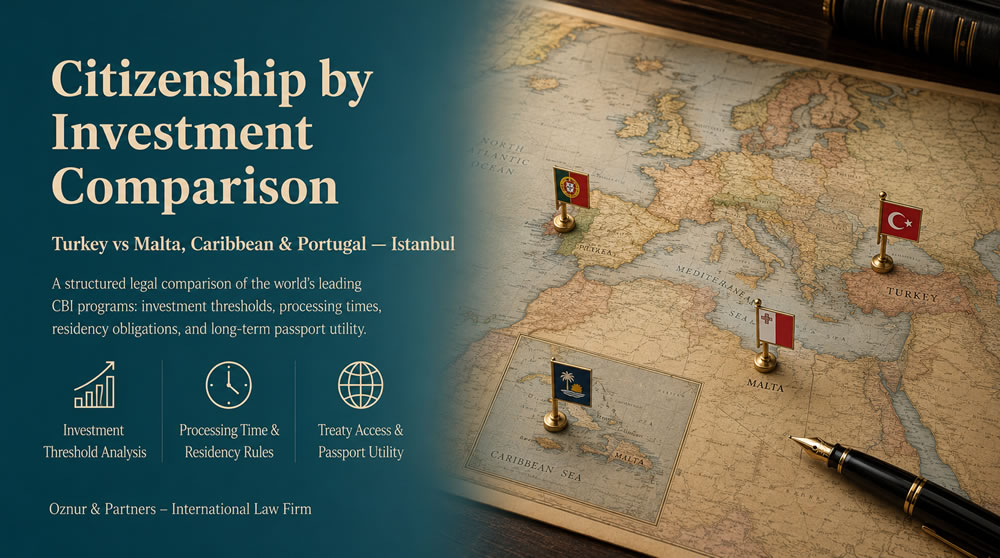
A Turkey citizenship by investment comparison across the leading programs — Malta, Caribbean, and Portugal — begins with a structural question: what does the investor actually need the citizenship to do? As of 2026, four jurisdictions dominate investor inquiries at Oznur & Partners: Turkey, Malta, Caribbean programs (St. Kitts, Antigua, Dominica), and Portugal’s Golden Visa pathway. Each program operates under a different legal framework, targets a different investor profile, and delivers a different long-term outcome.
Investors who approach this decision as a financial transaction often find themselves in the wrong program. The passport is the visible result; the legal structure behind it determines whether that result holds. A program that appears faster may carry higher regulatory exposure. A program that appears cheaper may restrict the exit of capital. Understanding the structural differences before committing is not caution — it is the first form of protection.
This page compares the four programs across the criteria that matter most for investors with families, businesses, and long-term mobility goals: investment threshold, processing time, residency obligation, passport strength, and tax exposure. This turkey citizenship by investment comparison addresses each criterion in turn.
⚖️ Which Citizenship by Investment Program Has the Lowest Entry Requirement in 2026?
Turkey’s citizenship by investment program currently requires a minimum qualifying investment of USD 400,000 in real estate, as established under Council of Ministers Decree No. 2018/14149 and updated in subsequent regulatory revisions. Alternative routes include a minimum USD 500,000 deposit in a Turkish bank for at least three years, or a USD 500,000 investment in a government bond or approved venture capital fund. The real estate route remains the most frequently used by foreign investors.
Caribbean programs (St. Kitts and Nevis, Antigua and Barbuda, Dominica, Grenada, St. Lucia) offer lower nominal entry points, with several programs starting at USD 100,000 for a government contribution route or USD 200,000 for real estate. Malta’s program operates at a substantially different scale: the Malta Permanent Residence Programme requires a government contribution of EUR 600,000 (or EUR 750,000 for properties in Gozo or southern Malta) combined with a real estate purchase or lease and a charitable donation, placing it in a distinct category.
Portugal’s Golden Visa no longer permits direct real estate acquisition in most urban zones following 2023 legislative changes. Qualifying routes now center on investment funds and job creation, typically starting at EUR 500,000.
⚖️ Which Program Processes Fastest — and What Does That Timeline Actually Mean?
Turkey processes citizenship applications typically within three to six months from the date of complete file submission to the Directorate General of Migration Management. The timeline depends on the completeness of the application file, the investment route selected, and current administrative volumes. Several Caribbean programs advertise processing times of 45 to 120 days for approved applicants; however, real timelines including due diligence, document apostille, and biometric scheduling typically extend this range.
Portugal’s pathway is not a direct citizenship route. It confers residency first, with citizenship eligibility arising after five years of legal residence, subject to language requirements and presence minimums. Malta’s pathway involves a 12-month residency period before citizenship application, combined with extensive due diligence. Processing after application submission runs approximately 12 to 18 months in practice.
Investors often ask: “Which citizenship by investment program is fastest for families?” Turkey’s timeline is competitive precisely because it grants citizenship directly, without an intermediate residency phase, and includes spouse and dependent children under 18 in the same application.
⚖️ CBI Program Comparison: Key Criteria at a Glance
The table below summarizes the four programs across criteria most relevant to investor decision-making as of 2026.
| Criterion | Turkey | Caribbean | Malta | Portugal |
|---|---|---|---|---|
| Minimum Investment | USD 400,000 (real estate) | USD 100,000–200,000 | EUR 600,000+ | EUR 500,000 (funds) |
| Processing Time | 3–6 months | 3–6 months | 12–18 months | 5 years (residency first) |
| Residency Obligation | None (one biometric visit) | Minimal (varies by program) | 12-month effective presence | 7 days/year avg. during residency |
| Passport Strength (Visa-Free) | ~110 countries | 140–160 countries | 180+ countries (EU) | 185+ countries (EU) |
| Direct Citizenship | Yes | Yes | Yes (after 12-month period) | No (residency to citizenship) |
| Family Inclusion | Spouse + children under 18 | Spouse + children + some programs include parents | Spouse + minor children | Family reunification after residency |
⚖️ Turkey vs Caribbean: Different Utilities, Not Different Versions of the Same Product
Caribbean programs and Turkey’s program are often treated as interchangeable alternatives in the same price range. They are not. They serve structurally different investor purposes.
Caribbean programs are optimized for visa-free mobility at a lower entry cost. Investors primarily from the Middle East, Africa, and South Asia use them to expand travel access and reduce dependency on a single passport. The investment is typically not expected to generate returns; it is treated as a fee for a mobility upgrade.
Turkey’s program operates in a different register. The qualifying investment is in a real estate market with active liquidity, rental income potential, and long-term appreciation. The passport provides access to approximately 110 countries visa-free, which is competitive for Gulf, Central Asian, and MENA investors who currently hold passports with significantly more restricted access. More importantly, Turkish citizenship creates eligibility for the US E-2 investor visa treaty, a pathway not available through Caribbean passports.
Investors who already hold a strong existing passport and are optimizing purely for mobility may prefer Caribbean programs. Investors who want a real asset underlying the citizenship, a functioning business environment, and specific treaty access will typically find Turkey’s program more aligned with their actual goals. For more on the E-2 treaty angle, see our dedicated page on E-2 Visa Turkey.
⚖️ Turkey vs Malta: Investment Scale and Due Diligence Depth
Malta’s program operates at a different investment scale and involves the most intensive due diligence process among the four jurisdictions. The program is EU-regulated and has faced European Commission scrutiny; this has produced a robust but demanding compliance framework. Applicants undergo multi-layer background checks, and processing involves multiple government agencies.
The result of this process is an EU passport, which is the strongest mobility document commercially available through investment migration. Malta citizenship provides full EU freedom of movement, Schengen travel, and the ability to live and work in any EU member state without restriction.
Turkey does not provide EU membership and does not offer the same visa-free access to the Schengen zone. The Turkish passport currently provides visa-free or visa-on-arrival access to Schengen for short stays in some programs but not unilateral access. Investors specifically targeting EU integration through citizenship will need either Malta or Portugal. Investors targeting Middle Eastern markets, Central Asia, OIC member states, and the US E-2 framework will find Turkey more practically useful.
It is no coincidence that sophisticated investors increasingly ask: “Which second citizenship delivers more value over a 10-year horizon, not just at the moment of issue?” The answer depends on where the investor’s business, family, and regulatory exposure are actually located.
⚖️ Portugal Golden Visa: Residency Architecture, Not Citizenship
Portugal is structurally different from the other three programs because it is a residency pathway, not a citizenship pathway. The Golden Visa grants renewable residency permits. Citizenship becomes available only after five years of continuous legal residency, subject to a Portuguese language test and a demonstrated connection to Portugal.
The minimum physical presence requirement is low — approximately seven days per year on average during the five-year residency period — which makes the program attractive to investors who want a long-term EU optionality without relocating. However, the five-year horizon and language requirement create meaningful friction that direct CBI programs do not.
Portugal’s program is most appropriate for investors who want EU residency now and are willing to pursue citizenship over a five-year arc, and who have the patience and planning capacity for a multi-stage compliance process. Investors who need citizenship — not residency — within a 12-month window should look elsewhere.
⚖️ Tax Considerations Across the Four Programs
No citizenship by investment program eliminates an investor’s home-country tax obligations. Tax residency is determined by domicile, presence, and fiscal ties — not by the passport an investor holds. Investors who assume that a second citizenship reduces their existing tax exposure without a corresponding change in fiscal residency are operating on a misunderstanding that can produce serious compliance risk.
Turkey does not impose global income tax on non-resident citizens. Turkish citizens who are not tax residents of Turkey are taxed only on Turkish-sourced income. This structure is comparable to most Caribbean programs and is more favorable than Malta for investors who maintain non-European fiscal residency.
Portugal is a territorial tax system with a Non-Habitual Resident (NHR) regime that has been modified multiple times in recent years. As of 2026, the NHR regime in its original form has been replaced by a more targeted IFICI regime applicable to specific professional categories. Investors considering Portugal for tax optimization purposes should take independent tax advice on the current state of the regime before treating prior analyses as valid.
For Turkish citizenship specifically, investors should be aware that Turkey and several GCC states have double taxation agreements in place, and that Turkish tax law provides specific carve-outs for foreign-sourced income of non-resident nationals.
⚖️ Which Program Is Right for Different Investor Profiles?
The most useful framework for comparing CBI programs is not “which is cheapest” or “which passport is strongest” in the abstract. It is: which program aligns with where this investor will actually use the citizenship, what assets they want to hold, and what regulatory framework they operate in.
For investors seeking a real asset and treaty access: Turkey. The real estate investment provides a tangible asset with liquidity potential, and Turkish citizenship unlocks E-2 treaty access and broader OIC market connectivity.
For investors prioritizing pure mobility expansion at lower cost: Caribbean programs. Lower nominal investment, strong visa-free coverage across Asia, Africa, and the Americas, minimal ongoing obligations.
For investors targeting EU freedom of movement and long-term European integration: Malta (if budget allows) or Portugal (if a five-year residency-to-citizenship arc is acceptable).
For Gulf-based families with Sharia-compliant investment requirements: Turkey offers participation banking routes and Sharia-compliant real estate fund structures that Caribbean and European programs do not accommodate. This is a frequently overlooked differentiator for investors from Saudi Arabia, the UAE, and Kuwait.
For investors with US ties or US E-2 strategy: Turkey is the only program among the four that creates E-2 treaty eligibility. Caribbean passports do not provide this access. This is a decisive factor for investors building a US market entry structure. For detailed guidance, see our page on E-2 Visa Turkey.
For investors interested in Schengen access advantages of Turkish citizenship: See our dedicated page on Turkish Citizenship and Schengen Visa.
⚖️ Common Risks Investors Underestimate When Choosing a CBI Program
The most frequent structural error in CBI selection is optimizing for the headline metric — lowest price or strongest passport — without evaluating the legal durability of the program over time.
Caribbean programs have faced increased scrutiny from the EU, UK, and US governments. Several programs have had visa-free access suspended or restricted in recent years, which directly affects the utility of the passport purchased. An investor who acquired a St. Kitts passport in 2018 partly for Schengen access found that access restricted in 2023 without any recourse. Program terms change; the passport does not.
Malta’s program faced a formal European Commission infringement procedure and has been subject to ongoing political pressure regarding the legitimacy of citizenship-for-sale in an EU context. The program is legal but operates under sustained institutional scrutiny.
Portugal’s program has been modified legislatively multiple times since 2021, most significantly with the removal of urban real estate as a qualifying asset in 2023 and the restructuring of the NHR tax regime in 2024. Investors who committed to a five-year arc on Portugal may have found the conditions of that arc materially changed by the time citizenship became available.
Turkey’s program has remained structurally stable since its establishment, with changes limited to investment threshold adjustments — the threshold was raised from USD 250,000 to USD 400,000 in 2022. The legal framework governing the program rests on Council of Ministers decrees that are administered through the Directorate General of Migration Management, providing a clear regulatory anchor.
Investors who are comparing programs should ask: not just what are the current terms, but what is the regulatory durability of this program over the next decade?
⚖️ How Oznur & Partners Advises on CBI Program Selection
Oznur & Partners is an Istanbul-based law firm. Our practice is centered on Turkish law, Turkish citizenship by investment, and the legal architecture supporting foreign investment in Turkey. We do not operate as a multi-jurisdictional migration agency and do not provide primary legal advice on Maltese, Caribbean, or Portuguese programs.
What we do provide is a structured legal assessment of the Turkish CBI route and, where relevant, a comparative framework that allows investors to evaluate Turkey against other programs they are considering. This assessment covers the legal requirements for qualifying investment, the application process through the Directorate General of Migration Management, the family inclusion structure, and the long-term legal status implications of Turkish citizenship.
Most investors who contact our team have already identified Turkey as a serious option. The comparative analysis on this page is designed to give them the structural clarity to make that decision on substantive grounds — not marketing language.
The Turkish citizenship application process can be completed remotely through a properly executed power of attorney. The principal applicant and spouse are required to appear once for biometric data registration, either at a Turkish consulate in their country of residence or at a Migration Management office in Turkey. All other procedural steps are handled through our team in Istanbul.
❓ Frequently Asked Questions
✅ Is Turkey citizenship by investment faster than Portugal Golden Visa?
Yes, significantly. Turkish citizenship by investment is typically finalized within three to six months from complete file submission. Portugal’s Golden Visa does not grant citizenship directly — it grants residency, with citizenship eligibility arising only after five years of continuous legal presence, subject to a language test. For investors who need citizenship within a one-year window, Turkey is a more direct route.
✅ Which citizenship by investment program requires no physical residency?
Turkey’s program requires the principal applicant and spouse to appear once for biometric registration, either at a Turkish consulate abroad or at a Migration Management office in Turkey. Beyond that single visit, there is no ongoing residency requirement. Caribbean programs also offer largely remote processing. Malta requires an effective 12-month presence period. Portugal requires approximately seven days of physical presence per year on average during the residency phase, with citizenship requiring an additional language and integration assessment.
✅ What is the main difference between Turkey and Caribbean citizenship programs?
The primary structural difference is investment utility and long-term treaty access. Turkish citizenship involves a real estate or financial investment in a large emerging market economy, with the investment retaining asset value and generating potential rental income. Caribbean programs involve smaller contributions primarily used as government fees or held in restricted real estate structures with limited secondary market liquidity. Turkish citizenship also creates E-2 investor visa treaty eligibility with the United States; Caribbean passports do not.
✅ Can I include my parents in a Turkish citizenship application?
Turkey’s citizenship by investment program covers the principal applicant, the spouse, and dependent children under the age of 18. Parents of the principal applicant are not included in the standard CBI application. Some Caribbean programs offer broader family inclusion rules that extend to parents and sometimes siblings above certain age thresholds, which may be relevant for investors with multigenerational family structures.
✅ Which CBI program is better for real estate investors?
Turkey offers the most developed independent real estate market among the four programs. The qualifying USD 400,000 investment can be made in a property that generates rental income, appreciates independently of the citizenship program’s regulatory status, and can be sold after a mandatory three-year holding period. Caribbean real estate options are typically linked to approved resort or hotel projects with restricted secondary market liquidity. Malta and Portugal’s programs have moved away from direct residential real estate as primary qualifying assets.
✅ Does Turkish citizenship reduce my tax obligations?
Turkish citizenship itself does not create new tax obligations for non-residents, nor does it eliminate existing home-country obligations. Turkish citizens who are not fiscal residents of Turkey are taxed only on Turkish-sourced income. However, a change in citizenship does not change an investor’s tax residency — that requires a separate, carefully structured fiscal relocation. Investors should take independent tax advice before assuming that any CBI program reduces their current tax exposure.
✅ Which program is most suitable for Gulf investors?
Gulf investors — particularly those from Saudi Arabia, the UAE, Kuwait, and Qatar — frequently choose Turkey for its combination of geographic proximity, cultural familiarity, Islamic finance compatibility through participation banking structures, and practical business connectivity with Turkish markets. The Turkish real estate market is accessible for Gulf investors in ways that Maltese or Caribbean markets are not, and the legal framework for Sharia-compliant investment structures is established in Turkish financial law.
✅ What happens if a Caribbean program’s visa-free access is restricted after I obtain citizenship?
If a Caribbean program loses visa-free access to a jurisdiction after an investor obtains citizenship, the investor retains the citizenship but loses that specific mobility benefit. There is no contractual guarantee embedded in the citizenship itself regarding visa-free access, which is determined by bilateral agreements between states and can change with political developments. This is a structural risk that is often underweighted in CBI comparisons focused purely on current passport rankings.
Schedule a Legal Consultation
If you are evaluating Turkey’s citizenship by investment program against other jurisdictions, or need a structured legal assessment of the Turkish CBI route for your specific family and investment profile, our Investment Lawyers in Istanbul are available for an initial consultation.
Citizenship by investment decisions are not reversed easily. The legal structure chosen at the outset shapes the investor’s regulatory exposure, family planning options, and asset architecture for years. Turkey’s program offers a specific combination of investment utility, processing speed, family inclusion, and treaty access that makes it the right choice for a defined set of investor profiles — and the wrong choice for others. The goal of this comparison is not to recommend Turkey in all cases, but to give investors the structural clarity to know whether Turkey is right for their specific situation.