

Transit trade tax exemption Turkey is a corporate tax incentive that allows foreign and domestic companies to conduct international trade intermediation through Turkey while paying little to no corporate income tax on those earnings. Under Law No. 7582, published in the Official Gazette on 4 June 2026, companies operating outside the Istanbul Finance Centre (IFC) are now entitled to a 95% corporate tax exemption on profits derived from transit trade activities, while IFC-registered companies benefit from full exemption. This regulation fundamentally changes Turkey’s position in international trade structuring, and for companies evaluating their next hub, the timing demands attention.
Most international companies approach Turkey with a clear investment objective but an incomplete picture of its tax architecture. The transit trade exemption is one of the least understood components of Turkey’s 2026 reform package, yet it carries the most immediate relevance for companies engaged in cross-border goods trading, intermediary procurement, and regional distribution networks. The question is not whether the exemption applies; it does, broadly, but whether the legal structure surrounding it will hold under scrutiny.
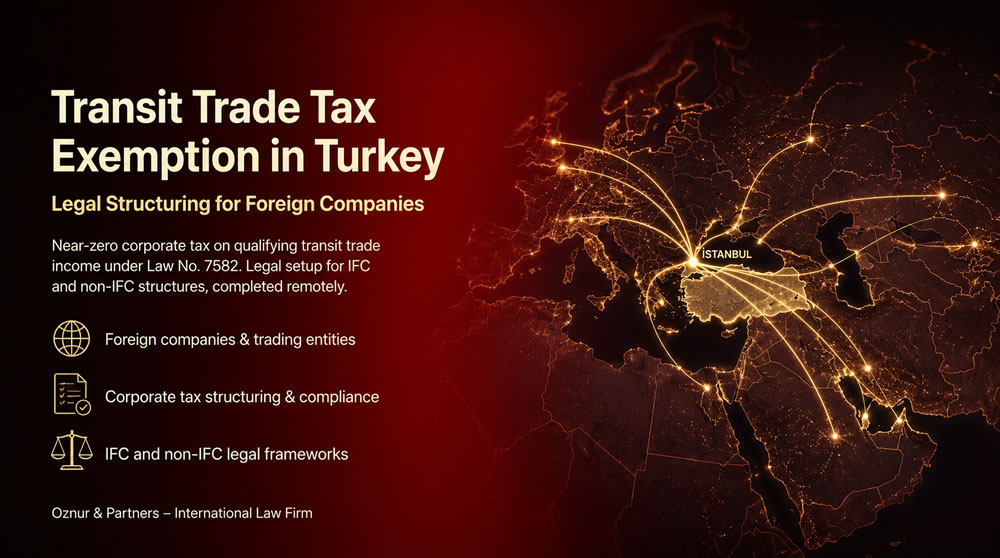
⚖️ Transit Trade Tax Exemption Turkey: How It Works and Who It Covers
Transit trade, in the Turkish tax context, refers to commercial transactions in which goods are purchased abroad and sold abroad without physically entering Turkey. The company managing the transaction, negotiating contracts, arranging financing, coordinating logistics, or acting as an intermediary, is based in Turkey, but the goods themselves never cross Turkish customs. This distinction matters because it separates transit trade from import-export activity, which carries entirely different tax and customs treatment.
Before the 2026 reform, companies operating within the Istanbul Finance Centre already enjoyed a 50% deduction on transit trade income under the existing corporate tax framework. The new regulation makes two significant changes. First, it raises the IFC exemption to 100%, effectively eliminating corporate tax on qualifying transit trade income for IFC participants. Second, it extends a 95% exemption to companies operating outside the IFC, a meaningful expansion that opens the incentive to the broader Turkish corporate landscape.
What qualifies as transit trade income under the new framework covers a wider range of activities than many companies initially assume. Profits from intermediary services in overseas goods procurement and sales, earnings from trade finance structures involving Turkish entities, income from contract management and regional distribution coordination, and revenues from commodity trading operations managed from Turkey, all fall within the scope of the exemption, subject to documentation and structural conditions that secondary legislation will further define.
*This is precisely why experienced international investors increasingly ask: “Does my current structure qualify, or does it need to be rebuilt before I can access the exemption?”*
⚖️ IFC vs. Non-IFC: Which Structure Delivers the Better Outcome?
The choice between operating within the Istanbul Finance Centre and maintaining a standard Turkish corporate structure is not simply a tax calculation: it is a strategic decision with operational implications that extend well beyond the exemption rate itself.
Companies registered and operating within the IFC benefit from a complete corporate tax exemption on transit trade income. In addition, the IFC framework offers supplementary advantages including BITT exemptions, stamp duty relief, bookkeeping in foreign currency, and a 20-year corporate tax exemption for overseas companies relocating their regional headquarters to the centre. For companies whose primary activity is financial intermediation, commodity trading, or regional headquarters management, the IFC structure is likely to deliver the strongest overall tax position.
For companies with broader operational profiles, those combining transit trade with local Turkish market activity, or those requiring operational flexibility across multiple business lines, the non-IFC structure with a 95% exemption may prove more practical. A 95% exemption on transit trade profits, when combined with standard corporate tax rates on other income streams, can yield an effective tax burden that competes favorably with comparable jurisdictions.
| Structure | Transit Trade Exemption | Regional HQ Benefit | Operational Flexibility | Setup Complexity |
|---|---|---|---|---|
| IFC-Registered Company | 100% (full exemption) | 20-year corporate tax exemption | IFC operational requirements apply | Higher: specific IFC criteria |
| Standard Turkish Company | 95% on qualifying income | Not applicable | Full operational flexibility | Standard company formation |
| Qualified Service Centre | 95-100% depending on activity | Overlapping incentives possible | Specific revenue composition rules | Higher: 80% foreign revenue threshold |
The difference between a 95% and 100% exemption, while meaningful in absolute terms, is rarely the deciding factor. What determines the optimal structure is the composition of the company’s revenue, the jurisdictions of its trading counterparties, its transfer pricing exposure, and its compliance capacity. These are legal and structural questions, not accounting questions.
⚖️ Why Turkey, and Why Now?
Turkey’s geographic position has always made it a logical node for goods moving between Europe, the Middle East, Central Asia, and North Africa. What changed in 2026 is the tax architecture supporting that position. A near-zero effective tax rate on transit trade income places Turkey in direct competition with established intermediary hubs, and on several structural dimensions, Turkey now offers advantages those jurisdictions cannot easily match.
The standard corporate tax rate in Turkey is 25%. For manufacturing exporters, the 2026 reform reduced this to 9%. For companies with qualifying transit trade income, the effective rate on those earnings falls to approximately 1.25% for non-IFC structures and 0% for IFC participants. This is not a temporary incentive or a negotiated concession: it is statutory law, published and in force as of 4 June 2026.
Istanbul’s position as a logistics and financial centre reinforces the tax advantage. The city connects to over 300 international destinations, hosts a deep banking system capable of handling complex trade finance structures, and maintains treaty networks with more than 85 countries for the avoidance of double taxation. For companies routing goods between Asian suppliers and European or Gulf buyers, Turkey offers a legally stable, cost-competitive operating environment that the tax reform has now made significantly more attractive.
*Sophisticated investors in transit trade structuring regularly ask: “Which jurisdiction gives me the combination of legal stability, operational infrastructure, and tax efficiency I need for the next decade?”* Turkey’s 2026 package is a direct answer to that question.
⚖️ Common Structural Risks: Why They Matter Before You Register
The transit trade tax exemption is not self-executing. Companies that form a Turkish entity and begin routing trade through it without addressing the underlying structural requirements risk two outcomes: disqualification from the exemption on audit, and exposure to back taxes, interest, and penalties on income they believed was exempt.
The most frequent structural vulnerabilities fall into four categories.
Transfer pricing exposure. Where the Turkish transit entity transacts with related parties in other jurisdictions, Turkish tax authorities apply transfer pricing rules to ensure the Turkish entity is being compensated at arm’s length. Underpricing the Turkish entity’s contribution, a common approach to minimizing taxable income in other structures, can trigger transfer pricing adjustments that eliminate the benefit of the exemption entirely. The correct approach is to document the Turkish entity’s genuine economic contribution and price it accordingly.
Substance requirements. A transit trade exemption claimed by a company that has no real presence in Turkey, with no staff, no decision-making, no operational activity, is vulnerable to challenge. The 2026 reform does not explicitly codify minimum substance requirements for the non-IFC exemption, but secondary legislation and audit practice are expected to develop criteria consistent with OECD BEPS standards. Companies that establish genuine operational substance from the outset are significantly better positioned.
Documentation gaps. The exemption applies to income from qualifying transit trade activities. What constitutes a qualifying activity, and what documentation is required to substantiate the claim, will be clarified by Hazine ve Maliye Bakanlığı tebliğleri in the coming months. Companies that begin operations before this secondary legislation is published should ensure their transaction records are structured to satisfy documentation requirements under any likely interpretation.
Permanent establishment risk in counterparty jurisdictions. A Turkish company managing transit trade may inadvertently create permanent establishment exposure in the jurisdictions where its counterparties are located, depending on the nature of its activities and the applicable tax treaties. This risk is manageable with proper structuring but is frequently overlooked in initial setup.
⚖️ How the Legal Structuring Process Works
Accessing the transit trade tax exemption requires a legal structure that is correctly formed from the outset. Retrofitting a structure that was established without the exemption in mind, or restructuring after an audit challenge has begun, is significantly more difficult and expensive than building correctly from the start.
The process begins with a structural assessment. Before any entity is formed, the company’s existing trade flows, counterparty relationships, revenue composition, and transfer pricing framework are reviewed to determine which structure, IFC, non-IFC, or Qualified Service Centre, that best fits the operational profile. This assessment also identifies any treaty positions that affect the overall tax outcome.
Entity formation follows the assessment. A Turkish limited liability company (limited şirket) or joint stock company (anonim şirket) is the typical vehicle for non-IFC transit trade structures. The choice between entity types affects capital requirements, governance flexibility, and certain withholding tax positions. For IFC structures, additional registration requirements with the Istanbul Finance Centre apply.
Operational setup runs in parallel with entity formation. Banking arrangements, trade finance lines, accounting systems in a format that supports exemption documentation, and employment or service agreements for substance purposes are all established before the first transaction is executed. This sequence matters because retroactive documentation is harder to sustain under audit.
Ongoing compliance maintains the exemption. Annual corporate tax returns must correctly identify and segregate qualifying transit trade income, supported by transaction-level documentation. Transfer pricing files must be maintained where related-party transactions are present. As secondary legislation develops, compliance procedures will be updated accordingly.
Most foreign companies complete the formation phase within four to six weeks, assuming documentation from the home jurisdiction is in order and banking timelines are predictable. The legal process itself, covering entity registration, tax number, trade registry, and chamber of commerce enrollment, typically takes two to three weeks. Remote completion is available for most steps through power of attorney, with no physical presence in Turkey required during formation.
⚖️ Turkey and the Global Hub Comparison
International companies evaluating transit trade structures typically compare Turkey against a small number of established jurisdictions. The comparison is worth examining directly, because the 2026 reform changes the calculus in Turkey’s favor on dimensions that were previously less competitive.
Dubai has long been the default choice for companies routing goods between Asia and Europe or the Gulf. Its zero corporate tax rate, established logistics infrastructure, and liberal foreign ownership rules remain genuinely attractive. What Turkey offers that Dubai does not is a deep domestic market of 85 million people, direct land connectivity to Europe and Central Asia, a significantly lower operating cost base, and, critically, double taxation treaty coverage that Dubai’s treaty network does not fully replicate for all source jurisdictions.
Singapore’s position as a transit trade hub rests on its treaty network, English-language legal system, and financial infrastructure. Turkey’s 2026 effective tax rate on transit trade income is now comparable to Singapore’s, while Istanbul’s proximity to emerging market supply chains in Central Asia, the Caucasus, and the Middle East creates sourcing advantages Singapore cannot offer.
The Netherlands and Switzerland have historically served European companies seeking transit trade structures within the EU or with favorable treaty access. For companies whose counterparties are concentrated in OECD jurisdictions, these structures remain relevant. For companies with significant trading activity in Turkey’s near-abroad, a geography that includes some of the world’s fastest-growing trade corridors; Istanbul offers a structural and logistical alignment that neither Amsterdam nor Zurich can match.
⚖️ The Istanbul Finance Centre: Is It Worth Registering?
The Istanbul Finance Centre is a designated financial zone in the Ataşehir district of Istanbul, established to attract international financial institutions and create a regulated environment for cross-border financial services. Since its formal activation, it has developed into a credible operating environment for banks, asset managers, insurance companies, and trading entities seeking the full package of IFC-specific tax advantages.
For transit trade purposes, IFC registration provides the 100% exemption versus the 95% available outside the centre. The additional 5% may or may not justify the operational requirements of IFC registration, depending on the scale of the company’s transit trade income. At higher income levels, where 5% of exempt income represents a meaningful absolute figure; the IFC structure becomes more compelling. At smaller scales, the compliance overhead of IFC registration may outweigh the incremental benefit.
IFC registration also positions a company favorably for the 20-year corporate tax exemption available to overseas companies relocating their regional headquarters to the centre. For companies considering Turkey not just as a transit trade vehicle but as a genuine regional operational base, the IFC framework offers a comprehensive incentive structure that extends well beyond the transit trade exemption itself.
⚖️ What Happens After Law No. 7582: Secondary Legislation and What to Watch
Law No. 7582 is the primary legislation. It establishes the exemption, defines the broad categories of qualifying activity, and sets the exemption rates. What it does not yet fully specify are the procedural conditions: documentation standards, minimum substance requirements, transfer pricing safe harbors, and the treatment of mixed-income companies that derive both qualifying and non-qualifying income.
Hazine ve Maliye Bakanlığı tebliğleri, secondary regulations published by the Ministry of Treasury and Finance, will provide this operational detail. Based on the pattern of previous reform packages, these tebliğler are typically published within three to six months of the primary legislation entering into force. Companies that begin structuring now, before secondary legislation is published, should build in flexibility to adapt their compliance procedures as the operational framework is clarified.
The areas most likely to require careful attention once secondary legislation is published are the documentation requirements for qualifying transit trade income, the treatment of income from activities that partially overlap with the exemption’s scope, and the interaction between the transit trade exemption and Turkey’s controlled foreign company (CFC) rules for Turkish shareholders of foreign entities.
❓ Frequently Asked Questions
✅ What is the corporate tax rate on transit trade income in Turkey in 2026?
For companies operating outside the Istanbul Finance Centre, 95% of qualifying transit trade income is exempt from corporate tax under Law No. 7582, published on 4 June 2026. The effective tax rate on that income is approximately 1.25% (5% of the standard 25% rate). For IFC-registered companies, the exemption is 100%; the effective rate is zero.
✅ Does a foreign company need to form a Turkish entity to access the transit trade exemption?
Yes. The exemption applies to Turkish resident companies, entities registered and tax-resident in Turkey. A foreign company cannot claim the Turkish transit trade tax exemption through a branch or representative office; a separately incorporated Turkish entity is required, and the entity must have genuine economic substance in Turkey to sustain the exemption under audit.
✅ Do goods need to physically enter Turkey for a transaction to qualify as transit trade?
No. The defining characteristic of qualifying transit trade is that goods are purchased abroad and sold abroad, with the Turkish entity managing the commercial, financial, or intermediary aspects of the transaction from Turkey. Physical entry of goods into Turkey is not required and, in practice, is typically absent in qualifying structures.
✅ How long does it take to set up a Turkish company for transit trade purposes?
Entity formation typically takes two to three weeks from submission of documents. A complete transit trade structure , including banking, accounting setup, and operational documentation, is generally functional within four to six weeks. Most of the process can be completed remotely through a power of attorney, without the company principals traveling to Turkey.
✅ What is the difference between transit trade and the Qualified Service Centre regime?
Transit trade covers commercial intermediation in the purchase and sale of goods abroad. The Qualified Service Centre (Nitelikli Hizmet Merkezi) regime applies to capital companies that provide services, including financial consulting, strategic management, legal consulting, and R&D, to related companies in at least three countries, generating at least 80% of annual revenue from those related foreign entities. The two regimes can overlap in certain structures but have distinct eligibility requirements.
✅ Is the transit trade tax exemption permanent or time-limited?
Law No. 7582 does not impose a sunset date on the transit trade exemption. The exemption is legislated as a permanent feature of the Turkish corporate tax framework, not a temporary incentive. Future legislative changes could modify its terms, but as of the date of publication, the exemption applies without a defined expiry.
✅ What are the transfer pricing risks in a transit trade structure?
Where the Turkish transit entity transacts with related parties, Turkish transfer pricing rules require that those transactions be priced at arm’s length. Failure to maintain arm’s length pricing, together with the documentation to support it, exposes the company to transfer pricing adjustments that can eliminate the economic benefit of the exemption. Transfer pricing analysis and documentation should be built into the structure from inception, not addressed after the fact.
✅ Can a company access both the transit trade exemption and the 20-year income tax exemption for relocating individuals?
These are separate regimes with separate eligibility criteria. The transit trade exemption applies at the corporate level, to the Turkish entity’s income. The 20-year income tax exemption applies at the individual level, to qualifying natural persons who relocate to Turkey and meet the residency conditions. A foreign entrepreneur who both relocates to Turkey and conducts transit trade through a Turkish company may potentially access both regimes, subject to satisfying each regime’s specific conditions.
✅ Which law firm services are relevant for a transit trade structure in Turkey?
The legal services most relevant to transit trade structuring include entity formation and corporate governance, tax structuring and transfer pricing analysis, trade finance documentation review, and ongoing corporate compliance. Where the structure involves IFC registration, additional administrative and regulatory coordination is required. Legal counsel should be engaged before entity formation, not after the structure is in place, to ensure the legal architecture supports the exemption from the outset.
Schedule a Legal Consultation
If you are evaluating a transit trade structure in Turkey, considering IFC registration, or need a legal assessment of how Law No. 7582 applies to your existing operations, our Investment Lawyers in Istanbul are available for an initial consultation. Most formation work can be completed remotely.
⚖️ Related Legal Resources
🔹 Corporate and Investment Law
- Investment Law Firm Turkey: Legal structuring for foreign direct investment, company formation, and regulatory compliance across Turkey’s investment incentive framework.
- Company Formation in Turkey: Step-by-step legal guidance on forming a limited şirket or anonim şirket, including capital requirements, registration timelines, and remote formation procedures.
- Corporate Lawyer in Istanbul: Corporate governance, shareholder agreements, and ongoing legal counsel for companies operating in Turkey.
- Foreign Investment and Citizenship Law: Comprehensive hub for the legal framework governing foreign investment in Turkey, including incentive structures, citizenship pathways, and regulatory compliance.
🔹 Tax and Financial Structuring
- Istanbul Finance Centre Law Firm: Legal services for companies considering IFC registration, including the full IFC tax incentive framework and operational requirements.
- Qualified Service Centre Turkey: The Nitelikli Hizmet Merkezi regime explained, covering eligibility, revenue composition requirements, and how it interacts with the transit trade exemption.
- Turkey 20-Year Tax Exemption 2026: The individual income tax exemption for qualifying persons relocating to Turkey, a separate regime that may complement a corporate transit trade structure.
- Banking and Finance Lawyer Turkey: Trade finance documentation, correspondent banking arrangements, and financial regulatory compliance for international trading structures.
A transit trade structure is only as strong as the legal foundation beneath it. Turkey’s 2026 reform has opened a genuinely competitive window, but the exemption does not apply by default: it applies to structures that are correctly formed, properly documented, and legally maintained. The difference between those two outcomes is decided before the first transaction is executed.
“Law is not an idea but a force, and the force here is structural preparation.”