

Turkish citizenship obtained through job creation is not a symbolic promise of employment, nor a numerical exercise based on headcount. It is a legally structured pathway in which the Turkish state evaluates whether an investor has created real, sustainable, and verifiable economic activity that contributes to the domestic labor market. Approached correctly, this pathway reflects alignment with public interest. Approached carelessly, it becomes one of the most frequently rejected citizenship routes.
What actually distinguishes this route from every other investment-based path to citizenship? Continuity as the qualifying condition itself, not a byproduct of it. A real estate purchase or a bank deposit sits and waits for three years; fifty jobs cannot simply sit, each one has to keep existing, continuously, insured, and paid, for the entire holding period, or the qualifying condition quietly stops being true.
From a legal perspective, citizenship by job creation is assessed not by intention, but by continuity, compliance, and documentation. When do most job creation applications actually fail? Rarely at the fifty-person threshold itself. They fail in the months after hiring, when short-term positions are quietly reduced, when SGK premiums lapse, when a workforce that looked credible on the application date no longer matches the company’s actual scale a year later.
The question authorities ask is never “how many people were hired,” it is whether those positions exist as part of a lawful, ongoing business operation. Which investors genuinely succeed on this route? Counterintuitively, not the ones optimizing for the fastest path to fifty names on a payroll. It is the investors already running, or genuinely building, a labor-intensive business for entirely commercial reasons, for whom the fifty employees are a natural consequence of scale rather than a target constructed to satisfy a citizenship threshold.
This route is also structurally unusual in one further respect: it is the only pathway among the six where the qualifying condition is a relationship between people, employer and employee, rather than a relationship between an investor and an asset. A bank deposit does not resign. A piece of real estate does not decide the job is not a good fit and leave. Fifty employment relationships, by contrast, are subject to ordinary human turnover, resignations, terminations, disputes, each of which needs to be managed and, where a position is vacated, refilled without breaking the continuity the application depends on.
Who should read this page before committing to this route, not after? Any investor who has heard this pathway described as “just hire fifty people,” a description that omits the part authorities actually scrutinize most closely, whether those fifty positions would exist at all if the citizenship application were withdrawn tomorrow.
⚖️ What Does “Job Creation” Mean Under Turkish Citizenship Law?
Under the Turkish Citizenship Law and its implementing regulations, job creation is evaluated as a functional outcome of investment, not as an isolated act. Employment must arise from an operating company that complies with Turkish commercial, tax, and social security regulations. Artificial or temporary hiring structures do not meet this standard.
Authorities examine whether the employment:
- Is tied to a legally incorporated company in Turkey
- Is supported by valid Social Security Institution (SGK) registrations
- Reflects actual business activity, not paper-based payroll structures
Citizenship is granted because employment exists as a consequence of lawful enterprise, not because employment was staged to obtain citizenship.
This standard sounds straightforward stated abstractly, but it has a specific practical consequence: the business has to make sense on its own commercial terms, independent of any citizenship objective. A company whose only apparent purpose is reaching the fifty-employee threshold, with no clear product, service, or market rationale for its existence, invites exactly the scrutiny this framework is designed to apply. A company that would exist at roughly this scale regardless of any citizenship application rarely faces the same difficulty, because its economic logic answers the question before an examiner has to ask it.
Who This Route Actually Suits
This pathway suits investors who intend to operate a genuinely labor-intensive business in Turkey, manufacturing, hospitality, logistics, retail at scale, regardless of the citizenship outcome. It suits poorly an investor seeking the least operationally demanding route, since sustaining fifty continuous positions for three years is, by a meaningful margin, the most operationally demanding commitment among the six routes in this framework.
There is a specific investor profile for whom this route is genuinely the natural choice: someone already planning to establish a manufacturing facility, hospitality operation, or logistics business in Turkey at a scale that would organically require fifty or more employees, for entirely commercial reasons unrelated to citizenship. For this profile, the citizenship eligibility is close to an incidental consequence of the business plan rather than its driving purpose, and these are, in our experience, consistently the strongest applications this route sees, precisely because the workforce credibility question was never in doubt to begin with.
⚖️ Minimum Employment Thresholds and Practical Reality
While regulations refer to a minimum number of Turkish employees, legal evaluation extends beyond numerical thresholds. The presence of employees must be continuous, insured, and consistent with the company’s sector and scale. A mismatch between company activity and workforce composition often triggers additional scrutiny.
In practice, authorities review:
- Duration of employment prior to application
- Salary payments and SGK premium records
- Workplace activity and operational capacity
Meeting the minimum number is necessary, but never sufficient on its own.
The 50-Person Threshold in Practice
For Turkish citizenship applications based on job creation, the legal benchmark is clear: a minimum of 50 Turkish citizen employees must be employed by the applicant’s company. This requirement is not discretionary and does not include foreign nationals, shareholders, or contractors.
However, this threshold functions only as an entry point. Authorities do not assess compliance based on headcount alone, but on whether the scale of employment reflects a credible and sustainable business operation. Fifty employees hired without operational logic are treated as a risk indicator, not as compliance. From an administrative perspective, the decisive question is not whether fifty people appear on payroll, but whether those positions are economically justified, continuously maintained, and legally documented through SGK records.
Investors sometimes ask whether hiring more than fifty provides any additional buffer or advantage. It does not change the legal threshold itself, but a modest margin above fifty can provide practical protection against ordinary workforce fluctuation, resignations, seasonal turnover, that might otherwise bring the count below the minimum at an inconvenient moment during the holding period. Treating fifty as an exact target rather than a floor to comfortably clear is a common and avoidable source of unnecessary risk.
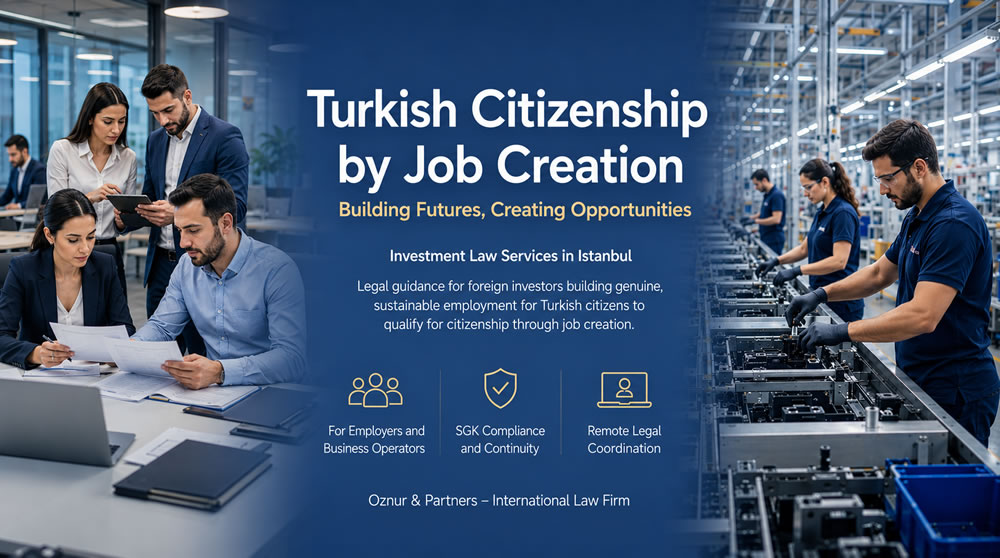
Building a business that will genuinely employ 50 Turkish citizens?
A short consultation can confirm your workforce structure will withstand the continuity and credibility review this route actually applies.
⚖️ SGK Registration, Employee Numbers, and Continuity Requirements
In citizenship applications based on job creation, SGK (Social Security Institution) records are not a formality, they are the backbone of legal verification. Authorities do not evaluate employment solely by contracts or payroll lists, but by continuous and traceable SGK data that proves real labor relations over time.
Employee Numbers and Legal Expectation
While the regulation refers to a minimum number of Turkish employees, the decisive factor is not only how many employees are hired, but whether the workforce structure is credible for the company’s line of business. A small trading company with an unusually large workforce, or a manufacturing company with implausibly low staffing, immediately raises red flags.
SGK Duration: Why Time Matters More Than Headcount
In practice, authorities focus heavily on how long employees have been continuously registered with SGK prior to the citizenship application. Although legislation does not always state a fixed period explicitly, administrative practice generally expects:
- Employees to be registered and actively working for a meaningful continuous period, often assessed in the range of 12 to 24 months
- SGK premiums to be paid regularly, without interruption or retroactive correction
- Employment continuity to extend beyond the application date, demonstrating that jobs were not created solely to meet eligibility criteria
Short-term hiring immediately before an application, even if numerically sufficient, is one of the most common grounds for enhanced scrutiny.
The twelve-to-twenty-four-month window is worth planning around explicitly rather than discovering by accident. An investor who begins hiring only once the citizenship strategy is finalized, expecting to reach fifty employees and file within a few months, has not given the workforce time to establish the continuity record authorities actually look for. Building this route successfully generally means beginning the hiring and business-building process well before the citizenship filing is contemplated as imminent, not as a final step compressed into a short window.
Salary, Premiums, and Consistency Checks
Authorities cross-check declared salaries with SGK premium payments, tax filings, and sector averages. Discrepancies between salary levels, company revenue, and workforce size are interpreted as indicators of artificial employment structures.
A company reporting fifty employees at minimum wage while its declared revenue would not plausibly support that payroll, or a company with salary levels far above sector norms without a commensurate business justification, both attract the same kind of scrutiny, a mismatch between the numbers on paper and the economic reality they are meant to represent. Consistency across these figures is not a matter of choosing convenient numbers, it is a matter of the underlying business genuinely operating at the scale the payroll implies.
Citizenship is evaluated not on promises, but on SGK records that withstand time.
⚖️ The Most Common Legal Risks in Job Creation Applications
This pathway carries higher rejection risk than capital-based investment options due to frequent misuse. The most common legal failures include:
- Hiring employees solely for application purposes and terminating them shortly after
- Registering employees without real workplace presence
- Establishing companies with no genuine commercial output
These patterns are well known to administrative authorities. Once identified, they compromise not only the citizenship application but also future investment credibility.
What makes these patterns particularly costly is that they rarely surface as an outright, immediate rejection. More often, they surface as a request for additional documentation, an inspection, or a delay that extends the review well beyond what a genuinely compliant application would take. By the time the underlying issue is identified, the investor has often already committed years of capital and effort to a structure that was compromised from an early stage, precisely the kind of outcome that front-loaded legal structuring is designed to prevent.
The state does not penalize ambition, but it does not tolerate simulation.
What “Real Workplace Presence” Actually Means
Registration without genuine presence is a specific and recognizable pattern to authorities: employees registered with SGK who show no evidence of actually working at the declared location, no consistent attendance pattern, no operational output attributable to their role, no colleagues or supervisors who can confirm their day-to-day function. A citizenship file built on this kind of registration is not simply weak, it resembles a pattern authorities are specifically trained to identify, and identification tends to trigger scrutiny well beyond the individual positions in question.
This pattern is sometimes the result of deliberate structuring, but just as often it emerges from genuine businesses that grew carelessly, a satellite office registered on paper without meaningful activity, a subsidiary that exists mostly for administrative convenience rather than operational substance. The remedy in either case is the same: workforce composition needs to map cleanly onto verifiable, observable business activity, not merely onto a payroll spreadsheet that technically satisfies the numerical threshold.
⚖️ Employer Obligations That Continue Throughout the Holding Period
Job creation is the one route in this framework where the investor becomes, functionally, an ongoing employer under Turkish labor law for the entire three-year period, not simply a passive holder of a qualifying asset. This carries obligations that continue regardless of the citizenship timeline, timely SGK premium payments, compliance with minimum wage and overtime regulations, adherence to termination and severance rules, and ordinary corporate tax and reporting obligations tied to the operating business.
An investor who treats these obligations as separate from the citizenship strategy, delegating them entirely to operational staff without oversight, is taking on a specific risk: a labor law violation or a lapsed SGK payment is not merely a commercial or regulatory problem in isolation, it directly undermines the continuity record the citizenship application depends on. On this route more than any other in the framework, ordinary business compliance and citizenship compliance are, in practice, the same compliance.
Severance and termination in particular deserve careful handling, since ordinary business reasons for letting an employee go, restructuring, underperformance, seasonal downturn, are legitimate under Turkish labor law but still require the departing position to be filled promptly if the workforce count is to remain above the qualifying threshold. An investor who lets natural turnover erode the headcount without a deliberate rehiring process is, without necessarily intending to, allowing the qualifying condition to lapse in slow motion.
⚖️ How Authorities Verify Employment Authenticity
Verification is multi-layered. Beyond documentation, authorities cross-check records across institutions. SGK filings, tax declarations, company financials, and sectoral norms are evaluated together. In some cases, on-site inspections or additional explanations may be requested.
This process is not adversarial, but it is exacting. Any inconsistency, however minor, can delay or halt the application. The role of legal coordination here is not to embellish facts, but to ensure that lawful facts are presented coherently and defensibly.
A useful way to think about this verification is that no single institution holds the complete picture on its own. SGK confirms registration and premium continuity, tax authorities confirm the business’s declared revenue and expenses, and the citizenship reviewer looks at both together against sectoral norms to judge plausibility. An application that is technically accurate at each institution individually but tells a subtly inconsistent story across all three is treated the same as one with an outright factual error, because the inconsistency itself is what triggers doubt.
What Our Review Covers Before Hiring Begins
Before an investor begins building the workforce that will eventually support a citizenship application, we review the proposed business structure against the credibility standard authorities actually apply, confirm the sector-appropriate workforce composition, and structure payroll, SGK registration, and employment contracts so that continuity is documentable from the first hire rather than reconstructed retroactively once fifty names appear on a payroll. This front-loaded review is what prevents an investor from discovering, at month twenty, that their hiring pattern reads as artificial to a reviewer regardless of how genuine the underlying business actually is.
In practice, the documentation this route generates and requires across its lifecycle includes:
- Corporate formation and registration documents for the operating Turkish company.
- SGK registration records for each employee, updated continuously throughout the holding period.
- Payroll records and proof of salary payment, reconciled against SGK premium filings.
- Corporate tax filings and financial statements demonstrating a business scale consistent with the declared workforce.
- Employment contracts establishing the terms and continuity of each qualifying position.
- The Certificate of Conformity or equivalent confirmation issued once the employment threshold and continuity requirement are satisfied.
Unlike a bond confirmation letter or a title deed, most of this documentation is not a one-time submission. Payroll and SGK records continue generating new data every month of the holding period, and each new data point needs to remain consistent with the workforce composition and continuity story the application is built on.
⚖️ Job Creation Compared to Other Investment Routes
Job creation sits at the most operationally demanding end of the citizenship framework, exceeding even fixed capital investment in continuous obligation, since a business’s operational substance can be demonstrated through assets and production capacity, while employment continuity has to be proven through fifty individual, ongoing labor relationships that each carry their own compliance history.
The comparison to fixed capital investment is worth making explicit, since the two routes are the most operationally similar in the framework. Both require a genuinely operating Turkish business rather than a passive asset. The distinction is what each route measures as its core evidence: fixed capital investment is verified primarily through capital deployment, valuation, and production capacity, while job creation is verified primarily through sustained, documented employment relationships. A single business can, in principle, satisfy elements of both, but each carries its own separate certification standard and its own distinct failure modes, and conflating the two is a common source of confusion for investors evaluating this framework for the first time.
Compared to a bank deposit or government bonds, which require no ongoing operational involvement at all, job creation asks for the opposite extreme: sustained management attention for the full three-year period, with the qualifying condition itself, active employment, at risk of quietly lapsing if that attention wavers. This pathway forms part of the broader legal framework governing investment-based citizenship routes, examined in full in our overview of the paths to Turkish citizenship by investment.
Family Inclusion and Remote Coordination
As with the other investment routes in this framework, the applicant’s spouse and dependent children under eighteen may be included in the same citizenship application, provided family relationships are properly documented. This extends the outcome of the underlying business to the full family unit rather than requiring separate qualifying investments per person.
Unlike the other five routes, this pathway does not lend itself to a fully remote operational model, running a business that genuinely employs fifty Turkish citizens requires meaningful ongoing presence or, at minimum, active management engagement, whether through the investor’s own residence in Turkey or through a trusted operational team the investor actively oversees. The legal and documentary coordination, corporate structuring, SGK compliance monitoring, employment contract review, can be handled with significant remote support, but the underlying business operation itself is the one element of this route that genuinely cannot be delegated to counsel the way a bank deposit or bond purchase can.
⚖️ Who Should Consider Citizenship by Job Creation?
This pathway is appropriate for investors who intend to operate an active business in Turkey, plan long-term employment rather than short-term hiring, and accept regulatory visibility as part of citizenship eligibility. For investors seeking speed or minimal operational involvement, other citizenship routes may provide greater legal predictability.
Citizenship by job creation is not a shortcut. It is a commitment-based pathway, and the investors who succeed on it tend to be the ones who would be building this workforce regardless of the citizenship outcome, not because of it.
A useful test for any investor weighing this route seriously: if the citizenship application were withdrawn tomorrow, would the business still make commercial sense to run at this scale, with this workforce, in this sector? An investor who answers yes without hesitation is generally well positioned for this pathway. An investor who has to think carefully about whether the business would exist at all without the citizenship objective is describing precisely the pattern authorities are trained to identify, and is likely better served by one of the five capital-based routes in this framework instead.
Schedule a Legal Consultation
For investors seeking a secure and structured route to Turkish citizenship through job creation, professional legal coordination ensures regulatory compliance, SGK continuity, and procedural accuracy throughout the evaluation process. Our Citizenship and Investment Lawyers in Istanbul are available for an initial consultation.
Fifty jobs that quietly stop being fifty jobs do not become citizenship on this route, only fifty jobs that remain fifty jobs, continuously, for three years, do. That distinction, more than the threshold number itself, is what separates a job creation application that clears review from one that unravels in it.
Of the six routes within Turkey’s investment-based citizenship framework, this is the only one where the qualifying condition is fundamentally social rather than financial, fifty ongoing employment relationships rather than a static asset held in an account, a property, or a piece of paper. That distinction makes it the most demanding route to sustain and, for the right investor, the one where the citizenship outcome arrives as the natural byproduct of building something that was always going to exist on its own terms. For an investor without genuine commercial intent to build a labor-intensive business, five other routes on this page offer a considerably more predictable path to the same civil status.