

The UK non-dom abolished regime ended a two-hundred-year advantage that let UK residents shelter foreign income and gains from British tax, and since its abolition on 6 April 2025 Turkey’s new 20-year exemption on foreign-sourced income has quietly become one of the strongest replacements available. For an internationally mobile individual who built a life around the remittance basis, the question is no longer whether the old advantage is gone. It is gone. The question is where the equivalent advantage now exists, and on what terms.
Loss lands harder than an equivalent gain, and the end of non-dom status is felt as a loss by tens of thousands of people who did nothing except keep a structure that was legal for two centuries. That instinct to protect what is slipping away is worth pausing on, because it pushes people toward fast, defensive decisions. This guide slows the moment down. It sets out, in order, what actually changed in the UK, what the alternatives look like, and why Turkey’s exemption is not merely comparable to destinations like Italy but in several respects more generous.
How long can a non-dom stay in the UK now? Indefinitely as a resident, but the tax advantage no longer lasts: from 6 April 2025 a new arrival is sheltered from tax on foreign income and gains for only four tax years, after which worldwide taxation applies regardless of how long they stay. What is the 5-year rule for tax in the UK? It is the temporary non-residence rule, under which someone who leaves the UK and returns within roughly five years can be taxed on their return on certain income and gains that arose during the absence, which is why a departure has to be genuine and long enough to hold 〔BÜRO: temporary non-residence (5-year) kuralı kapsamı ve süre tanımı, doğrulandı; yayın öncesi teyit〕. Am I still a UK tax resident if I live abroad? Not for income and gains once you break residence under the Statutory Residence Test, but the inheritance tax connection does not end on the day you leave. And how long do I have to live outside the UK to avoid inheritance tax? Under the new residence-based rules a long-term resident stays within the UK inheritance tax net for several years after departure, so the clean break people expect does not happen immediately 〔BÜRO: uzun dönem mukim için çıkış sonrası IHT tail süresi (yıl aralığı), doğrulandı; yayın öncesi teyit〕.
The answers above expose the real problem. The UK now offers residence without the advantage, a return trap for those who leave carelessly, and an inheritance tail that follows people out of the country. So does any jurisdiction still offer something close to the old remittance position? Yes, and Turkey’s version, a twenty-year exemption on foreign income with no fixed annual charge, is arguably the closest and longest-running successor now available. Affected non-doms are moving predominantly to residence-based or flat-tax jurisdictions such as Italy, Spain, the UAE, and increasingly Turkey, whose twenty-year horizon outlasts every four-year window the UK now offers.
Each of these answers carries conditions, and the sections below work through them one at a time: what the abolition changed, how the four-year FIG window really works, how the transitional reliefs operate, how Turkey’s 20-year exemption compares to Italy and its neighbours, which profile of departing non-dom the Turkish route suits, what tax residency requires, and how the inheritance tax picture shifts in your favour. The aim is to replace the reflex to react with a structure you can actually decide on.
⚖️ UK Non-Dom Abolished: What Actually Changed?
The abolition replaced a domicile-based tax system with a residence-based one, meaning that from 6 April 2025 all UK residents are taxed on their worldwide income and gains regardless of where their permanent home lies. The remittance basis, under which foreign income and gains could remain untaxed in the UK as long as they stayed offshore, no longer exists.
For over two centuries the non-dom regime allowed a UK resident whose permanent home was considered to be abroad to keep foreign income and gains outside the reach of UK tax unless the money was brought into the country. It was, in substance, a territorial pocket inside a worldwide system. That pocket has closed. The Finance Act 2025 removed domicile as a connecting factor entirely, and the roughly sixty-eight thousand people who relied on the regime now face the same worldwide basis as any other resident.
The change reached further than annual income. Offshore trusts that non-doms used to shelter non-UK assets from inheritance tax lost their protected status, and UK resident settlors of those trusts can now be taxed on worldwide trust income and gains as they arise 〔BÜRO: offshore trust IHT koruma kaybı ve settlor vergilendirmesi, doğrulandı; yayın öncesi teyit〕. The inheritance tax system itself moved to a residence test, bringing non-UK assets into scope for anyone resident in the UK for at least ten of the last twenty years. In practical terms, the very features that made the UK attractive to globally mobile wealth were dismantled together.
None of this was accidental, and none of it is likely to be reversed. The reform was projected to raise substantial revenue and was framed as a permanent modernisation, not a temporary measure. For anyone weighing their options, that permanence is the important signal: this is not a rule to wait out, it is a structural shift to plan around.
⚖️ How Does the Four-Year FIG Window Really Work?
The four-year Foreign Income and Gains regime exempts a new UK arrival’s foreign income and gains from UK tax for their first four tax years, after which they are taxed on worldwide income like everyone else. It is a short runway, not a destination, and understanding its limits is what separates a considered move from a costly one.
Eligibility is narrow. The regime is open only to individuals who have not been UK tax resident in any of the previous ten tax years, and it runs for a maximum of four consecutive years from the point of becoming resident 〔BÜRO: FIG rejimi 4 yıl süre ve önceki 10 yıl non-resident şartı, doğrulandı; yayın öncesi teyit〕. Existing non-doms who were already resident on 6 April 2025 can access only whatever portion of those four years they have left, which for most is little or nothing. During the relief the individual also loses entitlement to certain UK personal allowances, so the exemption is not quite as clean as it first appears.
What does the four-year window mean for someone deciding today? It means the UK now offers a temporary reprieve where it once offered a durable position. A person who arrives, claims the FIG regime, and builds a life in Britain faces full worldwide taxation in year five, on income and gains that were entirely sheltered before. For a genuinely mobile individual, planning a life around a benefit that expires in forty-eight months is planning around an exit. This is precisely why the comparison that follows matters: a jurisdiction offering twenty years is not marginally better than one offering four, it is a different category of decision.
⚖️ The Transitional Reliefs: TRF and Rebasing
The UK built two temporary reliefs into the abolition, the Temporary Repatriation Facility and capital gains rebasing, and both are wind-down mechanisms for the old regime rather than reasons to stay. Understanding them matters mainly so that a departing non-dom extracts the last available value from the UK side before shifting the base abroad.
The Temporary Repatriation Facility lets individuals who previously used the remittance basis bring earlier untaxed foreign income and gains into the UK at a reduced rate, set at twelve percent for the 2025/26 and 2026/27 tax years and rising to fifteen percent for 2027/28 〔BÜRO: TRF oranları %12 (2025/26-2026/27), %15 (2027/28), doğrulandı; yayın öncesi teyit〕. The election is made in the tax return, and the tax falls due on the amount designated in the year of election, not when the funds actually move. For someone with large pools of previously unremitted income, using the TRF before it closes can be the difference between a modest charge now and a far higher one later, but whether to elect, and for how much, is a case-by-case calculation rather than a default.
Rebasing addresses capital gains. Individuals who were not UK domiciled before the 2025/26 year and who claimed the remittance basis at least once can rebase foreign assets to their value on 5 April 2017, so that only the gain since that date is taxed on a later disposal 〔BÜRO: rebasing tarihi 5 Nisan 2017 ve uygunluk şartı, doğrulandı; yayın öncesi teyit〕. It is a genuine benefit, but a narrow one, unavailable to those who became UK domiciled or deemed domiciled before the cut-off, and not available for assets inside trusts or companies. The practical point for a person planning a Turkish move is sequencing: the UK reliefs are time-boxed, and the order in which you use the UK exit and establish the Turkish position affects how much of each you capture.
⚖️ Turkey’s 20-Year Exemption: The Structural Alternative
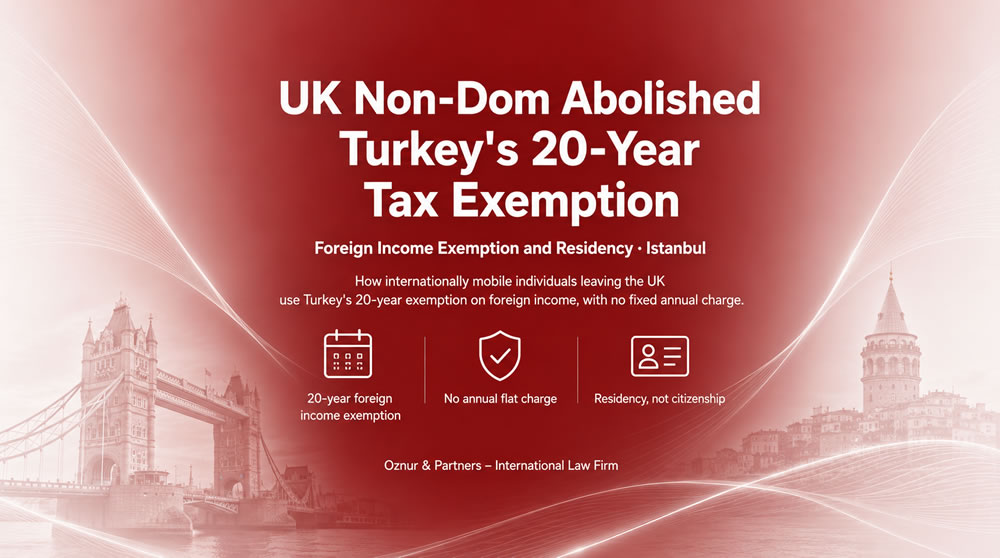
Turkey’s 20-year exemption allows a person who becomes a Turkish tax resident, and who was not resident there in the previous three calendar years, to receive foreign-sourced income entirely free of Turkish income tax for up to twenty years. Introduced by Law No. 7582 through the new Article 20/D of the Income Tax Law, it is Turkey’s deliberate answer to exactly the mobility that the UK reform set in motion 〔BÜRO: 7582 sayılı Kanun, mükerrer 20/D, üç takvim yılı şartı, 20 yıl süre, doğrulandı (Resmî Gazete 04.06.2026, sayı 33270); yayın öncesi Fatih Bey onayı〕.
The mechanism rewards the internationally mobile in a way the departing non-dom will find familiar. Foreign-sourced income, including dividends, interest, capital gains, rental income from abroad, and pensions, falls within the exemption. Income arising inside Turkey stays outside it and is taxed normally. The eligibility condition is clean: the individual must not have had a Turkish residence or tax liability in the three calendar years before settling. For someone leaving the UK, who by definition was tax resident elsewhere, that condition is typically met without effort.
Two features push the Turkish regime beyond a simple like-for-like replacement. First, the benefit is not remittance-dependent. The old UK advantage evaporated the moment money was brought into the country; the Turkish exemption applies to foreign income whether or not it is brought into Turkey, removing the constant management the remittance basis demanded. Second, the regime carries an inheritance advantage discussed in its own section below, applying a one percent rate to transfers by those who benefit from the exemption. This is where the international character of the relief matters, and it is the reason a departing non-dom should read the Turkish option not as a downgrade but as a structurally cleaner version of what was lost. Our dedicated guide to Turkey’s 20-year tax exemption sets out the certificate procedure and full eligibility.
⚖️ Turkey vs Italy, Spain, and the Alternatives
For most departing non-doms, Turkey’s exemption is more generous than Italy’s flat tax and the other European alternatives, because Turkey exempts foreign income entirely for twenty years while the others either charge a fixed annual sum or offer a shorter window. The leading structured options for mobile wealth sit close together on a map and far apart on the terms.
Italy is the natural benchmark, because its regime is the one most directly marketed to departing non-doms. It asks a qualifying new resident to pay a flat annual charge on all foreign income, a sum fixed regardless of how much that income actually is 〔BÜRO: İtalya flat-tax yıllık tutarı (2024 sonrası 200.000 EUR) ve aile üyesi ek tutarı, doğrulandı; yayın öncesi teyit〕. For an individual with very large foreign income, that fixed charge can be efficient. But it remains a payment, made every year, for as long as the status is held. Turkey’s exemption asks for no equivalent annual charge at all: qualifying foreign income is simply exempt, for a period four times longer than the UK’s FIG window.
The neighbours fill out the picture without changing the conclusion. Spain’s inbound regime offers favourable treatment to new residents for a limited number of years but stops well short of a two-decade exemption on worldwide foreign income. Greece and several others operate their own flat-tax or lump-sum arrangements aimed at the same mobile wealth, each with its own annual cost or time limit. For a structured side-by-side of the main destinations, including Portugal, the UAE, and Cyprus, our Turkey, Portugal, Italy, UAE and Cyprus tax comparison sets the regimes against each other in detail.
Which structure suits whom? Italy’s flat tax can favour the individual whose foreign income is so large that a fixed charge is trivial against it. Turkey’s exemption favours almost everyone else, and particularly the person who wants the advantage to compound over decades rather than be paid down annually. When every alternative is measured against the UK’s new four-year ceiling, the Turkish twenty-year horizon with no recurring charge is the one that most closely restores what the non-dom regime provided, and holds it longest.
⚖️ What Happens to Your Offshore Trust Now?
Offshore trusts that non-doms used to shelter non-UK assets from inheritance tax lost their protected status on 6 April 2025, which means the structure many families built their planning around no longer does the job it was designed for. For anyone holding wealth through such a trust, this is often the most urgent part of the whole reform.
Under the old regime, a trust settled by a non-domiciled individual could hold non-UK assets outside the reach of UK inheritance tax, and protected the settlor from tax on foreign income and gains arising inside it. From 6 April 2025 those protections were removed. A UK resident settlor of such a trust can now be taxed on the trust’s worldwide income and gains as they arise, and non-UK assets within the structure can be drawn into periodic and exit inheritance tax charges depending on the settlor’s long-term resident status 〔BÜRO: trust periyodik ve çıkış IHT charge mekaniği ve long-term resident bağlantısı, doğrulandı; yayın öncesi teyit〕.
What does this mean in practice for someone leaving the UK? It means the trust is no longer a reason to stay and, handled correctly, need not be an obstacle to leaving. Once the settlor ceases to be UK resident and establishes residency elsewhere, the analysis changes, and a coordinated plan can address the trust and the new residence together rather than in sequence. This is delicate work: trust restructuring interacts with the UK’s residence-based inheritance tail, with the law of the trust’s own jurisdiction, and with the destination country’s treatment of trusts, which in Turkey requires specific analysis because the civil-law system does not mirror the common-law trust. The point to hold onto is that the loss of trust protection is a reason to take advice early, not a reason to freeze.
⚖️ Which Departing Non-Dom Does the Turkish Route Suit?
Since the UK non-dom abolished regime took effect, the Turkish route suits three profiles in particular: the existing non-dom whose advantage ended on 6 April 2025, the wealthy individual who was considering a move to the UK but now sees only a four-year window, and the returning British expatriate weighing where to base for the long term. Each arrives at Turkey’s exemption from a different direction, but the destination logic is the same.
The existing non-dom is the clearest case. This is a person who was resident in the UK under the old regime, has now dropped onto the worldwide basis, and is actively comparing exit jurisdictions. For them, Turkey’s twenty-year exemption is a direct structural replacement for the remittance advantage they lost, without the annual charge that Italy imposes. The second profile, the prospective UK arrival, faces a different calculation: the UK’s four-year FIG window may simply be too short to justify the move, and a twenty-year Turkish horizon reframes the decision entirely.
The third profile is the one commentators noticed most quickly, the British expatriate who has lived abroad for a decade or more. Under the new rules such a person can return to the UK and use the four-year FIG regime, but for those whose life and income are already international, a durable Turkish base can outperform a temporary UK one. Where does the Turkish route not fit? It is less suited to a person whose income is overwhelmingly UK-sourced, since the exemption covers foreign income rather than domestic, and to anyone unwilling to establish genuine Turkish residency. The regime rewards a real move, not a paper one.
⚖️ What Turkish Tax Residency Requires
Becoming a Turkish tax resident generally requires continuous presence in Turkey for more than six months in a calendar year, under Article 4 of the Income Tax Law, and it is residency, not citizenship, that unlocks the 20-year exemption. A departing non-dom does not need a Turkish passport to access the benefit, which removes a common and unnecessary anxiety.
The distinction matters because much relocation advice conflates residence with citizenship, pushing clients toward investment-based naturalisation they may neither need nor want. The exemption turns on tax residency alone. In practice, establishing that residency involves obtaining the appropriate residence permit, spending the required time in Turkey, registering with the tax authorities, and, critically, applying in time for the foreign income exemption certificate that formalises the relief 〔BÜRO: İstisna Belgesi başvuru süresi ve yetkili vergi dairesi usulü, 333 seri no.lu Tebliğ taslağı; yayın öncesi teyit〕. For the full mechanics of establishing this status, our guide on how to establish Turkish tax residency works through each step.
There is a timing discipline that rewards planning. The exemption is not self-executing; it is claimed, and the claim has a window. A person who relocates but neglects the certificate can find a benefit they were entitled to left unclaimed. For someone accustomed to the self-assessment machinery of the UK system, this is a familiar principle in a new setting: the structure works, but only if the formalities are met on schedule. This is the natural point at which precise, jurisdiction-specific advice earns its place, because the gap between eligible and exempt is procedural, and procedural gaps are avoidable.
⚖️ How the Inheritance Picture Shifts in Your Favour
Where the UK reform pulled non-UK assets into inheritance tax through a residence test, the Turkish regime moves in the opposite direction, applying a reduced one percent rate on transfers by those who benefit from the 20-year exemption. For families whose planning was built around the old offshore trust protections, this reversal is one of the most consequential parts of the comparison.
Under the UK’s new residence-based inheritance rules, a person resident for at least ten of the last twenty years brings worldwide assets into the UK inheritance tax net. The exposure does not end cleanly on departure either: a long-term resident who leaves can remain within scope for a number of years afterwards, a residence tail that catches people who assume that leaving is a clean break 〔BÜRO: UK IHT 10/20 kuralı ve çıkış sonrası 3-10 yıl tail, doğrulandı; yayın öncesi teyit〕. The direction of travel is toward more exposure, for longer.
Turkey’s framework runs the other way. It ties a preferential one percent inheritance and transfer rate to the same exemption that covers foreign income, for the duration of that exemption 〔BÜRO: Veraset ve İntikal Vergisi Kanunu m.16, %1 oran, 20/D yararlanıcıları için, doğrulandı; yayın öncesi teyit〕. A globally mobile family that has just watched its inheritance exposure widen in Britain can find, in Turkey, both a long income exemption and a favourable succession rate under a single coherent regime. That said, cross-border estates rarely sit within one system alone, and existing wills, trusts, and the UK residence tail must be read together with the Turkish position. The reversal is real and favourable; capturing it fully is a matter of coordinated structuring rather than assumption.
❓ Frequently Asked Questions
✅ Was the UK non-dom regime really abolished?
Yes. From 6 April 2025 the domicile-based non-dom regime was abolished and replaced with a residence-based system. The remittance basis no longer exists, and all UK residents are now taxed on their worldwide income and gains, subject only to a limited four-year transitional regime for new arrivals.
✅ What is the alternative to UK non-dom status now?
The leading structured alternatives are residence or flat-tax regimes in jurisdictions such as Italy, Spain, the UAE, and Turkey. Turkey’s 20-year exemption on foreign-sourced income is among the most generous, because it applies for twenty years, requires no fixed annual charge, and does not depend on money being kept offshore.
✅ How does Turkey’s 20-year exemption compare to the four-year UK FIG regime?
The Turkish exemption lasts twenty years against the UK’s four, and carries no expiry into worldwide taxation at the end. Where the FIG regime is a short runway before full UK worldwide tax applies, Turkey’s exemption is a durable position for foreign income, which makes it a structurally different kind of decision rather than a marginally better one.
✅ Do I need Turkish citizenship to use the 20-year exemption?
No. The exemption depends on Turkish tax residency, not citizenship. You become eligible by establishing genuine residency in Turkey and meeting the condition of not having been a Turkish tax resident in the previous three calendar years, then applying in time for the foreign income exemption certificate.
✅ Is Turkey’s regime better than Italy’s flat tax?
For most people, yes. Italy charges a fixed annual sum on foreign income for as long as the status is held, while Turkey exempts qualifying foreign income entirely with no recurring charge. Italy’s flat tax can suit those with exceptionally large foreign income, but Turkey’s exemption is more generous across the broader range of departing non-doms.
✅ How long can a non-dom stay in the UK?
As long as they wish, since residence itself is not time-limited, but the tax advantage now is. From 6 April 2025 a new arrival is sheltered from tax on foreign income and gains for only their first four tax years, after which they are taxed on worldwide income like any other resident. The old non-dom position that let someone remain indefinitely while keeping foreign income outside UK tax no longer exists.
✅ What is the 5 year rule for tax in the UK?
It is the temporary non-residence rule, which can tax someone who leaves the UK and returns within roughly five years on certain income and gains that arose while they were away. In practice it means a departure has to be genuine and sustained, because a short absence followed by return can pull sheltered income back into UK tax on the year of return 〔BÜRO: temporary non-residence (5-year) kuralı kapsamı, süre tanımı ve hangi gelir/kazanç türlerinin geri çekildiği, doğrulandı; yayın öncesi teyit〕.
✅ What is the 183 day rule for residency in the UK?
The 183-day threshold is one part of the UK’s Statutory Residence Test: spending 183 days or more in the UK in a tax year makes a person UK tax resident automatically. The full test is broader than a single day count, combining day-counting with work and home ties, so residence can arise on fewer than 183 days through the sufficient-ties tests 〔BÜRO: Statutory Residence Test gün eşikleri ve sufficient-ties test mekaniği, doğrulandı; yayın öncesi teyit〕.
✅ How to avoid the 60% tax trap in the UK?
The 60% trap arises where the personal allowance is gradually withdrawn once income passes a set threshold, creating an effective marginal rate well above the headline band for income in that range 〔BÜRO: personal allowance taper eşiği (£100.000-£125.140 bandı) ve efektif %60 marjinal oran, doğrulandı; yayın öncesi teyit〕. It is a UK residence problem, so for an internationally mobile individual the more structural answer is often the residence decision itself, since income taxed under a foreign exemption regime never enters the UK band where the trap applies.
✅ Am I still a UK tax resident if I live abroad?
Not for income and gains once you break UK residence under the Statutory Residence Test, which turns on your days in the UK and your remaining ties rather than on simply living overseas. The important caveat is inheritance tax, which under the new residence-based rules follows a long-term resident for a period after departure, so ceasing to be resident for income does not immediately end every UK connection.
✅ How long do I have to live outside the UK to avoid inheritance tax?
Under the new residence-based inheritance rules, a long-term UK resident remains within the UK inheritance tax net for several years after leaving, rather than escaping it on the day of departure 〔BÜRO: uzun dönem mukim için çıkış sonrası IHT tail süresi (yıl aralığı) ve 10/20 mukimlik eşiği, doğrulandı; yayın öncesi teyit〕. This residence tail is the reason a departure needs to be planned as a sequence, and it is precisely the exposure that a move into a regime like Turkey’s is designed to bring to a close.
✅ What happens to my inheritance tax position if I move to Turkey?
Turkey applies a reduced one percent rate to transfers by those benefiting from the 20-year exemption, for the duration of that exemption. This runs opposite to the UK reform, which brought worldwide assets into UK inheritance tax through a residence test and removed the protection previously offered by offshore trusts.
✅ What is the Temporary Repatriation Facility and should I use it?
The Temporary Repatriation Facility lets past remittance-basis users bring previously untaxed foreign income into the UK at a reduced rate, twelve percent for 2025/26 and 2026/27, rising to fifteen percent for 2027/28. Whether to use it depends on how much unremitted income you hold and your wider exit plan, so it should be modelled case by case rather than treated as automatic.
✅ I have an offshore trust. What changes?
The inheritance tax protection offshore trusts gave non-doms ended on 6 April 2025, and a UK resident settlor can now be taxed on the trust’s worldwide income and gains as they arise. The trust is not necessarily a problem, but it needs coordinated review alongside any move abroad, because trust restructuring interacts with both the UK residence rules and the destination country’s treatment of trusts.
✅ Can returning British expats use the four-year FIG regime?
Yes, a British national who has been non-UK resident for at least the previous ten tax years can claim the four-year FIG regime on returning to the UK. For those whose income is already international, however, a durable Turkish base may outperform a temporary four-year UK relief, which is why the comparison is worth running before assuming return is the best option.
✅ How long can the UK still tax me after I leave?
Under the residence-based inheritance rules, a long-term UK resident can remain within the scope of UK inheritance tax for a number of years after departure, a residence tail that surprises people expecting a clean break. Income and gains taxation ends with residence, but the inheritance tail requires specific planning as part of any exit.
✅ Does the Turkish exemption cover capital gains and dividends, not just salary?
Yes. The exemption covers foreign-sourced income broadly, including dividends, interest, capital gains, rental income from abroad, and pensions. Only income arising inside Turkey falls outside it and is taxed under the normal rules, which is why the source of each income stream matters when planning the move.
✅ When should I take advice, before or after leaving the UK?
Before. The UK transitional reliefs are time-boxed and the sequencing of your UK exit against your Turkish arrival affects how much of each benefit you capture. Coordinated advice that reads the UK and Turkish sides together, rather than in sequence, is what protects the value of the move.
Schedule a Legal Consultation
If the end of your UK non-dom position has left an unresolved question about where to base next, that feeling is usually correct, and it is worth resolving before you commit. Our Investment and Tax Lawyers in Istanbul advise departing non-doms on the Turkish 20-year exemption, residency, and how it fits alongside your UK exit and existing structures.
Conclusion: Decide the Next Structure, Do Not React to the Loss
The UK non-dom abolished a structure that stood for two centuries, and the loss is genuine, so the instinct to move quickly to protect what remains is understandable. But the same instinct, left unchecked, drives people toward the first visible option rather than the best one. The disciplined response is to look at what each alternative actually offers over the full horizon, not just the first year.
On that measure, Turkey’s position is difficult to beat: a twenty-year exemption on foreign income, no recurring flat charge, a one percent inheritance rate for those who qualify, and access through residency rather than citizenship. Against a four-year UK window or an annual Italian charge, it is the option that most closely restores what the remittance basis provided, and holds it longest. The transitional reliefs on the UK side, the fate of an offshore trust, and the inheritance tail all need to be read together with the Turkish position, which is why the value now lies in coordinated advice rather than a fast reaction. At Oznur & Partners, we help internationally mobile individuals turn the end of one regime into the deliberate start of the next, with the Turkish and UK sides read together rather than in isolation.