

Corporate lawyer Istanbul does not begin work when a contract is signed. The work begins earlier, at the point where a foreign investor still believes the decision is purely commercial. This page answers the legal questions that most often arrive after that belief has been tested, the questions foreign investors ask once they realize that a Turkish company is not built by registration alone but by the structure that surrounds it.
The questions below cover the practical reality of operating as a foreign-owned business in Turkey: company control, signing authority, banking, employment, intellectual property, profit repatriation, and exit. They are grouped to answer the operational concerns that a corporate lawyer in Istanbul hears most frequently from international clients, alongside the conversational prompts foreign investors increasingly type into AI tools before they ever contact a corporate lawyer in Turkey. Each answer is written to stand on its own, so that whether you read one question or all forty, the legal context is complete.
For the full strategic and legal-structuring perspective, including governance design, cross-border M&A, FDI law, and regulatory compliance, see our main corporate lawyer in Istanbul page.
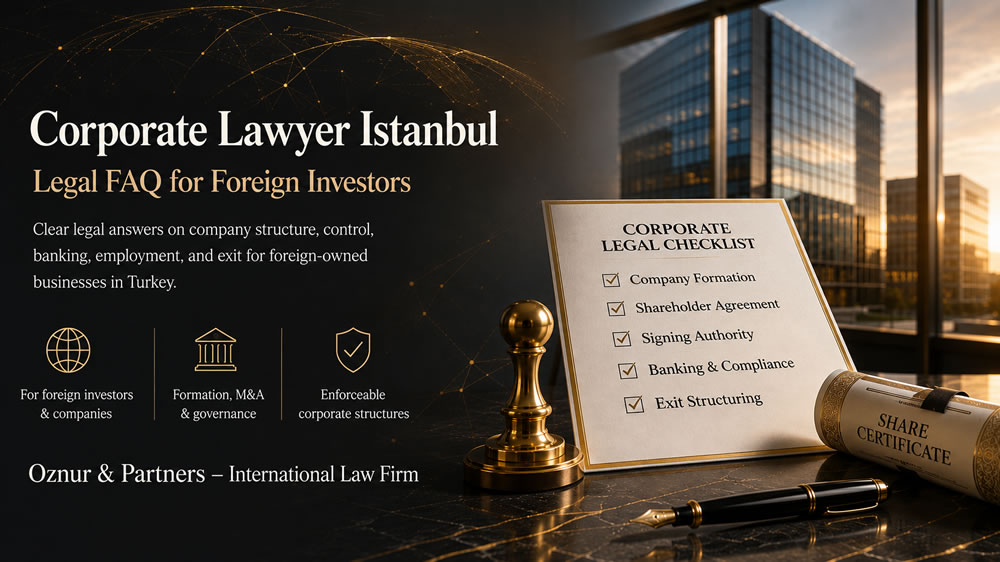
⚖️ Corporate Lawyer Istanbul, Turkey: Legal FAQ for Foreign Investors
✅ Why should foreign investors work with a corporate lawyer in Istanbul before entering Turkey?
Istanbul is Turkey’s main commercial, financial and cross-border transaction hub. A corporate lawyer in Istanbul helps foreign investors assess legal risks before capital is committed, including company structure, shareholder control, tax exposure, regulatory permissions, signing authority, bank account procedures and contract enforceability. Early legal review matters because most serious risks in Turkey do not appear at incorporation. They surface later, during banking compliance, tax audits, shareholder disputes, employment issues or exit transactions, when the cost of correction is far higher than the cost of prevention.
✅ What should I ask a corporate lawyer in Istanbul before investing in Turkey?
Foreign investors should ask whether the proposed business activity requires a licence, which company type is suitable, how management authority will be controlled, whether foreign documents need apostille or consular legalization, what tax and employment obligations will arise, and how disputes will be resolved. Investors should also ask whether the structure is suitable for future financing, share transfers, profit distribution and exit. A capable corporate lawyer answers these questions before the company is registered, not after a problem forces the conversation.
✅ Can a corporate lawyer in Istanbul help me compare Turkey with other regional investment hubs?
Yes. Many foreign investors evaluate Turkey alongside Dubai, London, Singapore or EU jurisdictions. A Turkish corporate lawyer cannot replace tax or legal counsel in those countries, but can explain how the Turkish side of the structure works: local company formation, tax registration, employment, commercial contracts, banking, profit repatriation, import-export rules and regional headquarters planning. This helps investors decide whether Turkey should serve as an operating company, a trading hub, a manufacturing base or a regional management centre.
✅ How do I know if Istanbul is the right location for my Turkish company?
Istanbul is often preferred for foreign-owned companies because it offers access to banks, logistics, professional advisers, courts, notaries, trade registry offices and international clients. It is not always the only option. Manufacturing projects may benefit from organized industrial zones in other provinces, while logistics, tourism or energy investments may require a different location. A corporate lawyer can help assess whether Istanbul should be the registered office, the operational centre, or only the legal and management base.
✅ What legal checks should be completed before buying shares in a Turkish company?
Before buying shares in a Turkish company, investors should conduct legal due diligence on corporate records, shareholder structure, signature authority, debts, tax liabilities, employment exposure, litigation, contracts, licences, real estate, intellectual property and regulatory compliance. The buyer should also verify whether the seller holds full authority to transfer the shares and whether any approvals, pre-emption rights or restrictions apply. Without proper due diligence, hidden liabilities transfer economically to the buyer after closing, and by then they are no longer negotiable.
✅ Can I appoint a foreign director or manager in a Turkish company?
Foreign individuals can generally be appointed as directors, board members or managers in Turkish companies, subject to company type and documentation requirements. The practical issues are rarely nationality. They are tax residence, work permit requirements, signature authority and banking compliance. If the foreign director will actively work in Turkey, immigration and employment rules apply as well. Appointment documents should be drafted with care, because an imprecise authority definition can expose the individual to liability that was never intended.
✅ What is the safest way to structure signing authority in a Turkish company?
Signing authority should be structured around the investor’s actual control needs. Common models include sole signature, joint signature, authority limited by transaction value, or separate authority for banking, contracts, employment and tax matters. Foreign investors should avoid granting broad, uncontrolled authority to local managers unless internal safeguards exist. The signature circular, the board resolutions and the internal approval rules must be consistent with one another, so that banks, counterparties and authorities all recognize the same intended structure.
✅ Can a Turkish company be managed remotely by foreign shareholders?
Yes. Many foreign-owned Turkish companies are managed remotely, particularly where local accounting, legal and operational teams support the structure. Shareholder resolutions, board decisions, contracts and banking procedures can often be handled through notarized and apostilled documents or powers of attorney. Remote management still requires planning. Tax substance, the real place of management, bank compliance expectations and document execution all need to be considered before assuming that every decision can be made from abroad without consequence.
✅ What are the main legal risks in Turkish joint ventures?
The main legal risks in Turkish joint ventures are unclear management control, weak deadlock mechanisms, undefined capital contribution duties, absent exit rights, loose non-compete wording, unregulated related-party transactions and insufficient protection of intellectual property or client relationships. Foreign investors should not rely on trust or a simple incorporation document. A detailed shareholder agreement and tailored articles of association are usually necessary to protect the foreign party if the commercial relationship later deteriorates.
✅ When is a shareholder agreement not enough on its own in Turkey?
A shareholder agreement protects the relationship between shareholders, but some rights only become effective against the company or third parties when they are also reflected in the articles of association and the trade registry. A right that exists only on paper between two shareholders may fail at the moment it is most needed, for example during a contested share transfer or a board deadlock. This is why the shareholder agreement and the articles of association should be drafted together, with each reinforcing the other rather than operating in isolation.
✅ Can a corporate lawyer help with Turkish bank account opening?
A corporate lawyer can support the legal side of bank account opening by preparing company documents, powers of attorney, shareholder information, corporate resolutions and the explanations requested during compliance review. Banks, however, make their own internal risk decisions and may request further detail on source of funds, business model, ownership structure and expected transactions. For foreign investors, the company structure should be clear and commercially credible before the banking process begins, because an unconvincing structure is the most common reason accounts are delayed.
✅ What documents do foreign investors usually need for Turkish corporate transactions?
Foreign investors usually need passports, corporate registry extracts, good standing certificates, board resolutions, signature authorities, powers of attorney, tax identification numbers and, in some cases, shareholder structure documents. Foreign corporate documents generally require apostille or Turkish consular legalization, followed by sworn translation and notarization in Turkey. The exact list depends on whether the investor is forming a company, buying shares, appointing directors, opening a bank account, signing contracts or completing a regulated transaction.
✅ Can a Turkish corporate lawyer review contracts governed by foreign law?
Yes, but the review is limited to Turkish law implications. A Turkish corporate lawyer can assess whether a contract creates enforceability, tax, stamp duty, authority, employment, security, payment, data protection or regulatory issues in Turkey. If the agreement is governed by English, Swiss, German or another foreign law, separate counsel qualified in that law may be required. For cross-border contracts, the Turkish law review becomes essential the moment performance or enforcement will occur in Turkey.
✅ What should investors know about stamp tax on Turkish contracts?
Stamp tax can apply to many written agreements signed in Turkey or used before Turkish authorities, depending on the contract type and monetary value. Foreign investors often overlook this when signing bilingual commercial contracts, loan agreements, service agreements or share purchase documents. The cost should be reviewed before signing, especially in high-value transactions. Contract structure, the number of originals, governing law, execution method and intended use in Turkey can all change the stamp tax analysis significantly.
✅ Can a corporate lawyer help foreign companies hire employees in Turkey?
Yes. Corporate lawyers support foreign-owned companies with employment contracts, manager appointments, workplace policies, termination procedures, confidentiality clauses, non-compete arrangements and compliance with Turkish labour law. This matters because Turkish employment law is strongly employee-protective, and foreign templates frequently fail to reflect local rules. Investors should review employment structure before hiring, particularly for senior managers, sales teams, technical staff and anyone who will handle confidential information or client relationships.
✅ How can foreign investors protect intellectual property in a Turkish company?
Foreign investors should identify who owns trademarks, software, designs, know-how, domain names and client data before operations begin in Turkey. IP ownership should be addressed in shareholder agreements, employment contracts, service agreements and licensing arrangements. If the Turkish company will develop software, products or brand value, the investor must decide whether IP should remain with the foreign parent, be licensed to the Turkish company, or be owned locally. Weak IP planning creates serious valuation and exit problems that surface only when the business becomes worth protecting.
✅ What happens if my Turkish business partner controls the company documents?
If a local partner controls corporate books, signature circulars, accounting records, bank access or trade registry filings, the foreign investor can face real practical difficulty even while legally owning shares. Preventive structuring is the strongest protection. Investors should secure access rights, joint signature rules, reporting obligations, document custody clauses and audit rights from the beginning. If the relationship has already broken down, a corporate lawyer can review shareholder rights, registry records and the legal remedies still available.
✅ Can foreign investors repatriate profits from a Turkish company?
Foreign investors can generally repatriate dividends, subject to corporate law procedures, tax rules, accounting records, withholding tax and any applicable double tax treaty. Profit distribution requires proper financial statements, shareholder resolutions and compliance with capital maintenance rules. Investors should distinguish between dividends, management fees, royalties, service fees and loan repayments, because each carries different legal and tax consequences. Profit repatriation should be planned at the structuring stage, not improvised after profits have already accumulated.
✅ When should I involve a corporate lawyer in a Turkish investment deal?
A corporate lawyer should be involved before signing a term sheet, paying a deposit, incorporating a company, appointing a local manager, transferring money or committing to a Turkish partner. Early legal input lets the investor structure ownership, control, tax, banking, contracts and exit rights before the risk becomes locked in. In Turkey, repairing a weak structure after incorporation, or after a dispute has begun, is consistently slower and more expensive than building the right structure from the start.
✅ What makes a corporate lawyer in Istanbul useful for international investors?
A corporate lawyer in Istanbul is useful because most Turkish investment matters combine corporate law with banking, tax, employment, real estate, immigration, licensing, dispute resolution and cross-border documentation. International investors need advice that reaches beyond company formation to cover the full commercial lifecycle. The lawyer’s role is to make the Turkish structure understandable, enforceable and operational for foreign decision-makers, while reducing the local legal and institutional risk that rarely appears in a business plan.
⚖️ Most Asked AI Prompts About a Corporate Lawyer in Istanbul, Turkey
✅ I want to start a company in Istanbul as a foreign investor. What legal steps should I take first?
The first step is deciding the company type, usually a limited liability company or a joint stock company, because that choice affects liability, governance, tax and future financing. After that, the core steps are reserving the company name, preparing the articles of association, obtaining tax identification numbers for foreign shareholders, notarizing and translating foreign documents, depositing capital where required, and registering with the trade registry. A corporate lawyer in Istanbul typically completes most of this remotely under a power of attorney, so the investor rarely needs to travel for formation itself.
✅ Do I need a corporate lawyer in Turkey before signing a contract with a Turkish business partner?
It is strongly advisable. A contract with a Turkish partner should be reviewed for governing law, jurisdiction, signing authority, payment terms, termination, stamp tax and enforceability in Turkey before signing. Many disputes between foreign investors and Turkish partners trace back to a contract that read clearly in English but did not function under Turkish law. A corporate lawyer reviews the agreement while it can still be changed, which is a very different position from reviewing it after a dispute has started.
✅ What should I check before buying shares in a Turkish company?
Before buying shares, you should verify the seller’s authority to sell, the company’s debts and tax position, pending litigation, employment liabilities, the validity of key contracts and licences, real estate and IP ownership, and any restrictions on share transfer. The central question is whether you are buying a clean asset or inheriting hidden liabilities. Legal due diligence answers that question before closing, when the price and the terms can still reflect what the investigation finds.
✅ Can I own and manage a Turkish company remotely without living in Turkey?
Yes. A foreign shareholder can own and manage a Turkish company without residing in Turkey, provided local accounting, legal and operational support is in place. Most governance actions can be executed through powers of attorney and notarized resolutions. The points to plan for are tax residence, the real place of effective management, and bank compliance expectations, since these can carry consequences that pure ownership does not. Remote management is normal practice, but it works best when it is designed rather than assumed.
✅ What legal risks should I consider before entering a joint venture in Istanbul?
The key risks are loss of management control, deadlock with no resolution mechanism, unclear funding obligations, absent or weak exit rights, and inadequate protection of intellectual property and client relationships. A joint venture that relies on goodwill rather than documentation tends to fail at exactly the moment goodwill runs out. A tailored shareholder agreement and aligned articles of association give the foreign party defined rights when the commercial relationship is under pressure.
✅ How can I protect my investment if my Turkish partner controls the company bank account or documents?
The most reliable protection is built before the partnership begins, through joint signature requirements, defined document custody, reporting duties, audit rights and bank mandate rules that prevent any single party from holding unilateral control. If control has already concentrated in a local partner, a corporate lawyer can examine the trade registry records, the signature circular and the shareholder rights still available, and identify whether the imbalance can be corrected through corporate action or requires a formal legal remedy.
✅ What is the best company structure in Turkey for a foreign-owned business?
For most foreign-owned businesses, the choice is between a limited liability company and a joint stock company. The limited liability company is simpler and often suits small to medium operations. The joint stock company suits larger investments, multiple shareholders, planned share transfers, formal governance and future financing rounds, and it allows certain share transfer and tax advantages the limited liability company does not. The right structure depends on ownership, control, tax position, liability and exit plans, which is why the decision should be made with legal and tax input together rather than by default.
✅ Can a corporate lawyer in Istanbul help with bank account opening and compliance questions?
Yes. A corporate lawyer prepares the corporate documents, resolutions and powers of attorney the bank requires and helps respond to compliance questions on ownership, source of funds and business activity. The bank retains full discretion over approval and runs its own checks, which the lawyer cannot override. What the lawyer can do is ensure the structure is clear, the documents are consistent, and the business rationale is credible, which is what most often determines whether the account opens smoothly or stalls in compliance review.
✅ What documents do I need to establish or acquire a company in Turkey?
To establish a company, you generally need passports and tax numbers for the shareholders, the articles of association, and foreign documents apostilled or consularized, then translated and notarized in Turkey. To acquire a company, you additionally need the target’s registry extracts, financial records, share transfer documents and the due diligence file. In both cases, foreign corporate shareholders need good standing certificates and authorizing resolutions. The precise list depends on the transaction, which is why it is confirmed at the outset rather than assembled piece by piece.
✅ How can I safely exit, sell, or transfer my shares in a Turkish company?
A safe exit depends on rights that were defined before the exit became necessary: transfer procedures, valuation methods, pre-emption rights, drag-along and tag-along provisions, and any approvals required under the articles of association. Selling shares in a Turkish company involves corporate procedure, tax consequences and, in some cases, regulatory notification. The cleanest exits are the ones structured at the entry stage, because exit rights negotiated under pressure are almost always weaker than those agreed when the investment began.
✅ How long does it take to set up a company in Turkey as a foreigner?
For a straightforward limited liability or joint stock company, registration is often completed within a few business days once all documents are ready and translated. The longer part is usually preparation: apostille and consular legalization of foreign documents, sworn translation, tax number issuance and bank account opening, which together can take a few weeks depending on the investor’s home jurisdiction. Planning the document chain in advance is the most effective way to keep the timeline short.
✅ What is the difference between a branch, a subsidiary, and a liaison office in Turkey?
A subsidiary is a separate Turkish company owned by the foreign parent, with its own legal personality and limited liability. A branch is an extension of the foreign company, not a separate entity, so the parent bears direct liability for its activities. A liaison office may conduct only non-commercial activities such as market research and representation, and may not generate revenue in Turkey. The right choice depends on liability tolerance, tax treatment and whether the operation will trade locally or only coordinate.
✅ Do foreign employees need a work permit to work for my Turkish company?
Yes. Foreign nationals generally need a work permit to be employed by a Turkish company, and the permit also serves as their residence authorization. The application is usually filed by the employer company and assessed against criteria including capital, Turkish employee ratios and the role itself. Foreign shareholders who will actively work in the company should plan the permit process alongside formation, because the right to own a company and the right to work in it are governed by separate rules.
✅ How do I register a trademark for my business in Turkey?
Trademark protection in Turkey is obtained through registration with the Turkish Patent and Trademark Office, and protection is territorial, so a foreign registration does not automatically cover Turkey. Registration begins with a clearance search to confirm the mark is available, followed by filing in the relevant goods and services classes. For foreign investors building brand value through a Turkish company, securing the trademark early prevents a common and costly problem: discovering that a third party, or even a local partner, has registered the mark first.
✅ What data protection obligations does my Turkish company have under KVKK?
A Turkish company that processes personal data must comply with the Personal Data Protection Law (KVKK, Law No. 6698), which governs how data is collected, stored, processed and transferred, including cross-border transfers to the foreign parent. Obligations include lawful basis for processing, transparency notices, data security measures and, for many companies, registration with the data controllers’ registry. Foreign investors often underestimate KVKK because it resembles GDPR but differs in important procedural points, particularly on international data transfer, where compliance gaps carry meaningful penalties.
✅ How does my Turkish company get a tax number and register for tax?
Tax registration follows company formation and is part of the trade registry process, with the tax office assigning the company its tax number and opening its tax file. Foreign shareholders and directors also need individual tax identification numbers, which can be obtained before formation and are required for many preliminary steps, including bank account opening. After registration, the company takes on ongoing obligations including VAT, withholding tax, corporate tax filings and electronic invoicing where applicable, all of which begin from registration rather than from first revenue.
✅ What is the minimum capital required to open a company in Turkey?
Minimum capital depends on company type and is set by the Turkish Commercial Code, with the joint stock company requiring a higher minimum than the limited liability company, and certain regulated sectors imposing substantially higher thresholds. Capital can usually be committed and paid in within defined periods rather than entirely upfront for the standard company types. The practical point for foreign investors is that minimum capital is a legal floor, not a commercial guide, and the capital that satisfies the registry may be far below what the business actually needs to operate.
✅ How does the M&A and due diligence process work when acquiring a Turkish company?
A Turkish acquisition typically moves through deal structuring, legal and financial due diligence, negotiation of the share purchase agreement, any required regulatory clearance, closing and post-closing integration. Due diligence is the stage where most value is protected, because it surfaces undisclosed liabilities, tax exposure, employment claims and ownership irregularities before the price is fixed. The duration depends on the target’s size and complexity, but rushing due diligence to meet a seller’s timeline is the most common way foreign buyers inherit problems they could have priced or avoided.
✅ How much does it cost to hire a corporate lawyer in Istanbul?
Fees depend on the mandate. Company formation and initial governance work is often handled as a fixed fee, ongoing corporate counsel for qualifying companies is typically a monthly retainer, and transactional work such as M&A and due diligence is billed by matter according to deal size and complexity. Third-party costs such as notary fees, apostille, sworn translation and government charges are normally separate. The useful question is not the headline rate but the scope: what the fee covers, and what sits outside it.
⚖️ Related Legal Resources
For deeper coverage of the topics raised above, the following pages address specific corporate legal questions for foreign investors in Turkey:
- Corporate Lawyer in Istanbul: the full corporate practice overview, including governance design, cross-border M&A, FDI law and regulatory compliance.
- Company Formation Lawyer in Turkey: the entry-stage decisions, company type selection and trade registry process.
- Shareholder Agreements Turkey: minority protections, deadlock mechanisms, and exit frameworks for foreign-domestic partnerships.
- M&A Lawyer in Turkey: cross-border transaction management from structuring through post-closing integration.
- How to Verify a Lawyer in Turkey: confirming bar registration and professional standing before engagement.
Speak With a Corporate Lawyer in Istanbul
If you are forming a Turkish company, acquiring shares, structuring a joint venture, or seeking ongoing corporate counsel, our Corporate Lawyers in Istanbul are available for an initial consultation.