

⚖️ Family Rights with BES Citizenship: Who One Pension Contribution Covers
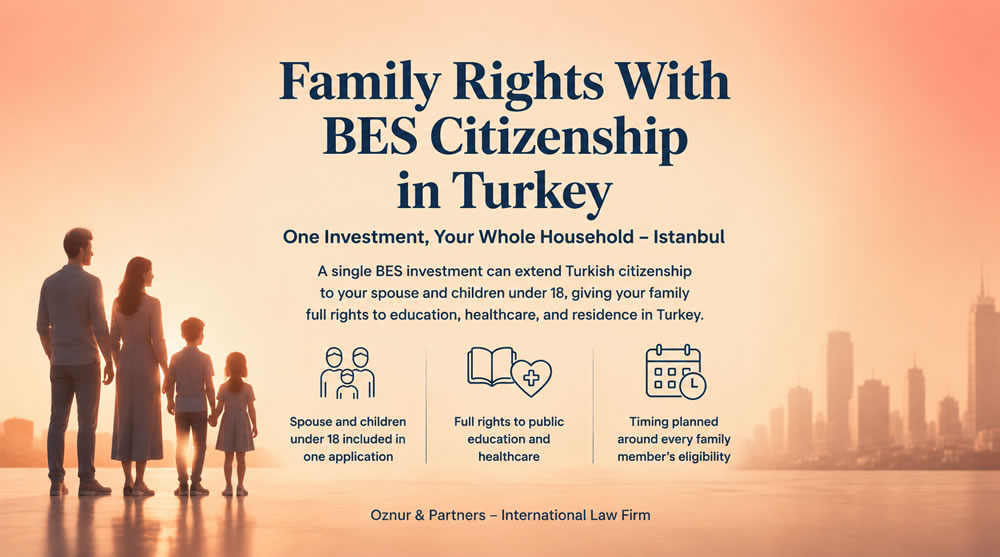
Family rights with BES citizenship let one USD 500,000 pension contribution extend Turkish citizenship to the investor’s spouse and both spouses’ minor children.
The rule is written into the statute, not left to practice. Article 12(1)(b) of Turkish Citizenship Law No. 5901 names the investor’s foreign spouse and the minor or dependent foreign child of the investor and of the spouse as persons who may acquire citizenship with the investor. The private pension route in Article 20(2)(f) of the Implementing Regulation feeds straight into that provision. There is no second contribution and no per-person top-up.
What the statute does not do is tell a family where its edges sit in practice. Those edges are drawn by administrative practice, by a consent rule most families have never heard of, and by a three-year condition that keeps running after the passports arrive. For a household with a sixteen- or seventeen-year-old, or with a child from an earlier marriage, the edges decide the outcome more than the investment does.
What exactly does one BES contribution cover? The investor, the investor’s foreign spouse, the investor’s minor children, the spouse’s minor children from an earlier relationship, and any child of either spouse who is legally dependent. Stepchildren are covered by the words of the statute itself, not by discretion.
That is the generous side of the provision. The rigid side is time.
When does a child stop qualifying? The age limit is a deadline without a date printed on it. Current practice of the General Directorate of Civil Registration and Citizenship measures minority on the day the citizenship decision is issued, so a child who is seventeen on filing day and eighteen on decision day can fall outside the grant, however early the pension contract was signed.
The boundary is equally firm in the other direction, and it surprises families from cultures where three generations share one household.
Who cannot be brought into the file, however close the relationship? Parents. A financially dependent mother or father has no route into the citizenship application, and the family residence permit under Article 34 of Law No. 6458 does not reach them either. Parents who want to live in Turkey need a residence permit on a ground of their own, such as one of the short-term permit categories in Article 31.
The last edge is the one families think about least, because it only matters after everything has gone right.
How can one early withdrawal reach the entire household? The contribution that brings the family into Turkish citizenship is also the one asset that can take it away from all of them at once. The Directorate’s published procedure treats failure to keep the investment for the full three years as grounds for cancelling the grant under Article 31 of Law No. 5901, and Article 32 applies a cancellation to the spouse and children who acquired citizenship through the investor.
As an Istanbul law firm handling BES citizenship files, Oznur & Partners fixes two things before the first transfer: the date by which a decision must be issued for every child in the household, and the consent documents that any child from an earlier relationship will need. Those are the two variables a family can still control.
⚖️ Who Does One BES Contribution Cover?
One qualifying BES contribution covers the investor, the investor’s foreign spouse, and every minor or dependent foreign child of either spouse, all in a single citizenship file. The investment is made once; the personal documents are filed per person.
The qualifying condition sits in Article 20(2)(f) of the Regulation on the Implementation of the Turkish Citizenship Law: a contribution of at least USD 500,000 or its foreign-currency equivalent, held in funds whose scope is set by the Insurance and Private Pension Regulation and Supervision Authority (SEDDK), with a commitment to remain in the private pension system (BES) for three years, as determined by SEDDK. The family provision then comes from the statute, not from the pension contract.
The spouse is a named applicant, not an automatic beneficiary. Article 20(2) of Law No. 5901 states that acquiring citizenship by decision does not affect the spouse’s nationality. The spouse therefore enters the same file as an applicant in their own right, with their own identity and civil status documents, and receives citizenship on identical terms to the investor.
Stepchildren are inside the provision. The statutory wording covers the minor children of the investor and of the spouse. A child from the spouse’s earlier marriage is included on the same footing as a child of the couple (a point that most summaries of the programme leave out, and that families with blended households tend to ask about last rather than first).
Dependent adult children are covered by a term the law never defines. The statute says “dependent”, not “disabled”, and legal scholarship has noted that no official text explains what the word means. Many guides narrow it to children with a disability; the law itself does not. In practice an adult child is included only after an individual assessment of documented dependency, and the official application form’s child section is built around minor children, so an adult dependent requires deliberate preparation rather than a line on the form.
The BES family provision does not cover parents, siblings, in-laws, or adult children who are not dependent. A household member outside that list needs a qualifying investment of their own or a residence-based route, and no amount of financial dependency changes the answer.
⚖️ Why Does a Child’s Eighteenth Birthday Matter More Than the Contract Date?
A child is included only if still a minor on the day the citizenship decision is issued, which makes the decision date, not the contract date or the filing date, the one that governs a teenager’s place in the file.
Law No. 5901 does not say on which date minority is measured. For several years the administration read the silence in the family’s favour: a child who was a minor when the parents applied could acquire citizenship through the parents’ file. The General Directorate later ended that practice without any change to the legislation, and began refusing children who had reached eighteen by the time the parents’ application was concluded. Administrative courts first ruled for the families; the Ankara Regional Administrative Court, which decides these cases with final effect, then changed course in 2025 and upheld the administration.
The practical result is blunt. A family can sign the pension contract when a child is sixteen, file when the child is seventeen, and still lose that child from the grant if the decision is issued a week after the eighteenth birthday. Nothing in the investment was wrong; the calendar was.
Is the pension route a better fit than property for a family with a seventeen-year-old? Often it is, because the BES route has fewer steps between the transfer and the decision. There is no licensed valuation report to commission and no title deed annotation to register. The sequence runs from the contribution into an eligible fund, to SEDDK’s confirmation that the investment qualifies, to the short-term residence permit that Article 31(1)(j) of Law No. 6458 grants to the investor and the same family members, and then to the citizenship file. Once that file is complete, the citizenship stage typically takes three to six months. The decision itself remains the Ministry’s, and no route removes that variable; what the pension route removes is the property-specific preparation that sits in front of it (compare the steps for citizenship through real estate investment).
The planning rule follows from the practice. Where a child’s eighteenth birthday falls inside the months a complete file needs to reach a decision, every personal document for that child should be ready before the contribution is transferred, so that no week of the remaining margin is spent collecting apostilles. Once the decision is issued, a later birthday no longer matters: Article 20(1) makes the acquisition effective from the decision date.
Is a child in your household sixteen or seventeen today? Check the decision date first
Our citizenship team maps each child’s eighteenth birthday against the realistic decision date before any funds move into the pension system.
⚖️ Children From a Previous Marriage: The Consent a BES File Cannot Skip
A child who is under the custody of one parent acquires Turkish citizenship with that parent only if the other parent consents; if consent is refused, Article 20(2) of Law No. 5901 sends the question to a court in the country where the parent has their habitual residence.
The rule is not a formality buried in the statute. The official application form for exceptional acquisition, form Vat-4 issued by the General Directorate, lists the consent as a required document: a declaration by the other parent, made before a notary or authorised officer in Turkey, or before a Turkish consulate or the competent authorities abroad, together with a certified Turkish translation where it is not issued in Turkish.
The consent matters in exactly the households the family provision is designed to help. An investor with a child from a first marriage, or a spouse bringing children from an earlier relationship into the file, needs the signature of someone who is not a party to the investment and may not be cooperative. Where the child’s two parents are the investor and the spouse and both apply together, the statute resolves the point by itself: children of parents who acquire citizenship together acquire it with them.
Timing turns this into a strategic question. A refusal does not stop the pension contract, and it does not pause the child’s birthday. A court decision abroad can take longer than the entire BES process, so the consent is requested and, where necessary, contested before the contribution is made rather than after the file is otherwise complete. For a teenager close to eighteen, a late refusal can close the door on its own.
⚖️ The Three-Year System Term Continues After the Family Becomes Turkish
The three-year BES condition keeps running after citizenship is granted. Article 20(2)(f) of the Implementing Regulation ties the route to remaining in the private pension system for three years, and that period is measured from entry into the system, not from the citizenship decision.
A citizenship decision on a complete BES file usually arrives within months, while the three-year pension term is measured in years. A family therefore typically holds Turkish passports while most of the BES term is still running. The citizenship decision does not shorten the term, and receiving a passport does not release the contribution.
The General Directorate’s published procedure on exceptional acquisition by foreign investors states that investors must continue to meet the investment conditions for the full three years, and that a failure to do so leads to cancellation of the citizenship decision under Article 31 of Law No. 5901. Legal scholarship questions whether Article 31, which speaks of false statements and concealment, can carry that reading. A family planning its liquidity should nonetheless plan on the administration’s position rather than on the academic debate.
If the BES contribution leaves the system before three years, the exposure is not the investor’s alone. Article 32 of Law No. 5901 applies a cancellation decision to the spouse and children who acquired Turkish citizenship through the investor. One withdrawal decision can therefore reach every person named in the family file.
Two groups stand outside that exposure. Under Article 58(2) of the Implementing Regulation, children born after the investor became a Turkish citizen, and a spouse who later acquired citizenship through the separate marriage route, are not affected by a cancellation of the investor’s grant. A child born to a Turkish citizen parent within marriage is a citizen by descent under Article 7 of Law No. 5901, independent of the pension file.
Cancellation and loss are different mechanisms with different family effects. Loss of citizenship under Article 29 of Law No. 5901, which concerns specific acts such as unauthorised service to a foreign state, is personal and under Article 30 does not affect the spouse or children. Cancellation under Article 31 is derivative and does. The full grounds are set out in our guide on whether Turkish citizenship can be revoked after approval.
⚖️ How Each Family Member Enters a BES File: Basis, Documents and Risk Point
Each family member enters a BES citizenship file on a specific legal basis and carries a specific failure point. The table below sets out the seven household positions that come up most often in BES family files, from the spouse and the couple’s own children to the positions that most often go wrong: stepchildren, children of an earlier marriage, adult dependants and parents.
| Family member | Legal basis | Key document beyond identity papers | Typical failure point |
|---|---|---|---|
| Foreign spouse | Law No. 5901, Art. 12(1)(b); Art. 20(2) | Marriage certificate, apostilled or legalised, with certified Turkish translation | Name or transliteration differences between passport and marriage record |
| Minor child of the investor and the spouse | Art. 12(1)(b); Art. 20(2), children of parents acquiring together | Birth certificate showing both parents | Child turns 18 before the decision is issued |
| Spouse’s minor child from an earlier relationship | Art. 12(1)(b), “of the investor and of the spouse” | Birth certificate and the other biological parent’s notarised consent | Consent missing or refused |
| Investor’s minor child from an earlier marriage | Art. 20(2), consent rule | Custody document and the other parent’s consent, or a court decision | Court process abroad outlasts the child’s minority |
| Dependent adult child | Art. 12(1)(b), “dependent” | Evidence of dependency, individually assessed | No statutory definition of dependency |
| Child born after the grant | Art. 7, citizenship by descent | Birth registration with the Turkish civil registry | None from the BES file; unaffected by a later cancellation (Reg. Art. 58(2)) |
| Parents of the investor or spouse | Not covered by Art. 12(1)(b) | Residence permit on an independent ground | Assumed eligible; not covered by the family residence permit either |
The investment evidence in a BES family file is filed once: the pension contract, the transfer records and SEDDK’s confirmation. Every other document is filed per person, and each person’s documents must agree with the others on names, dates and parentage. The complete list, including the certification and translation standard each document has to meet, is on our page covering the documents required for a BES citizenship application.
⚖️ Participatory BES and Family Inclusion
Choosing a participation-based pension plan changes the structure of the investor’s funds, not the family provision. A household that needs its USD 500,000 contribution to follow Islamic finance principles includes the same spouse and the same minor or dependent children under Article 12(1)(b) as a household in a conventional plan.
The one condition the fund choice must satisfy is the Regulation’s requirement that the contribution be held in funds within the scope set by SEDDK for the full three years. A participatory plan that sits inside that scope qualifies on the same terms; a plan outside it does not qualify for anyone in the family. The structural differences are set out in our comparison of the Citizenship BES Plan and the Participatory Citizenship BES Plan, and the treatment of contributions and withdrawals is covered in our note on the tax position of BES citizenship.
⚖️ Related Legal Resources
- Turkish Citizenship Opportunity with a BES Plan: the full conditions of the pension route, including the USD 500,000 contribution, the SEDDK fund scope and the three-year term in the system.
- Why You Need a Lawyer for Turkish Citizenship via BES: fund scope verification before the first transfer and exit-calendar management across the three years.
- Turkish Citizenship Law Firm: how our Istanbul team coordinates the investment, the residence permit and the citizenship file under Article 12 of Law No. 5901.
The statutory texts referred to on this page can be verified in Turkey’s official legislation database at mevzuat.gov.tr.
Plan Your Family’s BES Citizenship File
Whether a child is approaching eighteen, a stepchild needs the other parent’s consent, or the three-year term has to fit your liquidity plans, our Istanbul citizenship lawyers review the whole household before the first transfer.
⚖️ Conclusion: One Contribution, Three Dates
A BES family file turns on three dates, and only one of them is chosen by the family. The contract date opens the process. The decision date decides which children are inside it. The end of the three-year term decides whether everyone stays inside it.
The family provision itself is wide and written in plain statutory language: the spouse, the children of both spouses, and dependent children, on one contribution. What narrows it is practice, consent and calendar. A family that fixes the decision date against each child’s birthday, secures every consent before the transfer, and treats the three-year term as a commitment that outlives the passports, has done the work that the statute leaves to the family. That work is the difference between a household that becomes Turkish together and one that discovers, months later, who was left outside.