

A frozen bank account in Turkey is a restriction placed on an account holder’s ability to use their funds, imposed either by the bank itself under its compliance obligations or by an administrative, judicial or enforcement authority. It is not a confiscation, and it is not a criminal charge.
What makes the situation disorienting is rarely the restriction. It is the silence around it. The branch says it is a system issue, the call centre says compliance decided, and nobody says which authority made the decision, under which provision, or for how long. That silence is not poor service. Turkish law prohibits obliged institutions from disclosing the existence of a suspicious transaction report to the customer during the investigation, so the bank’s inability to explain is itself a legal duty.
Foreign account holders arriving at this situation for the first time tend to ask the same questions, and the answers determine every step that follows.
What does a frozen account actually mean in Turkish law? It is not one situation but five. The restriction may come from the bank’s own compliance decision, from an administrative suspension under anti-money-laundering legislation, from a seizure ordered by a criminal judgeship after the file reaches the prosecutor, from a tax authority attachment over unpaid tax debt, or from an enforcement attachment obtained by a creditor. These are separate legal instruments with separate remedies.
Who has the power to lift it? In most cases not the bank. The bank is executing a decision made elsewhere, which means pressing the branch does not change the outcome and spends the days that matter most.
How is the type identified? From written documentation, not from verbal explanation. The account holder is entitled to ask the bank for a written statement identifying the formal basis of the restriction and the relevant reference. That document determines whether an objection belongs before a criminal judgeship, an administrative authority, a tax appeal route, or an enforcement court.
When should counsel be involved? Before any written explanation is submitted. A source-of-funds statement becomes part of the file permanently and cannot be withdrawn or rewritten. In practice, a significant share of difficult cases became difficult because of the first statement the account holder submitted alone.
Oznur & Partners is an international law firm in Istanbul acting for foreign investors, expatriates and international companies in Turkish bank account restrictions, anti-money-laundering compliance reviews, blocked transfers and enforcement attachments. This page sets out how the five categories are distinguished and what remedy attaches to each.
⚖️ Why Do Turkish Banks Restrict Accounts Without Explaining?
Because Turkish banks are not simply financial intermediaries. Under Law No. 5549 on the Prevention of Laundering Proceeds of Crime, they are obliged institutions carrying mandatory reporting duties to MASAK, the Financial Crimes Investigation Board operating under the Ministry of Treasury and Finance. Where a transaction cannot be reconciled with a documented commercial or legal explanation, the bank is required to act, and required not to explain why.
The triggers cluster into a small number of recurring patterns.
Incoming transfers without supporting documentation. A large wire arriving without a contract, invoice or customs declaration already on file with the bank. The most common single trigger is a mismatch between the name of the remitter and the name of the contracting party, which appears in the compliance system as an unclear payment chain rather than as a routine commercial receipt.
Crypto-asset exposure. Movements between Turkish accounts and virtual asset service providers without documented source of funds. The difficulty here is frequently not the account holder’s own conduct but the counterparty’s, which is addressed separately below.
Multi-jurisdictional routing. Funds moving through several corporate entities in different countries without a demonstrable economic purpose at each stage. Group treasury structures that are entirely ordinary in the home jurisdiction can appear structurally opaque when examined from Turkey without the underlying agreements.
Incomplete beneficial ownership records. Failure to file updated ownership declarations or trade registry documents during periodic customer due diligence reviews. For foreign-owned corporate accounts this is the most frequent administrative trigger, and it carries no suspicion of wrongdoing at all, which is why it is also the fastest to resolve.
Sanctions screening. Incoming transfers connected to sanctioned jurisdictions or counterparties, even where the account holder has no sanctions exposure. Correspondent banks apply their own screening rules, so a transfer can be held upstream, before it ever reaches the Turkish institution.
Property and investment transfers. Large incoming funds linked to real estate acquisition, where the documentary chain between the foreign source and the Turkish purchase has a gap. A common break point is that the remitter is a family member while the buyer is the account holder, with no written explanation of the relationship between the two.
One characteristic of these reviews surprises most account holders. The transaction that triggered the review is not necessarily recent. Turkish compliance reviews examine the documented history of the account rather than only the flagged item, which explains why a modest routine transfer can produce questions about a transfer made three years earlier.
⚖️ What Should You Do in the First Days?
Obtain written documentation, and do not explain yourself before you know what you are answering. Any statement made before the legal character of the restriction is established can convert an administrative matter into a criminal one.
Four steps, in this order.
Ask the bank for a written statement. Request from the branch or the compliance department a written document identifying the formal basis of the restriction and the transaction reference. A verbal explanation has no evidential value and cannot support an objection. The bank will not disclose the content of a suspicious transaction report, but the existence and formal basis of a restriction is a different matter from the content of a report.
Stop repeating the transaction. Do not attempt the same transfer through a different branch, a related company account, or in smaller instalments. Monitoring systems treat this pattern as structuring, the risk profile is raised immediately, and a matter that might have been resolved at bank level moves toward a criminal track. This is the single most damaging avoidable error.
Assemble the source-of-funds chain. Contracts, invoices, customs declarations, bills of lading, statements from the source jurisdiction, tax records, share transfer agreements, sale contracts. What is assessed is whether the chain closes, not whether individual documents look impressive. Ten documents forming a complete chain are worth more than a hundred with a gap in the middle.
Take advice before submitting anything. Counsel can communicate with the compliance department at a level not accessible to the customer, and more importantly can determine which authority now holds the file. The wording of the first written submission tends to shape everything that follows.
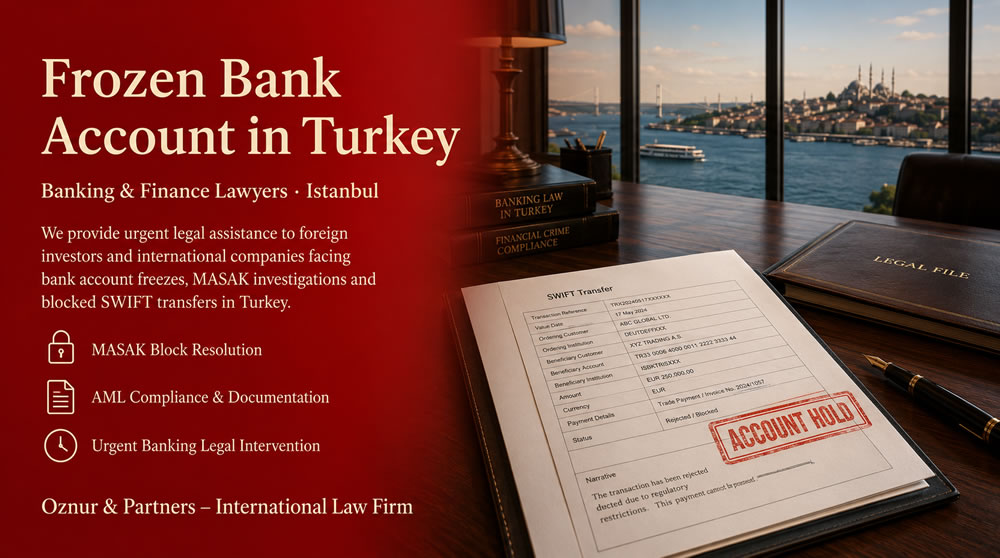
Account restricted and the bank will not explain why?
The first step is not to explain yourself but to establish the legal character of the restriction. Our Istanbul banking and finance lawyers can obtain the written basis and identify which authority holds the file.
⚖️ Five Different Restrictions, Five Different Remedies
Treating a frozen bank account in Turkey as a single legal event is the most common reason a challenge fails. The five situations below belong to different bodies of law. An application submitted to the wrong authority is usually not rejected on the merits; it is simply not entertained.
One, a bank compliance restriction. A decision taken by the bank under its own anti-money-laundering policies, before any report has produced an instruction. Strictly this is a limitation on use rather than a freeze. The route is documentary: supply what the compliance department has asked for, and where the bank has failed to observe its procedural obligations, complain to the Banking Regulation and Supervision Agency. This is the fastest of the five to resolve.
Two, an administrative suspension. Under Article 19/A of Law No. 5549, where there is reason to suspect that assets involved in a transaction derive from money laundering or terrorist financing, the transaction or the account may be suspended for seven business days. A detail that most published sources get wrong is worth stating plainly: the power to order that suspension sits with the Minister of Treasury and Finance, delegable to a deputy minister, while MASAK confirms the suspicion and performs the analysis. When the seven business days expire there are only two possibilities. The restriction is lifted, or the file has moved to the public prosecutor and the restriction has changed its legal nature.
Three, a judicial seizure. Once the file reaches the public prosecutor, a seizure is ordered by a criminal judgeship of peace. Law No. 5549 provides separately, at Article 17, for seizure where there is strong suspicion of laundering or terrorist financing. Duration follows the investigation, and the remedy is an objection before the criminal judgeship. Where the suspicion concerns terrorist financing, Law No. 6415 applies and the regime is distinct and slower.
Four, a tax attachment. An attachment placed directly by the tax authority over unpaid tax debt, unconnected to any money laundering review. The remedy is a tax appeal or proceedings before the tax courts, and the restriction can also be lifted by payment or an instalment arrangement. Foreign investors encounter this most often during company liquidation, property transfer, or after a historic value added tax assessment.
Five, an enforcement attachment. An attachment obtained by a creditor through enforcement proceedings. This is a commercial dispute appearing on the account rather than a compliance matter, and it belongs before the enforcement court. Foreign creditors can obtain the same measure against Turkish debtors, which is addressed on our page on international debt collection.
| Type | Decided by | Legal basis | Route of challenge |
|---|---|---|---|
| Compliance restriction | The bank | Internal AML policy | Documents to compliance; complaint to BDDK |
| Administrative suspension | Minister; MASAK analyses | Law No. 5549, Article 19/A, seven business days | Administrative route; nature changes at expiry |
| Judicial seizure | Criminal judgeship of peace | Law No. 5549 Article 17; Law No. 6415 where applicable | Objection before the criminal judgeship |
| Tax attachment | Tax authority | Public receivables collection | Tax appeal or tax court; payment or instalment |
| Enforcement attachment | Enforcement office | Enforcement and Bankruptcy Law | Enforcement court; challenge to the underlying debt |
The identification is made from the paperwork. The authority named in the document, the provision cited, and the file reference determine where an objection goes. This is why obtaining the written basis comes before composing an explanation.
⚖️ Who Holds the File: MASAK, the Prosecutor and the Courts
Three sets of institutions operate here, and their powers do not overlap.
MASAK is the financial intelligence unit attached to the Ministry of Treasury and Finance, established and exercising its powers under Law No. 5549. It receives suspicious transaction reports from obliged institutions, analyses them, and where warranted transmits its conclusions to the public prosecutor. The distinction worth preserving is that the seven business day suspension under Article 19/A is ordered by the Minister, with MASAK confirming the suspicion and conducting the analysis. The full text of the legislation is published on the MASAK official site.
The public prosecutor opens an investigation on receipt and applies to the criminal judgeship of peace for protective measures. What makes a restriction long-running is this stage, not the administrative suspension that preceded it.
The Banking Regulation and Supervision Agency supervises the conduct of banks rather than the merits of individual restrictions, but will entertain complaints where a bank has failed to observe its procedural duties.
On access to information, one point is regularly misunderstood. What is prohibited is disclosure of the suspicious transaction report and its content. The existence and formal basis of a restriction is a different matter. Once a file has moved into the judicial stage, defence counsel may examine the case file within the limits the law allows, which is a right the account holder cannot exercise personally.
The practical conclusion follows directly. Pressing the branch repeatedly, or contacting MASAK for an explanation, will not advance the matter. What advances it is establishing which stage the file has reached and addressing the authority that holds it. That stage is not always announced. A restriction that began as an administrative suspension and quietly became a judicial seizure looks identical from the customer’s side of the counter, which is precisely why the written basis needs to be obtained again rather than assumed to be unchanged. Broader regulatory questions across banking supervision are handled through our regulatory compliance practice, and account restrictions specifically through our banking and finance practice.
⚖️ Can a Foreign Account Holder Challenge the Restriction?
Yes, and on the same footing as a Turkish national. Foreign individuals and foreign companies have full procedural standing to demand a written basis, to examine what is examinable, and to object or bring proceedings before the competent authority. The substantive rules do not distinguish by nationality.
The real difference is evidential rather than legal. A foreign account holder’s source-of-funds chain runs through more than one jurisdiction, which means documents have to be gathered from institutions in the home country, translated by a sworn translator, and in some cases legalised. Where the account is corporate and the ownership runs through several layers, assembling the ownership chain to the standard Turkish institutions expect is usually the step that consumes the most time.
On timing, honesty is more useful than reassurance. A compliance restriction at bank level, where the requested documents exist and can be produced quickly, is the shortest path and frequently the only one needed. Once a matter has passed to the prosecutor and a seizure has been ordered, the timetable belongs to the investigation and no representation can compress it to a predictable figure. The proposition that holds across every category is narrower and more reliable: resolving the matter at bank level, before escalation, is materially faster than any route available afterwards.
⚖️ Documents That Establish Lawful Origin
What is being tested is whether every sum can be traced from its origin to its destination without an unexplained link. The categories requested in practice are consistent.
- Contracts, purchase orders and supply or distribution agreements underlying the payment
- Commercial invoices, with amounts and dates reconciling to the transfers
- Customs declarations, bills of lading and delivery confirmations where goods are involved
- Bank statements from the source jurisdiction covering the relevant period
- Tax returns, audited financial statements and proof of tax paid
- Trade registry extracts, share structure documents and beneficial ownership declarations for corporate accounts
- Sale contracts, valuations and title records for property-related transfers
- Exchange records, wallet ownership evidence and acquisition history for virtual asset movements
- Inheritance documents, loan agreements or asset sale contracts where funds derive from those sources
Documents in a foreign language require sworn translation for official use, and a power of attorney executed abroad requires notarisation and legalisation by Apostille where the country is party to the Apostille Convention, or consular legalisation where it is not. Translation quality is a recurring point of failure rather than a formality, because an imprecise rendering can change the scope of an authority or the meaning of a contractual obligation.
Where the underlying question is a tax position rather than a compliance one, our tax practice handles the assessment and appeal route, and the general framework applying to foreign investors is set out on our page on Turkish law for foreign investors.
⚖️ Crypto Transactions and Counterparty Contamination
Virtual asset activity is among the fastest growing categories of account restriction, and the reason is worth stating precisely, because it is usually misdescribed as a rule against crypto.
The difficulty in peer-to-peer trading is generally not the account holder’s own conduct. Someone sells a stablecoin holding and the buyer pays from funds connected to an offence. When the chain of funds is later traced, the seller’s account is restricted alongside the rest. The seller had no knowledge of anything, but the funds objectively arrived in their account, and that has to be explained by the seller rather than by anyone else.
The explanation is documentary: platform or exchange order records, evidence linking the wallet address to the account holder, the acquisition history of the assets sold, and the communications with the counterparty. The more complete the record, the shorter the time needed to separate the account from the contaminated chain.
Two further points are worth noting. Virtual asset service providers now fall within the scope of obliged institutions in Turkey and carry reporting obligations of their own, which means information moves between platforms and banks and switching platforms achieves nothing. And absence of knowledge, while relevant, does not by itself lift a restriction; what lifts it is evidence that the funds arrived against genuine consideration.
⚖️ Corporate Accounts and the Obligations That Do Not Pause
A restricted corporate account differs from a personal one in a way that is easy to underestimate. Payroll, social security contributions, value added tax filings and supplier payments all continue to fall due, and none of those obligations is suspended because the account cannot be used. The restriction therefore generates secondary exposure while it remains unresolved.
Foreign-owned Turkish corporate accounts attract heightened scrutiny in three recognisable situations: during periodic customer due diligence renewal, following a change in ownership structure, and where outbound foreign exchange transfers exceed a bank’s internal thresholds without matching commercial documentation.
Three things need handling in parallel with the restriction itself. The tax authority should be informed of the impediment to filing and payment rather than left to record a default. Suppliers should be brought to a written understanding on delayed payment rather than allowed to accelerate. And any thought of opening a substitute account and redirecting the flow of funds needs careful assessment, because operating around a restriction can be read as avoidance and can worsen the position materially.
The compliance state of the corporate structure also affects how quickly a review concludes. Companies whose share records, beneficial ownership declarations and actual control relationships agree with one another generally clear review faster. Where those records have drifted apart, the review becomes an exercise in reconciliation before it becomes an exercise in explanation. Corporate structuring questions of this kind are handled through our corporate law practice, and account opening standards on our page on opening a bank account in Turkey.
⚖️ What Prevents a Restriction in the First Place
Almost every difficult case has the same origin: documentation that existed at the time of the transaction but was never given to the bank. The remedy is unglamorous and it works, which is why it deserves stating even though it belongs to a moment that has already passed for anyone reading this during a restriction.
Notify the bank before a large transfer arrives rather than after. A short written note identifying the remitter, the underlying contract and the purpose, sent to the branch or relationship manager in advance, converts an unexplained inbound wire into an anticipated one. The compliance system still sees the transfer, but the file already contains its explanation.
Keep the remitter and the contracting party the same wherever possible. Where they cannot be, document the relationship in writing before the funds move. A payment made by a parent company, a shareholder or a family member is entirely lawful and entirely ordinary, and it is also one of the most reliable ways to trigger a review when nothing on file explains why the names differ.
Keep beneficial ownership records current rather than waiting for the periodic review to request them. For foreign-owned companies this single habit removes the most common administrative trigger altogether, at essentially no cost.
Where funds derive from something other than trading income, prepare the supporting document at the time rather than reconstructing it later. An inheritance, a property sale, a shareholder loan or an asset disposal is easy to evidence contemporaneously and progressively harder to evidence as time passes and institutions in the source country change their record retention.
None of this is a guarantee against review, because reviews are also triggered by counterparties and by screening rules that have nothing to do with the account holder. What it changes is the length of the review. An account whose file already contains the explanation is answering a question. An account whose file does not is building an answer under time pressure, which is a materially worse position to be in.
⚖️ The Silence Is Procedural, Not Legal
The hardest part of a restricted account is that it presents as a wall with no door in it. There is a door, but it is not at the branch counter and not on the customer service line. It is on the written document the account holder is entitled to demand, in the authority named there and the provision cited beside it.
Seen that way, lifting a restriction is not an exercise in persuasion. It is an exercise in classification: establish which of the five categories applies, then submit the right material to the authority that actually holds the file. What decides the outcome is rarely the severity of the restriction. It is whether the first days were spent explaining or classifying.
Where the underlying matter concerns assets rather than compliance, our asset protection practice approaches the same mechanisms from the opposite direction.
Schedule a Legal Consultation
Whether your personal account has been restricted, your company account is caught in a compliance review, or an outbound transfer has been held without explanation, our Istanbul banking and finance lawyers can establish the character of the restriction and the route available to you. Remote engagement is available for international clients.