

Legal exposure in Turkey is rarely where it first appears. A property acquisition that looks straightforward at signing may carry title encumbrances, zoning restrictions, or TAPU registration delays that surface only after funds transfer. A company formed without proper share structure documentation may create tax and governance complications years later. The relationship between legal precision and investment outcome is not linear; it is asymmetric. One structural gap can undo what months of commercial preparation built.
This is why international clients increasingly ask: what does a law firm in Turkey need to demonstrate before it handles a cross-border mandate? The answer goes beyond language fluency. It requires documented experience in the specific intersection of Turkish law and international client structures, the operational capacity to work remotely across time zones, and an institutional framework that holds the work to a consistent standard regardless of which team member carries it.
⚖️ What Does an International Law Firm in Turkey Actually Do?
An international law firm in Turkey is a full-service legal practice that advises clients whose legal matters cross at least one jurisdictional boundary involving Turkey. This is distinct from a domestic Turkish law firm that occasionally handles foreign client inquiries. The distinction is structural: international practice requires fluency in cross-border transaction architecture, foreign investment regulations, international arbitration procedures, and the coordination of legal work across multiple legal systems simultaneously.
At Oznur & Partners, the international practice spans five primary areas. Corporate and commercial law covers company formation, shareholder agreements, cross-border M&A, and ongoing governance for foreign-owned entities in Turkey. Investment law addresses the full lifecycle of foreign direct investment, from feasibility and regulatory compliance through to exit. Real estate law serves foreign buyers and developers navigating TAPU procedures, title due diligence, and construction agreements. Family and succession law handles cross-border divorce, international custody disputes, inheritance of Turkish assets by foreign heirs, and recognition of foreign court judgments in Turkey. Immigration law covers residence permits, work authorizations, and Turkish citizenship by investment for qualifying foreign nationals.
Each practice area operates within the firm’s remote-first engagement model. Most legal processes in Turkey, including company formation, property acquisition, investment applications, and contract execution, can be completed through a properly apostilled power of attorney without the client traveling to Turkey. The exception is the biometric registration step in Turkish citizenship by investment applications, which requires one in-person appearance. All other stages are handled remotely.
⚖️ Why Do Foreign Investors Choose Istanbul as Their Legal Base in Turkey?
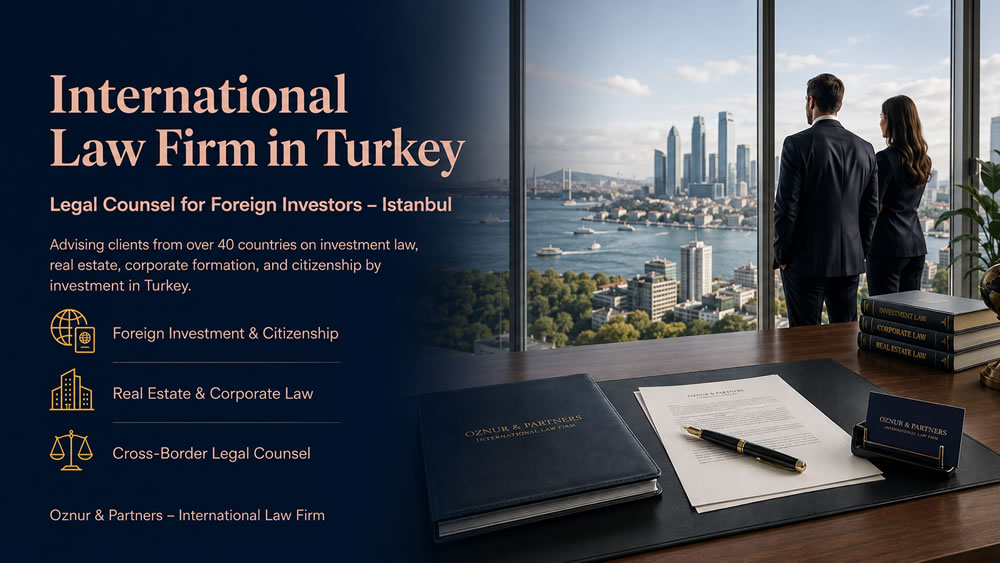
Istanbul functions as Turkey’s commercial, financial, and legal center. The Istanbul Finance Centre, established under Law No. 7412, positions the city as a regional financial hub connecting European and Middle Eastern markets. Major Turkish law firms, international arbitration institutions including ISTAC, and the commercial courts with the deepest cross-border caseload are all concentrated in Istanbul.
For foreign investors, this concentration matters operationally. Decisions requiring court intervention, Land Registry coordination, or direct engagement with regulatory authorities such as the Capital Markets Board (SPK) or the Banking Regulation and Supervision Agency (BRSA) are processed through Istanbul-based institutions. A law firm operating from Istanbul carries no travel delay when regulatory engagement is required on short notice.
Beyond logistics, Istanbul’s legal market reflects Turkey’s investment geography. Foreign direct investment into Turkey flows primarily through real estate, corporate acquisitions, and citizenship by investment programs, all of which are structured and executed from Istanbul. The firm’s location in Istanbul is not incidental; it places the legal team at the intersection of where investment decisions are made and where regulatory processes are completed.
International clients with cross-border legal needs in Turkey regularly ask: which practice areas benefit most from having Istanbul-based legal representation? Real estate transactions, corporate governance for Turkish subsidiaries, investment visa and citizenship applications, and enforcement of international arbitration awards in Turkish courts all gain materially from proximity to the relevant institutions and courts.
⚖️ International Legal Services for Foreign Investors and Businesses
Oznur & Partners structures its international legal services around the decision stages that foreign clients actually face, rather than around practice area categories. The result is advice that integrates corporate, tax, immigration, and property considerations within a single engagement rather than requiring the client to coordinate between separate specialists.
Foreign direct investment advisory. The firm advises foreign companies and individuals entering the Turkish market on the optimal legal structure for their investment objectives. This includes entity selection (limited şirket vs. anonim şirket), regulatory pre-clearance where required, TCMB foreign exchange documentation, and coordination with tax advisors on transfer pricing and profit repatriation frameworks. Full details are available on the Foreign Investment Advisory page.
Turkish citizenship by investment. Foreign nationals who acquire qualifying real estate or make a qualifying capital investment in Turkey may apply for Turkish citizenship under current regulations. The process typically takes between three and six months from application submission to approval. The firm’s Turkish Citizenship by Investment Lawyer team manages the full application lifecycle, including investment structuring, TAPU coordination, and Directorate General of Migration Management filings.
Real estate acquisition and title due diligence. Foreign buyers of Turkish property face a mandatory title search, zoning compliance review, and TAPU registration process. The firm’s Real Estate Lawyer in Turkey team conducts full due diligence prior to contract execution and manages the transfer process through to registered title. For clients pursuing citizenship by investment through real estate, the property acquisition and citizenship application processes are coordinated within a single engagement.
Company formation and corporate governance. Foreign investors establishing a Turkish entity require articles of association, trade registry registration, tax number registration, and, in most cases, a corporate bank account. The Company Formation Lawyer team completes the formation process remotely via power of attorney, with Turkish company registration typically achieved within five to ten business days of document receipt.
Family law for international clients. Cross-border family matters in Turkey include divorce proceedings where one spouse is a foreign national, international child custody disputes, and the recognition of foreign marriage certificates or divorce decrees in Turkey. The firm’s Family Law team advises clients from over 20 nationalities on Turkish family law procedure and coordinates with foreign counsel where bilateral legal cooperation is required.
Inheritance and succession for foreign heirs. Turkish assets held by foreign nationals or inherited by foreign heirs require probate and transfer procedures under Turkish law, regardless of the nationality of the deceased or the heir. The firm’s Inheritance Law team advises foreign heirs on asset identification, succession certificate procedures, and TAPU transfer of inherited real property.
⚖️ Common Legal Risks Foreign Clients Face in Turkey
Experience with international mandates reveals a consistent pattern: most legal problems that foreign clients encounter in Turkey are not caused by Turkish law being unusually complex. They are caused by structural mismatches between the client’s assumptions and the procedural realities of Turkish legal process.
Title and encumbrance risk in real estate. Turkish property may carry mortgages, liens, seizure orders, or zoning restrictions that do not appear in an informal property inspection. Full TAPU records and the municipal zoning plan must be reviewed before any purchase contract is signed. Foreign buyers who rely on seller representations rather than independent title search regularly discover encumbrances after funds have transferred.
Corporate structure misalignment. Foreign investors who form Turkish companies without addressing shareholder agreement provisions, minority protection clauses, and dividend repatriation mechanics at the outset frequently face governance disputes when the business relationship encounters its first disagreement. Turkish corporate law sets default rules that may not reflect the parties’ commercial intentions; bespoke documentation at formation prevents most of these disputes.
Citizenship by investment disqualification. Real estate purchases intended to qualify for Turkish citizenship must meet specific conditions: the property must be valued at a minimum of $400,000 USD as of current regulations, must be sold by a Turkish citizen or Turkish legal entity to a foreign national, and must not have been previously used to support another citizenship application. Properties that fail any of these conditions disqualify the application after funds have been committed.
Power of attorney deficiencies. Remote legal processes in Turkey depend on a validly executed power of attorney. POAs executed abroad must be apostilled under the Hague Apostille Convention (or authenticated through a Turkish consulate for non-Apostille countries) and officially translated into Turkish by a sworn translator. Deficiencies in any element of this chain create delays that can extend legal timelines by weeks.
Tax residency and reporting obligations. Foreign nationals who spend more than six months in Turkey in a calendar year may acquire Turkish tax residency and become subject to Turkish income tax on worldwide income. This is a consequence that many foreign investors are not aware of when planning extended stays. Early-stage tax planning prevents residency exposure from becoming an unexpected compliance obligation.
⚖️ How Oznur & Partners Works with International Clients
The firm’s engagement model is designed for clients who are not physically present in Turkey. Initial consultations are conducted by video call or telephone. After engagement, all document exchange occurs digitally through secure channels. Where Turkish originals are required, the firm coordinates notarization and apostille logistics with the client’s local notary public.
The standard remote engagement process for most legal matters follows four stages. First, the client provides the relevant background documentation for the matter, which the firm reviews and uses to prepare a legal assessment and engagement scope. Second, a power of attorney is prepared in the form required for the specific legal process; the client executes it before a notary in their jurisdiction, completes the apostille or consular authentication, and arranges official Turkish translation. Third, the firm files, registers, or litigates on the client’s behalf using the power of attorney. Fourth, the client receives the outcome documentation, including registered title deeds, company certificates, citizenship approval letters, or court judgments, by secure courier or digital transfer as appropriate.
Which legal matters in Turkey cannot be completed remotely? Under current regulations, the primary exception is the biometric enrollment step in Turkish citizenship by investment applications, which requires the main applicant and spouse to appear in person at a Directorate General of Migration Management office or Turkish consulate for fingerprinting and photograph registration. All other stages of the citizenship process, including property acquisition, investment documentation, and application filing, are completed remotely.
⚖️ Who Does Oznur & Partners Serve?
The firm’s international client base reflects Turkey’s position as an investment destination for a geographically diverse group of buyers, investors, and corporate entities. Clients from the United States, United Kingdom, Gulf states, European Union jurisdictions, Russia, Ukraine, and Central Asian countries have each been represented by the firm in Turkish legal proceedings or transactions.
The primary client segments are:
Foreign investors pursuing Turkish citizenship by investment. This group typically acquires residential or commercial real estate in Istanbul or other qualifying locations. The legal engagement covers the full sequence from property due diligence through TAPU transfer and citizenship application. The firm has coordinated citizenship applications for clients from over 40 countries.
Foreign nationals purchasing Turkish real estate outside the citizenship program. This segment includes lifestyle buyers, rental property investors, and second-home purchasers. The legal engagement covers title due diligence, purchase contract negotiation, TAPU transfer, and, where relevant, short-term rental regulatory compliance under current Turkish regulations.
Foreign companies establishing Turkish subsidiaries or joint ventures. This group requires entity formation, shareholder documentation, employment contract templates compliant with Turkish Labor Law No. 4857, and, in regulated sectors, licensing applications. The firm also advises on ongoing governance including board resolutions, capital increases, and annual statutory compliance.
International families with cross-border legal matters. This segment includes divorcing couples where one or both spouses are foreign nationals, foreign heirs to Turkish estates, and families navigating international child relocation or custody disputes with a Turkish connection.
Foreign nationals seeking Turkish residence or citizenship through non-investment routes. This includes short-term and long-term residence permit applications, family reunification permits, work permits coordinated with corporate clients, and naturalization applications for long-term residents.
⚖️ Why Choose Oznur & Partners as Your International Law Firm in Turkey
Oznur & Partners has been recognized by Legal 500 for its work in Turkish investment and corporate law. The firm’s team includes multilingual lawyers who advise clients across English, Turkish, and Arabic, with legal work reviewed under consistent quality standards regardless of the language of the underlying transaction.
The firm’s track record in Turkish citizenship by investment is documented across more than 750 completed applications. Its real estate practice has coordinated property transactions for foreign buyers in Istanbul, Antalya, Ankara, and other qualifying locations. Its corporate practice has formed and advised Turkish entities across manufacturing, technology, financial services, and real estate development sectors.
Operationally, the firm is structured for international mandates. Istanbul’s time zone (UTC+3) allows same-day communication with clients in Gulf states, Central Asia, and Eastern Europe, and practical next-morning turnaround for clients in Western Europe and the United States. All legal correspondence is conducted in English for international clients. Turkish-language filings and regulatory submissions are prepared by the firm and reviewed with the client before submission.
The firm operates under Turkish Bar Association professional standards and carries professional liability coverage consistent with Turkish legal practice requirements. Client funds, where held in connection with property transactions or investment structuring, are handled through segregated client accounts.
It is no coincidence that investors researching Turkey compare legal firms on the basis of documented case volume rather than marketing language. The question that matters is whether the firm has handled the specific transaction type the client needs, at the specific regulatory intersection the transaction involves. For citizenship by investment, real estate acquisition, company formation, and cross-border family matters in Turkey, Oznur & Partners’ documented experience across each area provides the answer directly.
❓ Frequently Asked Questions: International Law Firm in Turkey
✅ What is an international law firm in Turkey?
An international law firm in Turkey is a legal practice that advises clients whose matters involve Turkish law in combination with a foreign jurisdiction, foreign investment, or cross-border transaction. Unlike a domestic Turkish law firm, an international firm maintains the language capacity, procedural knowledge, and remote engagement infrastructure to serve clients who are not physically based in Turkey. Oznur & Partners operates as an international law firm in Istanbul, advising clients from over 40 countries on Turkish investment law, real estate, corporate formation, citizenship by investment, family law, and inheritance matters.
✅ Do I need to travel to Turkey to work with a Turkish law firm?
Most legal processes in Turkey can be completed remotely through a properly executed and apostilled power of attorney. Company formation, property purchase, investment applications, inheritance procedures, and contract execution are all achievable without the client traveling to Turkey. The main exception under current regulations is the biometric registration step in Turkish citizenship by investment applications, which requires one in-person appearance at a Migration Management office or Turkish consulate. All other stages of that process, and substantially all other Turkish legal procedures, are completed remotely.
✅ What is the minimum investment for Turkish citizenship through real estate?
The minimum qualifying real estate investment for Turkish citizenship by investment is $400,000 USD as of current regulations. The property must be purchased from a Turkish citizen or Turkish legal entity, must not have been used to support a prior citizenship application, and must be held for a minimum of three years. Properties that do not meet all qualifying conditions disqualify the citizenship application regardless of the purchase price paid. Legal review of the property before contract signing is the only reliable way to confirm eligibility.
✅ How long does it take to form a company in Turkey as a foreigner?
Turkish company formation for a foreign-owned limited şirket (LLC equivalent) typically takes between five and ten business days from the date all required documents are received in Turkey in properly authenticated form. Required documents include apostilled and officially translated identification documents for all shareholders and directors, articles of association prepared to Turkish trade registry standards, proof of share capital deposit, and a valid power of attorney if the shareholder is not present in Turkey. Delays typically result from document authentication deficiencies rather than from the registration process itself.
✅ Can a foreign national inherit property in Turkey?
Yes. Foreign nationals can inherit Turkish real property and other Turkish assets, subject to Turkish succession law and, in some cases, the reciprocity provisions that apply to nationals of certain countries. The inheritance process requires obtaining a Turkish succession certificate (veraset ilamı), identifying all Turkish assets, paying applicable inheritance and transfer taxes, and completing the TAPU transfer of any real property. Foreign wills must be recognized by Turkish courts before they take effect with respect to Turkish assets. The process is procedurally intensive but fully available to foreign heirs who engage Turkish legal representation.
✅ What is the difference between an international lawyer and a Turkish lawyer?
In Turkey, all practicing lawyers are licensed under the Turkish Bar Association and advise on Turkish law. The distinction between an “international lawyer” and a standard Turkish lawyer is practical rather than jurisdictional: international lawyers in Turkey have experience and infrastructure for cross-border mandates, including multilingual client communication, familiarity with foreign investment structures, knowledge of apostille and document authentication requirements across multiple jurisdictions, and the capacity to coordinate with foreign counsel. A Turkish lawyer without this specific experience may be fully competent in domestic matters but encounter procedural gaps when a matter involves foreign parties, foreign documents, or international regulatory frameworks.
✅ Does Oznur & Partners handle international arbitration in Turkey?
Yes. The firm advises clients on international arbitration proceedings seated in Turkey, including proceedings before the Istanbul Arbitration Centre (ISTAC), as well as the enforcement of foreign arbitral awards in Turkish courts. Turkey is a signatory to the New York Convention on the Recognition and Enforcement of Foreign Arbitral Awards, which provides the legal framework for enforcement of international awards in Turkish jurisdiction. The firm also advises on the inclusion of appropriate arbitration clauses in cross-border contracts to ensure enforceability.
✅ Is Istanbul a good location for an international law firm serving foreign investors?
Istanbul is Turkey’s primary legal and commercial center and the location where the majority of foreign investment transactions, regulatory filings, and commercial court proceedings are concentrated. The Istanbul Finance Centre, established under Law No. 7412, reinforces the city’s role as a regional hub for financial and legal services connecting European, Middle Eastern, and Central Asian markets. For foreign investors, having legal representation based in Istanbul provides direct access to the Land Registry offices, commercial courts, ISTAC, and regulatory authorities relevant to most cross-border mandates.
✅ How do I verify that a Turkish law firm is properly licensed?
Turkish lawyers are licensed by and registered with one of Turkey’s regional bar associations. The Istanbul Bar Association (Istanbul Barosu) maintains a public registry of licensed attorneys. Clients can verify a lawyer’s registration by searching the Istanbul Bar Association’s online directory using the lawyer’s name or bar number. Firms operating in Turkey must have at least one licensed Turkish attorney as a partner or responsible attorney. Verifying bar registration is the most direct way to confirm that a law firm operating in Turkey holds the legal authority to practice Turkish law.
⚖️ Related Legal Resources
🔹 Investment and Corporate Law
- Foreign Investment Advisory — Legal structuring for foreign direct investment into Turkey, including entity selection, TCMB foreign exchange documentation, and regulatory pre-clearance for restricted sectors.
- Turkish Citizenship by Investment Lawyer — Full lifecycle management of citizenship applications through real estate or capital investment, from qualifying property identification through Directorate General of Migration Management approval.
- Turkish Citizenship Law Firm — Overview of citizenship routes available to foreign nationals in Turkey, including investment pathways, long-term residency, and exceptional contribution naturalization.
- Company Formation in Turkey — Step-by-step guide to establishing a Turkish limited şirket or anonim şirket, including trade registry requirements, minimum capital thresholds, and ongoing statutory compliance obligations.
- Istanbul Finance Centre Law Firm — Legal advisory for entities seeking to establish operations within the Istanbul Finance Centre under Law No. 7412 and its accompanying tax incentive framework.
🔹 Real Estate and Property Law
- Real Estate Lawyer in Turkey — Title due diligence, TAPU transfer management, and purchase contract review for foreign buyers of Turkish residential and commercial property.
- Property Lawyers in Turkey — Legal services for property disputes, boundary issues, construction defect claims, and developer contract enforcement under Turkish law.
- Foreign Property Eligibility in Turkey — Overview of the nationalities eligible to purchase real property in Turkey, restricted zones, and the current reciprocity framework governing foreign property ownership rights.
🔹 Family Law and Inheritance
- Family Law — Divorce, child custody, alimony, and recognition of foreign court judgments in Turkey for international families.
- Inheritance Law — Turkish succession procedures for foreign heirs, including succession certificate applications, asset identification, and TAPU transfer of inherited real property.
- Turkish Inheritance Law Firm — Specialist guidance on Turkish forced heirship rules, tax obligations on inherited Turkish assets, and cross-border estate coordination.
- Foreign Spouse Divorce — Divorce proceedings in Turkey where one or both spouses are foreign nationals, including jurisdictional analysis and recognition of Turkish divorce decrees abroad.
🔹 Regulatory and Tax
- Tax Lawyer — Turkish tax compliance for foreign investors and companies, covering corporate income tax, VAT, withholding tax, and double taxation treaty applications.
- 2026 Turkey Tax Update for Foreign Investors — Summary of the tax regulation changes affecting foreign individuals and companies operating in Turkey as of 2026.
- Varlık Barışı 2026 — Current status and legal framework of Turkey’s asset repatriation program for foreign-held Turkish assets and offshore funds.
Schedule a Legal Consultation
If you are a foreign investor, company, or individual with a legal matter involving Turkish law, whether you are entering the Turkish market, acquiring property, applying for citizenship, or managing a cross-border family or inheritance matter, our international lawyers in Istanbul are available for an initial consultation.
An international law firm in Turkey is, at its core, a bridge. It translates not only language but legal logic, procedural sequence, and institutional expectation, from the world the client knows into the system Turkey operates. Oznur & Partners was built to function as that bridge, precisely because the investors and families who need it most are the ones who cannot afford to discover its absence after a transaction has closed.