

A power of attorney in Turkey lets a foreign investor act through a Turkish attorney, signing, registering and litigating without travelling to the country.
Distance is rarely the real obstacle. A client in Dubai, Frankfurt or Toronto can wait eleven months for a title deed correction, a company registration or an inheritance certificate, and in almost every one of those cases the file was not waiting on a flight. It was waiting on a document. One page, signed in front of the right officer, containing the right sentences.
That page is the power of attorney, and the entire architecture of remote legal representation in Turkey rests on it. Everything else, the litigation strategy, the corporate structure, the tax registration, sits on top of a single instrument that most investors sign without reading closely and most intermediaries hand over without explaining.
So the first thing worth asking is not whether remote representation is possible. It is what that representation actually covers. Foreign clients regularly open the conversation with the same question: “what can a Turkish lawyer actually do for me if I never set foot in the country?” Nearly everything a physically present client could do, including appearing in court, registering a company, transferring a title deed, filing tax declarations and accepting or rejecting an inheritance. The narrow band of exceptions involves acts the law treats as strictly personal, such as contracting a marriage or giving testimony where the court has ordered the party to appear. Outside that band, a properly drafted power of attorney reaches as far as your own signature would.
The second question follows immediately, and it is a choice: “should I sign the power of attorney at a Turkish consulate or in front of a notary where I live?” Both routes work. The consulate route produces a document that is already in Turkish and already usable in Turkey without further certification. The local notary route requires an apostille under the 1961 Hague Convention, a certified Turkish translation, and notarisation of that translation once it reaches Turkey. The consulate is usually slower to book and faster to use; the local notary is usually faster to book and slower to use. Which one is right depends less on convenience than on how soon the instrument has to be presented to a Turkish registry.
Timing matters more than most clients expect, which is why the third question tends to arrive too late: “when should I issue the power of attorney?” Before the matter becomes urgent. A power of attorney issued in advance costs an afternoon; the same document issued after a limitation period has started running, after a co-heir has filed suit, or after a registry has rejected an application, costs the case. Turkish procedural deadlines do not pause while a document travels.
And then the question that decides the whole engagement: “how much authority should I actually grant?” Enough to complete the specific matter and not one clause more. A power of attorney that grants everything protects nothing. Turkish law does not treat authority as a single block; the Turkish Code of Obligations, in Article 504, and the Code of Civil Procedure, in Article 74, both require certain acts to be authorised expressly and by name. Sale of immovable property, waiver of a claim, settlement, acceptance of a suit, arbitration, acknowledgement of a debt: none of these are covered by a general grant, however broadly it is worded. The practical consequence cuts both ways. A general power of attorney is simultaneously too weak to complete the transaction you need and too strong to leave in a stranger’s hands.
This page sets out what can be handled remotely in Turkey, how the instrument is issued and certified, where the scope of authority quietly fails, and how each of the main investor workflows, company formation, citizenship, real estate, tax and inheritance, is executed from abroad. It is written for people who intend to hold assets in Turkey for years and want the paperwork underneath those assets to hold as well.
⚖️ What Can a Power of Attorney in Turkey Actually Cover?
Almost every legal act in Turkey can be performed by an authorised representative, because Turkish law is built around the agency relationship rather than around personal attendance. The Turkish Code of Obligations regulates the contract of agency in Articles 502 to 514, and the Attorneys Act No. 1136 reserves representation before courts and public institutions to advocates registered with a bar association. Together these two frameworks mean that a foreign investor does not need to be present; the investor needs to be properly represented.
In practice, the matters our foreign clients hand over entirely are the following.
- Formation, restructuring, capital increase and liquidation of Turkish companies
- Purchase, sale, mortgage and title deed correction of immovable property
- Obtaining a Turkish tax identification number and filing tax declarations
- Recognition and enforcement of foreign judgments, including divorce decrees
- Obtaining a certificate of inheritance and completing estate transfers
- Civil, commercial and administrative litigation, including all hearings
- Enforcement and debt collection proceedings
- Applications to the Directorate General of Migration Management
- Citizenship by investment applications and the conformity certificate process
- Bank account opening, subject to the individual bank’s own compliance policy
The exceptions are narrower than the marketing on most law firm websites suggests, and they are worth naming honestly. Marriage cannot be contracted by proxy. A criminal defendant cannot have a representative give a statement in place of a compulsory personal appearance. In contested divorce proceedings the court may require the parties themselves to be heard, and while an attorney conducts the entire file, that particular hearing may need the client. Biometric enrolment for identity documents generally requires the person. Some banks, applying their own anti money laundering procedures rather than any statute, decline to open accounts on the basis of a power of attorney alone.
Clients often ask, at exactly this point, “is there anything my lawyer can do remotely that I could not do myself in person?” Yes, and it is the least discussed advantage of the arrangement. An advocate has standing your presence would not give you: access to court files through the national judicial system, standing to appear before courts under the Attorneys Act, the right to request records and correspondence from public institutions in a professional capacity, and the ability to file within deadlines without regard to visa timing or flight availability. Physical presence gives you nothing that representation does not, and representation gives you access that presence alone would not.
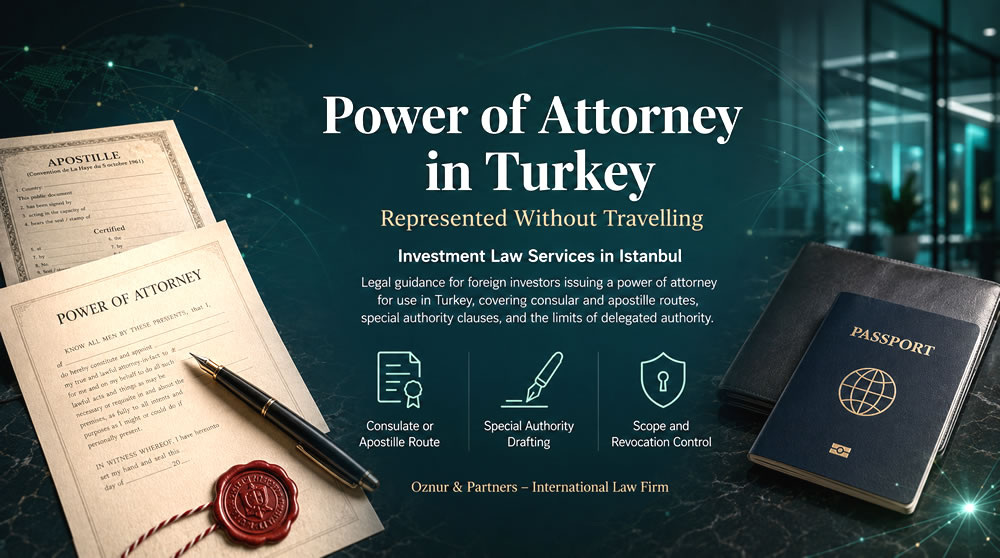
⚖️ Which Route Should You Use: Turkish Consulate or Local Notary With Apostille?
Both routes produce a valid instrument, and the correct choice depends on the type of transaction and how quickly the document must be presented to a Turkish authority. The difference is not one of legal strength. A consular power of attorney and an apostilled notarial power of attorney carry the same weight once they are properly in Turkish hands. The difference is in the friction, and in where that friction lands.
The consular route
You attend the Turkish consulate or embassy in your country of residence with your passport and, for property matters, passport photographs. The consular officer prepares the instrument in Turkish based on the text your Turkish attorney supplies, and you sign it there. The resulting document needs no apostille, no translation and no further certification. It can be used in Turkey the moment it arrives, and in many cases a scanned copy is enough to begin preparatory work while the original travels.
The cost of this route is calendar time. Consular appointment availability varies enormously by post, from a few days in smaller consulates to several weeks in London, Berlin or Dubai during peak periods. Appointment booking runs through the Ministry of Foreign Affairs system at konsolosluk.gov.tr.
The notary and apostille route
You attend any local notary, who certifies your signature on a text drafted in your own language or bilingually. The document then receives an apostille from the competent authority in your country, which for signatories of the Hague Convention of 5 October 1961 is a standardised certificate recognised in Turkey without further legalisation. The list of contracting states is maintained by the Hague Conference on Private International Law. Once in Turkey, the document is translated by a sworn translator and that translation is notarised.
This route is usually faster to start and slower to finish. It also introduces a specific risk that the consular route does not: translation drift. A power of attorney drafted in English, translated into Turkish by a translator who has never seen a Turkish land registry file, can lose exactly the special authority clause the transaction depends on. We draft the Turkish text first and have the foreign language version follow it, rather than the reverse.
If your country is not a party to the 1961 Convention, the apostille is unavailable and the document must be legalised through the Turkish consulate in the ordinary way, which adds a further step and typically a further week or two.
Choosing between them
For property transactions, corporate formation and anything with a registry deadline, the consular route is the safer default because it eliminates the translation and certification layer entirely. For urgent litigation instructions, an apostilled notarial power of attorney will often reach us faster. For clients in countries where the nearest Turkish consulate is a domestic flight away, the notary route is simply more realistic.
⚖️ Why the Scope of the Power of Attorney Decides the Outcome
The scope clause is where remote representation quietly fails, and it fails in two opposite directions. Files stall because the authority granted was too narrow to complete the act. Clients are exposed because the authority granted was broad enough to complete acts they never contemplated. Both failures are invisible at signing and expensive later.
Turkish law does not accept that a general grant of authority carries everything. Under Article 504 of the Turkish Code of Obligations, an agent requires express special authority to settle, to submit to arbitration, to sign a negotiable instrument obligation, to make a gift, to transfer or encumber immovable property, or to waive a right. Under Article 74 of the Code of Civil Procedure, the same logic governs litigation: withdrawal of a claim, acceptance of the opposing party’s claim, settlement in court, recusal of a judge, referral to arbitration and receipt of a judgment debt each require the clause to say so, by name.
The land registry applies this with particular strictness. A power of attorney used to transfer, mortgage or otherwise dispose of immovable property must carry the grantor’s photograph, and the authority must be worded specifically enough that the registry officer can match it to the transaction in front of them. A file that reaches the Land Registry and Cadastre Directorate with a general commercial power of attorney and no photograph is rejected at the counter, and the client learns about it after the appointment slot has already been consumed.
The opposite error is quieter. An unlimited power of attorney, valid indefinitely, authorising sale of all present and future assets, granted to a person the client met once, is a document that will never announce that it has been misused. Clients rarely ask about it, which is why we raise it: “what stops the person holding my power of attorney from using it beyond what I intended?” Three things, in descending order of reliability. First, scope drafting, which is the only genuine protection, because an authority that was never granted cannot be exercised. Second, professional liability, because advocates registered with a bar association are subject to disciplinary jurisdiction and mandatory professional indemnity insurance, and an intermediary holding the same document is subject to neither. Third, revocation, which works but only from the moment it is registered, and which therefore protects the future rather than the past.
Our standing practice is to issue matter-specific powers of attorney rather than general ones. A client buying an apartment in Istanbul receives a document that permits the purchase and the associated tax and utility registrations, and does not permit sale. When the same client later decides to sell, a second instrument is issued. This is slightly less convenient and substantially safer, and after fifteen years of cross-border files we have not once regretted the extra afternoon.
Not sure whether the power of attorney you were sent grants too much or too little?
Send us the draft before you sign it. Reviewing the scope clause takes us an hour and can save a rejected registry application or an authority you never meant to give.
⚖️ Special Authority Clauses That Must Be Written by Name
The following acts cannot be performed under a general power of attorney in Turkey and must appear expressly in the text. This list is the single most useful thing to check before signing.
- Sale, transfer or mortgage of immovable property. Requires express authority plus the grantor’s photograph on the instrument.
- Waiver of a claim or a right. Includes waiver of inheritance rights, which is irreversible once registered.
- Settlement and court settlement. Without this clause an attorney cannot conclude your dispute even on favourable terms.
- Acceptance of the opposing party’s claim. Distinct from settlement and separately required.
- Submission to arbitration. Relevant in most commercial contract disputes with an arbitration clause.
- Acknowledgement of debt and signature of negotiable instruments. Rarely needed and rarely appropriate to grant.
- Making a gift. Occasionally relevant in intra-family estate planning, otherwise omit it.
- Receipt of a judgment debt or enforcement proceeds. If your attorney is to collect, the clause must say so.
- Acceptance or rejection of an inheritance. Rejection carries a three-month statutory period and cannot be reversed.
- Company incorporation, share transfer and capital increase. Trade registry directorates require the corporate acts to be itemised.
- Right of substitution. Permits your attorney to appoint another advocate, which matters if the file spans several cities.
Two drafting points that do not appear on any official checklist but decide files in practice. First, add a validity period. A power of attorney with an end date is a security device that costs nothing, and Turkish registries accept time-limited instruments without difficulty. Second, name the acts rather than the outcome. An instrument authorising the attorney “to do everything necessary for the purchase” is weaker before a land registry officer than one authorising signature of the deed, payment of the transfer fee, registration of the title, and application for the tax number and utility subscriptions.
⚖️ Company Formation in Turkey Managed Entirely From Abroad
A foreign investor can incorporate a Turkish limited or joint stock company without entering the country, and this is the most fully remote of all the workflows on this page. Incorporation runs through MERSIS, the central trade registry system operated by the Ministry of Trade, and the articles of association are executed before the trade registry directorate under the authority of the power of attorney.
The sequence for a remote incorporation is as follows.
- Tax identification numbers are obtained for each foreign shareholder and director, which takes one to two business days.
- The articles of association are drafted and entered into MERSIS, with the company name reserved.
- Signature declarations for the authorised representatives are prepared. Foreign directors resident abroad issue theirs at the Turkish consulate.
- The registration application is submitted to the relevant trade registry directorate, typically the Istanbul Chamber of Commerce for Istanbul-based entities.
- Registration is announced in the Turkish Trade Registry Gazette and the company acquires legal personality.
- Tax office registration, opening of the statutory books and appointment of an accountant follow immediately.
- The corporate bank account is opened, which is the one step where the bank’s own compliance policy, not the law, may require a director to attend.
Registration itself commonly completes within three to five business days once the documents are complete. The realistic total, measured from the client’s first instruction to a company with a working bank account, is closer to three to six weeks, and the variable is almost always document certification abroad rather than anything happening in Turkey.
The structural decisions taken during this window are harder to reverse than the incorporation itself: whether a limited company or a joint stock company fits the exit plan, how the share ledger is drafted, whether a Turkish resident director is appointed, and how the shareholding sits in relation to any citizenship application. Our company formation lawyers in Istanbul take those decisions before the MERSIS entry rather than after, and clients who intend to hold the entity long term should also read our note on corporate governance and ongoing compliance obligations.
⚖️ Tax Registration, Bank Accounts and Capital Transfer From Abroad
The company exists after the trade registry entry, but it cannot operate until the money side is built, and this is where remote files most often lose their momentum. The legal work finishes in days; the financial infrastructure takes weeks, and almost all of the delay sits with institutions that are applying their own internal policy rather than any statute.
Tax identification and registration
A foreign individual obtains a Turkish tax identification number in one to two business days, either through the Interactive Tax Office online with a passport or through an attorney under power of attorney. The number is a prerequisite for almost everything else: opening a bank account, registering a property, receiving a share transfer or filing any declaration.
Company tax registration follows the trade registry entry automatically, but the tax office then conducts a site inspection at the registered address. This step catches out foreign founders who registered the company at a virtual office or an accountant’s address without confirming that the arrangement will survive an inspection. The consequence of a failed inspection is not a fine; it is a company that cannot issue invoices while the address is corrected.
Bank accounts
This is the one step no power of attorney can guarantee, and it should be said plainly rather than promised. Turkish banks apply their own anti money laundering and know your customer procedures, and those procedures are not uniform. Some banks open corporate accounts on the basis of a properly drafted power of attorney and certified corporate documents. Others require an authorised signatory to attend a branch in person, once, regardless of what the instrument says. The policy differs between banks, between branches of the same bank, and between account types.
So clients reasonably ask, before committing to a structure, “can my lawyer open a bank account for my Turkish company without me?” Sometimes, depending on the bank. We identify which institutions currently accept representation for the account type you need before the company is registered, rather than discovering the answer after incorporation when the structure is already fixed. Personal accounts for non-residents are harder than corporate accounts, and a residence permit materially improves the position with most institutions.
Bringing capital in
Foreign investment in Turkey operates under the Foreign Direct Investment Law No. 4875, which places foreign investors on the same footing as domestic ones and guarantees free transfer of profits, dividends, sale proceeds and liquidation balances abroad through banks. In practice the mechanics matter more than the guarantee.
- Capital is transferred into the company’s own account and documented as capital rather than as a shareholder loan or an unexplained inbound payment. This distinction determines the tax treatment later.
- Joint stock companies must pay in one quarter of the subscribed cash capital before registration. Limited companies may pay their cash capital within twenty four months of registration.
- Foreign-owned entities carry notification obligations to the Ministry of Industry and Technology through the E-TUYS system, including annual reporting of capital and shareholding data. These are administrative rather than difficult, and they are the obligation most commonly missed by companies whose owners live abroad.
- Inbound transfers are examined by the receiving bank under its own compliance rules. A transfer arriving from a third country or from an account in a name other than the shareholder’s will be queried, and sometimes returned.
Taking profit out
Corporate income tax applies at the rate in force for the financial year, currently twenty five percent for most companies, and distributed profits are then subject to dividend withholding tax. The domestic withholding rate should be confirmed for the year of distribution rather than assumed, because it has changed more than once in recent years. Where a double tax treaty applies, and Turkey has an unusually wide treaty network, the rate on dividends paid to a qualifying foreign shareholder commonly falls to between five and fifteen percent, subject to holding thresholds and a certificate of residence obtained from the shareholder’s home tax authority.
The certificate of residence is worth planning for in advance. It is a routine document in most jurisdictions and a slow one in a few, and treaty relief cannot be applied by the paying company until it holds the certificate. A dividend distributed before the paperwork arrives is taxed at the domestic rate and recovered, if at all, through a refund procedure that is considerably less pleasant than waiting three weeks would have been.
Ongoing compliance runs monthly rather than annually. A Turkish company requires a certified or independent accountant, keeps electronic ledgers, files monthly value added tax and withholding declarations and quarterly provisional corporate tax returns. Our note on tax consultancy for investors in Turkey sets out the calendar, and current-year changes are tracked in the 2026 Turkey tax update for foreign investors.
⚖️ Turkish Citizenship and Residence Applications Handled Remotely
Citizenship by investment can be prepared and filed almost entirely by an attorney under power of attorney, with the qualification that identity and biometric steps generally require the applicant and their family members to attend in person at least once. This is the honest position, and it is worth stating plainly because a great deal of published material on this subject implies otherwise.
What the attorney handles without the client present: property selection and legal due diligence, valuation reporting by a licensed appraiser, the purchase and title registration, the annotation prohibiting sale for three years, application for the certificate of conformity to the relevant ministry, and the submission and follow-up of the citizenship file itself. What generally requires attendance: biometric enrolment and identity verification for the applicant and dependants.
The qualifying threshold for the real estate route is USD 400,000 as of current regulations, with the three-year non-disposal commitment annotated on the title deed. Investors approaching that figure through multiple smaller properties should confirm the aggregation rules for their specific file before purchasing, because valuation reports rather than purchase prices govern the calculation and the gap between the two is where applications are refused. Our page on the most common legal mistakes in citizenship by investment covers this in detail, and the wider framework is set out in our legal guide to citizenship by investment.
Residence permit applications follow a different logic. Applications are made through the Directorate General of Migration Management at goc.gov.tr, and while an attorney prepares and submits the file, the appointment at the provincial directorate is ordinarily attended by the applicant. Corporate transfers and work permit routes are handled differently again, and are set out on our page for corporate immigration and work permits.
⚖️ Real Estate, Title Deeds and Tax Registration Under Power of Attorney
Property transactions are the most common reason foreign clients issue a Turkish power of attorney, and the most common place the instrument turns out to be defective. The land registry does not interpret authority generously; it reads the clause and either accepts it or does not.
The requirements for a property power of attorney are specific. The instrument must carry the grantor’s photograph. It must expressly authorise the disposal in question, purchase, sale, mortgage or partition, rather than referring generally to real estate matters. If issued abroad before a notary, it must carry an apostille and a notarised Turkish translation. Land registry procedures and the transaction fee schedule are published by the General Directorate of Land Registry and Cadastre.
Under the same instrument, an attorney can obtain the buyer’s Turkish tax identification number, pay the title deed transfer fee, register the property, arrange the compulsory earthquake insurance policy, transfer the utility subscriptions and register the property with the local municipality for property tax purposes. Each of these is a small administrative act, and each of them, left undone, generates a penalty notice two years later addressed to a Turkish address the owner does not check.
Due diligence before purchase matters more when the buyer is not physically present to inspect. The title record, the zoning status, the occupancy permit, any annotations, mortgages or liens, and any pending expropriation should all be verified before funds move. We set this out for buyers in our guide to real estate purchases by foreign buyers in Istanbul, and eligibility restrictions by nationality and location are covered under foreign property eligibility in Turkey.
⚖️ Inheritance, Divorce Recognition and Litigation Conducted in Your Absence
Court proceedings in Turkey are conducted by an advocate, and the client’s physical presence is the exception rather than the rule. This is the area where remote representation delivers the most and is understood the least.
Inheritance and estate transfer
Where the estate has a foreign element, and it almost always does when the heirs live abroad, the certificate of inheritance must be obtained from the civil court of peace rather than from a notary. Turkish notaries are not competent to issue a certificate of inheritance in files containing a foreign element, and clients who have been told otherwise have usually been told it by someone who has never filed one. Once the certificate is issued, the attorney registers the transfer of the estate assets, files the inheritance and gift tax declaration, and where the heirs intend to liquidate rather than hold, conducts the sale under a separate authority.
The deadlines here are unforgiving. Rejection of an inheritance carries a three-month period running from the date the heir learns of the death. Inheritance tax declarations carry their own filing deadlines with penalties for late submission. Heirs who wait until the family has agreed on a distribution frequently find that the legal position has already been settled by inaction. The substantive framework is set out on our page on Turkish inheritance law for foreign nationals, and contested estates are addressed under inheritance dispute resolution.
Recognition and enforcement of foreign judgments
A foreign divorce decree has no automatic effect on Turkish civil registry records. Until it is recognised by a Turkish court, the person remains married in the eyes of the Turkish registry, with direct consequences for inheritance, property regime and any subsequent marriage. Recognition proceedings are governed by the Act on Private International and Procedural Law No. 5718 and are conducted entirely by an attorney under power of attorney. The judgment must be final, and it must be presented with an apostille and a certified translation. Uncontested recognition files commonly conclude within two to five months. Our page on divorce involving a foreign spouse covers the substantive law.
Commercial and civil litigation
An advocate conducts the entire proceeding, files pleadings through the national judicial network, attends hearings and manages enforcement. Clients ask how they stay informed when they are not in the room. “How do I know what is actually happening in my case from three thousand kilometres away?” Through the hearing record, which is produced at every session and can be sent to you the same day, together with the case file status in the judicial system. A litigation file conducted properly generates a written trail at every step, and remote clients who receive that trail are usually better informed than local clients who attend hearings and understand none of the procedural language used in them. Commercial matters are addressed further under commercial contract disputes in Turkey.
⚖️ How a Remote Engagement Actually Works, Step by Step
The engagement follows the same sequence regardless of the matter, and the timeline below reflects what we see in practice rather than a best case.
- Initial assessment. You describe the matter and send whatever documents you already hold. We identify the legal route, the deadlines already running and the authority the file will require. One to three business days.
- Engagement terms. Scope, fee basis and reporting frequency are agreed in writing before any authority is issued.
- Power of attorney drafting. We prepare the Turkish text, itemising the special authority clauses the specific matter needs and excluding those it does not. One to two business days.
- Execution abroad. You attend the Turkish consulate, or a local notary followed by apostille. This is the step outside our control and the one that governs the overall timeline. One to four weeks depending on the post.
- Commencement. Work begins on receipt of a scanned copy where the first steps permit it, and on receipt of the original where a registry requires the physical instrument. Most files begin within two to three business days of the document reaching us.
- Reporting. Written updates at agreed intervals, with hearing records, registry receipts and official correspondence forwarded as they are produced.
- Closure. On completion, the file is returned to you and any power of attorney that remains open is revoked at your instruction.
That last step is not a formality. A power of attorney does not expire because the work finished, and a completed matter with a live unlimited instrument attached to it is an open exposure rather than a closed file.
⚖️ Revoking, Limiting and Monitoring a Power of Attorney
A power of attorney granted in Turkey is revoked through a notarial deed of revocation, and revocation takes effect for third parties from the moment it is registered rather than from the moment you decide. This timing gap is the reason limitation matters more than revocation.
The control mechanisms available, in order of effectiveness:
- Subject matter limitation. Authority tied to a named property, a named company or a named case file cannot be exercised elsewhere.
- Time limitation. An expiry date on the face of the instrument closes the exposure automatically.
- Exclusion of the right of substitution. Prevents the authority passing to a third party you have not chosen.
- Exclusion of disposal powers. The most common and most useful restriction: authority to buy, register and administer, but not to sell, mortgage or waive.
- Notarial revocation. Effective from registration, and to be issued the moment a matter closes rather than when a problem appears.
- Registry monitoring. Title records can be checked, and any transaction registered against a property leaves a trace in the land registry record.
Clients occasionally ask whether they can obtain e-Government credentials remotely so they can monitor their own records. Treat any confident promise on this point with caution. Access credentials are ordinarily issued on personal application with identity verification, and practice around third party collection varies by office and changes without notice. We will tell you what is currently possible for your specific situation rather than what would be convenient to promise.
⚖️ Where Our Remote Clients Are Based
Document certification practice differs sharply by country, and knowing in advance whether a client’s local notary produces an instrument a Turkish land registry will accept saves weeks. The regional notes below reflect where our remote files most often originate.
Europe
The largest source of remote instructions, driven by the Turkish diaspora in Germany, the Netherlands and Belgium and by property and corporate investors in the United Kingdom and France. All of these are Hague Convention states, so the apostille route is available throughout, and consular capacity in Germany is the deepest of any country outside Turkey.
Gulf and Middle East
Investment-driven instructions, concentrated in company formation, citizenship by investment and real estate portfolios. The United Arab Emirates, Qatar, Saudi Arabia and Kuwait each have their own attestation chain, and the Turkish consulates in Dubai and Doha handle a high volume of Turkish-language powers of attorney, which usually makes the consular route the faster of the two here.
Russia, Central Asia and the Caucasus
Company formation and relocation files dominate this group. Russia, Kazakhstan, Azerbaijan and Ukraine are all Hague Convention states, and the practical issue here is usually translation quality rather than certification, since a Russian-language power of attorney translated without reference to Turkish registry vocabulary is the single most common cause of rejected instruments in our files.
North America
Instructions from the United States and Canada are typically estate related, involving heirs who have never lived in Turkey and who hold property through inheritance rather than choice. Both countries are Hague Convention states, with apostilles issued at state level in the United States, which is a detail that catches out clients who send their document to the wrong authority. Investors expanding rather than inheriting should see our page for United States investors entering the Turkish market.
Asia and Pacific
A growing group, led by Chinese and Indian investors in company formation and citizenship files and by Australian clients in estate matters. China is not a party to the 1961 Convention in the same way as the others listed here, so files originating there require consular legalisation and should allow additional time. Country-specific guidance is available for Chinese investors and Indian investors.
⚖️ Why the Holder of Your Power of Attorney Should Be a Licensed Advocate
The document you sign is identical whether the person receiving it is a registered advocate or a consultancy that describes itself as a legal agent. What differs is everything that happens if something goes wrong.
An advocate registered with a bar association operates under the Attorneys Act No. 1136 and is subject to the disciplinary jurisdiction of that bar. Professional privilege attaches to the client relationship. Professional indemnity insurance is mandatory. Representation before courts is reserved to advocates, meaning that an intermediary holding your power of attorney cannot conduct the litigation it may turn out you need, and will at that point introduce a lawyer you did not choose and cannot assess. Client funds handling is regulated. Conflict of interest rules apply.
None of that applies to an unregulated intermediary. The instrument is the same, the exposure is not, and the difference only becomes visible at the moment it is too late to change. Verification takes ten minutes and is worth doing regardless of who you instruct; we set out the method on our page on how to verify a lawyer in Turkey.
Our own position: Oznur & Partners is a law firm based in Istanbul, with all attorneys registered with the Istanbul Bar Association, working in Turkish, English, Russian and French, and acting for foreign investors, expatriates and diaspora clients across the regions listed above. We conduct remote files as a core practice rather than an accommodation, which mainly means that the document infrastructure underneath them is treated as a legal question in its own right rather than as an administrative preliminary.
⚖️ Related Legal Resources
🔹 Company Formation and Corporate Matters
- Company Formation Lawyer in Turkey: entity selection, MERSIS registration and the articles of association executed under power of attorney.
- Business Formation and Licensing in Turkey: sector-specific permits and licences required after the trade registry entry.
- Corporate Attorney in Turkey: shareholder agreements, board resolutions and ongoing statutory compliance for foreign-owned entities.
- Commercial Contract Disputes in Turkey: litigation and arbitration, including the special authority clauses required for settlement.
🔹 Citizenship, Residence and Immigration
- Citizenship by Investment: Legal Guide: the USD 400,000 threshold, the three-year non-disposal annotation and the conformity certificate process.
- Legal Mistakes in Citizenship by Investment: valuation report gaps and aggregation errors that cause applications to be refused.
- Turkish Citizenship Processing Times: realistic stage-by-stage timelines from application to decision.
- Corporate Immigration and Work Permits: work permit routes for transferred employees and foreign directors.
🔹 Real Estate and Title Deeds
- Real Estate Lawyer for Foreign Buyers in Istanbul: pre-purchase title, zoning and annotation checks conducted before funds move.
- Foreign Property Eligibility in Turkey: nationality and location restrictions, including military zone limitations.
- Property Purchase Legal Assistance: the transaction sequence from preliminary contract to title registration.
🔹 Inheritance and Family Matters
- Turkish Inheritance Law for Foreign Nationals: applicable law, reserved shares and the certificate of inheritance procedure.
- How Foreigners Inherit Property in Turkey: estate registration and the inheritance tax declaration.
- Inheritance Dispute Resolution: contested estates, reserved share claims and collusive transfer actions.
- Divorce Involving a Foreign Spouse: recognition of foreign decrees and their effect on the Turkish civil registry.
🔹 Tax and Choosing Counsel
- Tax Consultancy for Investors in Turkey: registration, declaration deadlines and the treatment of non-resident taxpayers.
- 2026 Turkey Tax Update for Foreign Investors: current-year changes affecting foreign-held companies and property.
- How to Verify a Lawyer in Turkey: bar registration checks to run before you sign any power of attorney.
- Legal FAQ for Foreign Clients in Turkey: general questions on procedure, costs and instructing a Turkish firm.
Schedule a Legal Consultation
If you are preparing a power of attorney for use in Turkey, holding property or a company you cannot visit, or dealing with an inheritance or judgment that has been waiting on a document, our Investment Lawyers in Istanbul are available for an initial consultation.
⚖️ The Document Travels Further Than You Would
Most foreign clients arrive believing their problem is distance. It rarely is. The file that sat still for a year was not waiting for its owner to land in Istanbul; it was waiting for a clause that nobody had thought to include, or for a signature given in front of the wrong officer, or for an instrument that granted so much that no one wanted to use it.
Get that one page right and Turkey becomes a jurisdiction you can operate in from anywhere. Get it wrong and no amount of presence will fix it, because the registry does not read your intentions, it reads your authority.