

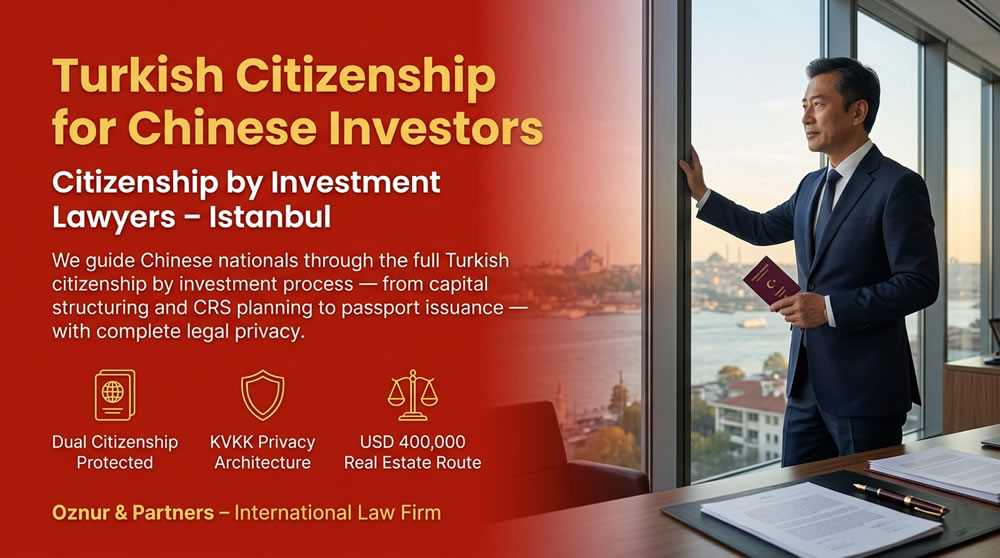
Turkish citizenship for Chinese investors is a legal pathway through which Chinese nationals acquire full Turkish citizenship by making a qualifying investment under Article 12 of the Turkish Citizenship Law No. 5901, without fulfilling the standard five-year residency or Turkish language requirements.
The minimum investment threshold starts at USD 400,000 for real estate, or USD 500,000 through bank deposits, investment funds, fixed capital, or government debt instruments. The process typically concludes within 6 to 8 months from application submission. A single investment file covers the main applicant, their legally married spouse, and all children under the age of 18.
For Chinese investors, this program carries a dimension that is rarely discussed openly: the intersection of Turkish legal protection and Chinese citizenship law. China prohibits dual citizenship under the Nationality Law of the People’s Republic of China. Yet Turkey legally recognizes dual citizenship and imposes no obligation to notify any foreign government when granting citizenship. The gap between these two legal systems creates both opportunity and structural risk. Navigating it requires a legal strategy that begins before the first document is signed, not after the passport arrives.
It is no coincidence that Chinese investors increasingly ask: which legal architecture ensures that a Turkish citizenship file remains inaccessible to Chinese authorities? The answer lies not in concealment but in the correct structural application of Turkish data protection law, CRS tax residency planning, and border crossing protocol, applied as an integrated system from the very first step.
⚖️ Why Do Chinese Investors Choose the Turkish Citizenship Program?
Turkey’s citizenship by investment program offers a combination of threshold, speed, and legal architecture that few comparable programs match. The USD 400,000 real estate entry point has remained stable under current regulations, the three-year holding period provides a clear exit horizon, and the program carries no minimum stay requirement during the application period.
Beyond the investment itself, Chinese investors typically evaluate Turkish citizenship for what it enables: a travel document with visa-free or visa-on-arrival access to over 110 countries, eligibility for the US E-2 treaty investor visa, and the freedom to hold titled real estate in a legally transparent jurisdiction outside China’s regulatory perimeter. For investors navigating China’s capital controls, property ownership in Turkey through TCMB-compliant foreign exchange documentation is itself a structurally sound asset.
The program also extends full citizenship rights to the family. Spouse and children under 18 are included in the same application file at no additional investment cost. Turkish citizenship, once granted by presidential decision, is a vested right under the Turkish legal system and cannot be revoked by a third country’s domestic law.
Turkey’s bilateral trade relationship with China has grown steadily, and Istanbul’s role as a logistics and finance hub continues to deepen as regional corridors expand. Chinese investors with commercial interests in Europe, the Middle East, or Central Asia find that Turkish citizenship provides both legal standing and operational flexibility that a Chinese passport alone does not offer.
⚖️ What Are the Investment Routes Available Under Turkish Law?
Turkish Citizenship Law No. 5901, Article 12, combined with Article 20 of the Implementation Regulation, defines six qualifying investment routes. Each carries different liquidity profiles, documentation requirements, and suitability depending on the investor’s capital transfer structure.
Real estate investment (USD 400,000 minimum): The most frequently used route. The investor purchases one or more properties with a combined SPK-certified appraised value of at least USD 400,000. A no-sale annotation is registered in the title deed, committing to a three-year holding period. A notarized preliminary sales contract for a property under construction with condominium or construction servitude is also accepted, provided the Ministry of Environment, Urbanization and Climate Change approves the structure and full payment is made in cash. For Chinese investors, the real estate route integrates most naturally with tax residency planning, because the property provides the residential address required to establish Turkish tax resident status.
Bank deposit (USD 500,000 minimum): Funds are deposited into a BDDK-authorized Turkish bank with a three-year lock-up condition. Documentation is straightforward and capital structure is predictable, but funds are illiquid during the holding period. BDDK approval confirms eligibility.
Real estate or venture capital investment fund (USD 500,000 minimum): CMB-regulated fund shares in a real estate investment fund (GYF) or venture capital investment fund (GSYF) qualify, provided the three-year holding condition is satisfied. This route suits investors with structured wealth management arrangements who prefer indirect asset exposure.
Fixed capital investment (USD 500,000 minimum): Direct investment into productive capacity in Turkey, confirmed by the Ministry of Industry and Technology. Suitable for investors establishing manufacturing, logistics, or technology operations.
Employment creation (50 persons minimum): Creating employment for at least 50 people through a business established or partnered with in Turkey, confirmed by the Ministry of Labor and Social Security.
Government debt instruments (USD 500,000 minimum): Purchase of Turkish government debt securities with a three-year holding condition, approved by the Ministry of Treasury and Finance.
For most Chinese investors, the real estate route combines the lowest threshold with the most direct path to tax residency structuring. Turkish citizenship for Chinese investors is most efficiently pursued through the real estate route precisely because it integrates both the investment requirement and the residential address needed for CRS structuring into a single transaction. The Turkish citizenship law firm team at Oznur & Partners structures the investment route selection as part of the overall privacy and tax residency plan, not as an isolated decision.
⚖️ Legal Services in Mandarin / 中文法律服务
我们为中国客户及投资者提供全面的一站式法律服务,涵盖公司注册、房地产投资、银行开户、居留许可、工作许可以及土耳其投资入籍(Turkish Citizenship by Investment)等领域。凭借丰富的国际业务经验,我们能够协助个人投资者、企业家及大型企业顺利进入土耳其市场,并确保所有法律流程安全、高效且符合当地法规。
我们的团队深知中国客户在海外投资与法律事务中的需求与文化差异,因此特别注重沟通的透明性、响应速度以及长期合作关系的建立。我们在整个流程中提供清晰、专业且高效的法律指导,并可根据客户需求提供中文沟通支持。
我们的服务范围包括:
• 土耳其公司设立及企业结构规划
• 银行开户与金融合规咨询
• 房地产尽职调查及产权审查
• 房地产买卖、租赁及投资法律支持
• 土耳其投资入籍申请(房地产、银行存款、基金等)
• 居留许可与工作许可申请
• 商业合同与国际贸易法律咨询
• 税务与跨境投资架构咨询
• 企业日常法律顾问服务
• 争议解决、仲裁及诉讼代理
我们致力于为中国客户提供长期、可靠并符合国际标准的法律支持,帮助客户在土耳其安心投资、顺利发展业务并实现长期目标。
⚖️ Privacy Protection: Will Chinese Authorities Know About the Turkish Citizenship?
Turkey has no legal obligation and no administrative practice of notifying a foreign government when it grants citizenship to one of that country’s nationals. This is not a policy gap: it reflects the principle of absolute sovereign right over citizenship decisions, which is standard in international law.
The legal basis for this privacy protection rests on three distinct pillars within Turkish law.
Turkish Citizenship Law No. 5901 and the sovereignty principle: There is no provision in the law or its implementing regulations requiring Turkish authorities to report citizenship grants to the applicant’s country of origin. Turkey is not party to any bilateral or multilateral agreement with China that mandates automatic sharing of citizenship information.
Personal Data Protection Law (KVKK) No. 6698, Article 9: A person’s citizenship status, identity information, and official records held by Turkish state institutions constitute personal data under KVKK. Article 9 is explicit: personal data cannot be transferred abroad without the data subject’s explicit written consent. Even if Chinese authorities submit a formal request to Turkish state institutions, fulfilling that request without the investor’s consent is legally prohibited and constitutes a criminal offense under Turkish law.
Confidentiality of the presidential decision: Exceptional citizenship approvals are granted by presidential decision. That decision is not published in the Official Gazette. It is notified only to the applicant or their legal representative. The citizenship file, including investment documentation and new identity records, is held within the closed infrastructure of MERNIS (Central Civil Registration System), which is inaccessible from outside state institutions without a Turkish court order.
The practical consequence is that Chinese authorities cannot detect a Turkish citizenship grant through open sources, visa databases, or diplomatic channels under normal circumstances. What remains within the investor’s control is their own travel behavior, which is why border crossing protocol is a mandatory component of the legal strategy we provide to all Chinese clients.
⚖️ CRS Reporting: Will Turkish Bank Accounts Be Reported to Chinese Tax Authorities?
Both Turkey and China are parties to the OECD Multilateral Competent Authority Agreement on Automatic Exchange of Financial Account Information (CRS). Turkish banks are required under Income Tax Law No. 193 and the Revenue Administration’s (GİB) CRS guidelines to review foreign clients’ account balances and report them to the relevant foreign tax authority.
The critical distinction is this: CRS operates on tax residency, not citizenship. The system identifies which country the account holder is legally a taxpayer of, and reports to that country’s authorities. Citizenship is not the trigger. Tax residency is.
This distinction creates a legally sound protection mechanism when the citizenship process is structured correctly from the beginning.
If a Chinese investor opens a Turkish bank account using their Chinese passport, a Chinese residential address, and a Chinese tax identification number, the bank registers them as a Chinese tax resident. That account balance is then reportable to Chinese authorities under CRS. This is the outcome of proceeding without legal structuring.
The correct sequence, as applied in Oznur & Partners’ citizenship process, is the following: an official residential address is established in Turkey for the investor before account opening; a Turkish Tax Identification Number (TIN) is obtained under the investor’s new Turkish identity; the bank account is opened using the Turkish identity card, Turkish TIN, and Turkish residential address. Under this structure, the investor is classified in the Turkish banking and tax system as a Turkish tax resident under Article 4 of Income Tax Law No. 193. The CRS obligation of Turkish banks to report to China is legally eliminated because the account is linked to Turkish residence, not Chinese.
A self-certification form error at account opening can automatically trigger CRS reporting, regardless of intent. This is why capital transfer to Turkey and account opening are conducted under direct legal supervision in every file we manage.
⚖️ Name Change Rights and Identity Architecture
Turkish law grants foreign nationals who acquire citizenship the right to adopt a completely new Turkish first and last name. For Turkish citizenship for Chinese investors, this right is one of the most strategically significant tools available, as it creates a legal identity with no traceable connection to the applicant’s Chinese records. It is guaranteed under the Population Services Law No. 5490 and the Regulation on the Implementation of the Turkish Citizenship Law No. 5901, and exercised through the VAT-4 form at the time of application submission.
The new Turkish name can have no phonetic or semantic connection to the applicant’s Chinese name. When the presidential citizenship decision is finalized, the Turkish Identity Card and Turkish Passport are issued exclusively in the new Turkish name. The original Chinese name does not appear on either document, not even in parentheses.
The link between the original Chinese name and the new Turkish name is maintained solely within MERNIS as a confidential administrative record. External access to MERNIS is not possible, and sharing this name link with third parties or foreign states without a Turkish court order is prohibited under KVKK.
In practical terms, the investor transacts internationally under their new Turkish identity: when applying for a third-country visa, opening accounts in a transit jurisdiction, or traveling as a Turkish citizen. The name change strategy is structured at the beginning of the application process, not added at the end. Its value depends on it being planned before the file is submitted.
⚖️ Border Crossing Protocol for Dual Passport Holders
Turkish law permits dual citizenship without restriction. Entering Turkey on a Chinese passport and exiting on a Turkish passport is legally permissible under Passport Law No. 5682 and the Law on Foreigners and International Protection (LFIP) No. 6458. There is no legal obstacle or penal sanction under Turkish law for this sequence.
The operational detail that must be managed is the PolNet border recording system. When an investor enters Turkey on a Chinese passport, that entry is recorded under the Chinese identity. If they then present a Turkish passport at exit, the system finds no entry record matching that Turkish name and flags the discrepancy. The resolution is straightforward: both passports are presented simultaneously to the border officer, who verifies the name change link via MERNIS and processes the exit under the Turkish passport. No notification is made to China.
The more sensitive exposure point is the Chinese passport itself. When an investor exits Turkey on their Turkish passport, no exit stamp is added to the Chinese passport. If the investor subsequently re-enters China and Chinese border officers observe an entry stamp to Turkey with no corresponding exit stamp, that gap can trigger scrutiny and potential detection of dual citizenship.
The strategic solution is the third-country transit protocol. The investor departs Turkey using the Chinese passport to a third country with visa-free entry (such as the United Arab Emirates, Qatar, or Thailand). The entry-exit cycle on the Chinese passport is closed cleanly in that transit country. From there, the investor continues to their actual destination using the Turkish passport. The Chinese passport shows a complete travel record with no visible connection to Turkish citizenship.
This protocol is provided as a structured advisory to every Chinese client at Oznur & Partners. For anyone pursuing Turkish citizenship for Chinese investors, this sequencing is planned before the citizenship process is completed, not improvised afterward.
⚖️ What Happens if China Revokes the Chinese Passport?
If Chinese authorities detect dual citizenship and revoke the investor’s Chinese passport or Chinese citizenship under Article 9 of the Chinese Nationality Law, Turkish citizenship remains entirely unaffected. This assurance rests on two principles of Turkish constitutional and citizenship law.
First, the principle of acquired rights (kazanılmış hak ilkesi): from the moment a presidential decision grants Turkish citizenship under Law No. 5901, that status becomes a vested right. Continuing to hold citizenship in another country is not a condition for retaining Turkish citizenship.
Second, the revocation conditions under Turkish Citizenship Law No. 5901, Article 31 are strictly defined. Turkish citizenship can be revoked only if the applicant made false declarations or concealed material facts when applying to Turkish authorities, such as submitting forged investment documents or a falsified criminal record. A decision by China to revoke Chinese citizenship under its own domestic law does not constitute grounds for revocation under Article 31.
If Chinese citizenship is revoked, the investor’s legal status transitions from dual citizen to sole Turkish citizen. All rights remain intact: commercial activities in Turkey, property ownership, family’s citizenship status, Turkish passport, and international mobility including US E-2 visa eligibility. The investor continues operating as a fully recognized Turkish citizen without interruption.
What does it mean to hold a second citizenship when the first may be withdrawn? Under Turkish law, the answer is structurally clear: the second citizenship is not conditional on the first. The legal standing is self-standing from the moment the presidential decision is issued.
⚖️ Can Chinese Authorities Obtain the Citizenship File from Turkish Institutions?
No. Turkish state institutions are legally prohibited from providing citizenship files, investment documentation, or identity records to a foreign government without the data subject’s explicit written consent, regardless of how the request is framed or through which diplomatic channel it arrives.
This prohibition operates through three independent legal mechanisms.
Under KVKK Article 9, explicit consent is required for any personal data transfer abroad. The General Directorate of Population and Citizenship Affairs and the Directorate General of Migration Management cannot fulfill a Chinese government information request without a signed consent letter from the investor. There is no exception for diplomatic requests.
For mutual legal assistance in criminal matters, the requesting country must demonstrate dual criminality: the conduct in question must constitute a crime under both Turkish law and the law of the requesting state. Dual citizenship is not a crime under Turkish law or international law. A mutual legal assistance request from China targeting a dual citizenship investigation would be rejected by the Turkish Ministry of Justice and Ministry of Foreign Affairs on this basis.
Under Banking Law No. 5411, Article 73, the investor’s financial transactions in Turkey are protected as customer secrets. Turkish banks cannot provide account statements or investment documentation to a foreign government or foreign tax authority without a Turkish court order issued in the context of a criminal case opened in Turkey.
The citizenship file, investment documentation, new Turkish name, and financial transfers are held within a multi-layered legal protection structure formed by KVKK, Banking Law No. 5411, and mutual legal assistance legislation. Access from outside this structure is not legally possible.
⚖️ The Application Process: Stages and Timeline
The exceptional citizenship process under Article 12 of Law No. 5901 follows a defined sequence. Turkish citizenship for Chinese investors moves through five distinct stages, from pre-investment structuring to passport issuance. The total timeline is typically 6 to 8 months, depending on document completeness and processing volumes at the relevant authorities.
Stage 1: Pre-investment structuring (2 to 4 weeks). Investment route selection, CRS and tax residency planning, Turkish TIN registration, residential address establishment, and power of attorney preparation. This stage occurs before any funds are transferred to Turkey and before any property is purchased. Errors at this stage are the primary cause of CRS exposure and application delays.
Stage 2: Investment execution (2 to 6 weeks). Property purchase with SPK-certified appraisal, title deed registration with no-sale annotation, or alternative investment route execution. TCMB foreign exchange documentation is prepared and submitted. All transactions are conducted under legal supervision.
Stage 3: Residence permit application (1 to 2 weeks). A short-term residence permit is obtained through the Directorate General of Migration Management. This is a mandatory step in the exceptional citizenship process and requires the applicant and spouse to provide biometric data either in Turkey or at a Turkish consulate abroad. This is the only stage that requires physical presence.
Stage 4: Citizenship application submission (1 to 2 weeks). The VAT-4 form, investment documentation, residence permit, translated and apostilled documents, and the requested Turkish name are submitted to the General Directorate of Population and Citizenship Affairs.
Stage 5: Presidential decision and identity document issuance (3 to 5 months). The file is evaluated and the citizenship decision is issued by presidential decree. Turkish Identity Cards and passports are issued for all approved family members. The process concludes when the family holds valid Turkish travel documents.
For investors evaluating when to begin, which stage carries the highest structural risk? In our experience, it is Stage 1. The decisions made before a single document is submitted determine whether the CRS structure is correct, whether the name change is optimally framed, and whether the border crossing protocol is in place before the passport is issued.
⚖️ Remote Process: Does a Chinese Investor Need to Travel to Turkey?
Most of the citizenship process can be completed remotely. Company registration, property purchase, title deed transfer, TIN registration, and contract execution are all handled under a notarized power of attorney, prepared in the investor’s home country, apostilled under the Apostille Convention, translated by a certified translator, and presented to the relevant Turkish authorities by the legal team. For countries not party to the Apostille Convention, Turkish consulate certification is available as an alternative.
The single stage requiring physical presence is biometric registration: the main applicant and spouse must appear once, either at a Directorate General of Migration Management office in Turkey or at a Turkish consulate abroad, to provide fingerprints and biometric data for the residence permit application.
For Chinese investors who prefer to minimize travel exposure during the application period, consulate-based biometric registration in a third country is a practical option that our team coordinates as part of the overall process structure.
⚖️ Legal 500 Recognition and Representation at Oznur & Partners
Oznur & Partners is a Legal 500-recognized law firm operating from Istanbul, with dedicated practice in Turkish citizenship for Chinese investors and other international clients. The firm has guided investors from over 40 countries through the Turkish citizenship by investment process. Our legal team includes English-speaking and Mandarin-assisted lawyers who manage the full citizenship process and the integrated legal architecture it requires.
For Chinese investors, our representation covers investment route selection, CRS and tax residency structuring, power of attorney preparation, title deed and investment documentation, residence permit application, citizenship application submission, name change strategy, border crossing advisory, and passport issuance. These services are delivered as a single integrated process because the privacy outcomes depend on each element being structured in relation to the others.
Our foreign investment advisory practice also supports Chinese investors evaluating the Turkish market before committing to citizenship. Preliminary consultations cover capital transfer structures, corporate formation options alongside citizenship, real estate due diligence, and the interaction between Turkish tax law and an investor’s existing cross-border holdings.
❓ Frequently Asked Questions
✅ Can Chinese citizens buy property in Turkey?
Yes. Chinese citizens can purchase real estate in Turkey without restrictions, except in designated military or security zones. Ownership rights are legally protected under Turkish property law. For citizenship by investment purposes, the property must be appraised by an SPK-certified appraiser and the title deed must carry a three-year no-sale annotation.
✅ How long does Turkish citizenship for Chinese investors take?
The Turkish citizenship by investment process typically takes between 6 and 8 months from investment completion to passport issuance. Pre-investment structuring adds 2 to 4 weeks to the total timeline and is required for Chinese investors who need CRS and privacy structuring before funds are transferred to Turkey.
✅ Does Turkey notify China when a Chinese national acquires Turkish citizenship?
No. Turkey has no legal obligation and no administrative practice of notifying the applicant’s country of origin when granting citizenship. The presidential citizenship decision is not published in the Official Gazette. Under KVKK No. 6698, Article 9, sharing citizenship information with a foreign state without the data subject’s explicit consent is legally prohibited and constitutes a criminal offense.
✅ Will my Turkish bank account be reported to Chinese tax authorities under CRS?
Not if the account is opened correctly. CRS reporting is triggered by tax residency, not citizenship. If the account is opened under a Turkish TIN and Turkish residential address established through the citizenship process, the CRS reporting obligation runs to Turkey, not China. This structuring must be completed before the first account is opened in Turkey.
✅ Can I enter Turkey on my Chinese passport and exit on my Turkish passport?
Yes. This is legally permitted under Turkish Passport Law No. 5682. Both passports must be presented simultaneously at the border so the officer can verify the name change link via MERNIS and close the entry record. The third-country transit protocol is recommended for investors returning to China to avoid a visible passport stamp gap on the Chinese passport.
✅ What happens to my Turkish citizenship if China revokes my Chinese citizenship?
Turkish citizenship remains fully valid. Under the principle of acquired rights in Turkish law, citizenship granted by presidential decision under Law No. 5901 is a vested right. The revocation conditions under Article 31 are limited to false declarations made to Turkish authorities, not to decisions made by a third country under its own domestic law. If Chinese citizenship is revoked, the investor’s status becomes sole Turkish citizen with no change to their rights, property, family’s citizenship, or passport.
✅ Can Chinese authorities obtain my citizenship file from Turkish institutions?
No. Under KVKK Article 9, personal data cannot be transferred abroad without explicit consent. Under mutual legal assistance law, dual citizenship is not a crime under Turkish law, so any Chinese government request targeting a dual citizenship investigation is rejected by Turkish authorities. Under Banking Law No. 5411, Article 73, financial records require a Turkish court order to be disclosed. These three protections operate independently and cumulatively.
✅ Do I need to travel to Turkey during the citizenship process?
Only once, for biometric registration. All other stages can be completed under a notarized power of attorney without traveling to Turkey. Biometric registration can also be completed at a Turkish consulate abroad, allowing Chinese investors to complete this step without entering Turkey.
✅ Can my spouse and children also obtain Turkish citizenship through my investment?
Yes. A single qualifying investment by the main applicant covers the legally married spouse and all children under the age of 18. They are included in the same citizenship application file and receive Turkish Identity Cards and passports upon approval. No additional investment is required for family members.
✅ Does Turkish citizenship give access to the US E-2 visa?
Yes. Turkey and the United States have a bilateral investment treaty making Turkish citizens eligible for the E-2 treaty investor visa. Chinese citizens are not eligible for the E-2 visa, so Turkish citizenship creates a legal pathway to US business residency that does not exist under Chinese nationality alone.
✅ What is the minimum investment for Turkish citizenship by investment?
The minimum qualifying investment is USD 400,000 for real estate, or USD 500,000 for bank deposits, investment fund shares, fixed capital investment, government debt instruments, or employment creation of 50 or more persons. The USD 400,000 real estate threshold is the lowest entry point and the most commonly used route among Chinese investors. All thresholds are set under current regulations and subject to change by regulatory update.
Schedule a Legal Consultation
If you are a Chinese investor evaluating Turkish citizenship by investment, managing CRS exposure, or structuring a real estate purchase in Istanbul, our Investment Lawyers in Istanbul are available for an initial consultation. We advise on the full process, from capital transfer to passport issuance, as an integrated legal structure.
⚖️ Related Legal Resources
🔹 Turkish Citizenship by Investment
- Turkish Citizenship Law Firm — full legal guidance on the exceptional citizenship program, investment route selection, and application management under Law No. 5901.
- Turkish Citizenship by Investment: 2026 Regulatory Updates — current threshold requirements, documentation changes, and processing timeline data under latest regulations.
- Can Turkish Citizenship Be Revoked After Approval? — legal analysis of the revocation conditions under Article 31 of Law No. 5901 and their implications for long-term citizenship security.
🔹 Real Estate and Property Law
- Real Estate Lawyer in Turkey — due diligence, title deed verification, SPK appraisal coordination, and property transaction management for foreign buyers in Istanbul and across Turkey.
- Foreign Property Eligibility in Turkey — legal framework governing which nationalities can purchase real estate, restricted zones, and conditions applicable to Chinese buyers.
🔹 Company Formation and Investment Law
- Company Formation Lawyer — 100% foreign-owned company structures in Turkey, LLC and joint stock options, registration process, and tax number issuance for Chinese investors entering the Turkish market.
- Foreign Investment Advisory — pre-investment legal analysis covering capital transfer structures, regulatory compliance, and cross-border asset governance for Chinese investors.
- VAT Exemption for Foreign Investors in Turkey — conditions under which foreign investors purchasing real estate or goods in Turkey are exempt from VAT under current regulations.
A legally sound Turkish citizenship file is not assembled at the end of the process. The decisions that determine privacy outcomes, CRS exposure, and long-term legal standing are made at the beginning. For Chinese investors, the difference between a correctly structured file and a reactively managed one is not a matter of preference. It is the difference between a citizenship that remains secure and one that creates the very exposure it was intended to avoid.