

A private pension contribution in Turkey can end in a passport, not just a retirement statement. This is what the Individual Pension System (Bireysel Emeklilik Sistemi, BES) route to Turkish citizenship actually does: it takes a regulated financial product, built for savings, and repurposes it as a vehicle for exceptional citizenship, provided the contribution meets a fixed threshold and stays untouched for a fixed period. The structure is simple to describe and easy to misjudge. Most of the mistakes we see are not legal errors; they are timing errors, fund selection errors, or a misplaced assumption that a pension product behaves like a bank account. It does not, and the difference is exactly where this page begins.
What exactly turns a pension contribution into a passport? A minimum of 500,000 USD, or the equivalent in another convertible currency, placed into an approved BES fund and held there for three uninterrupted years, converts a retirement product into a qualifying investment under Turkish citizenship law.
Why does a retirement product carry no promise of retirement income at all, and no one seems to mind? Because the buyer is not purchasing a pension in the ordinary sense; they are purchasing eligibility, and the fund’s investment performance is a secondary concern next to the citizenship outcome it unlocks.
When does the three-year clock actually start ticking? Not from the date of transfer, and not from the date of application; it starts from the effective date of the pension contract itself, the date the funds are confirmed inside the designated citizenship plan.
How can a falling currency and a shrinking balance still leave your citizenship completely intact? Because the qualifying condition is met at contribution, not maintained as a running balance; a currency swing that pushes the account value below 500,000 USD afterward does not undo what was already established.
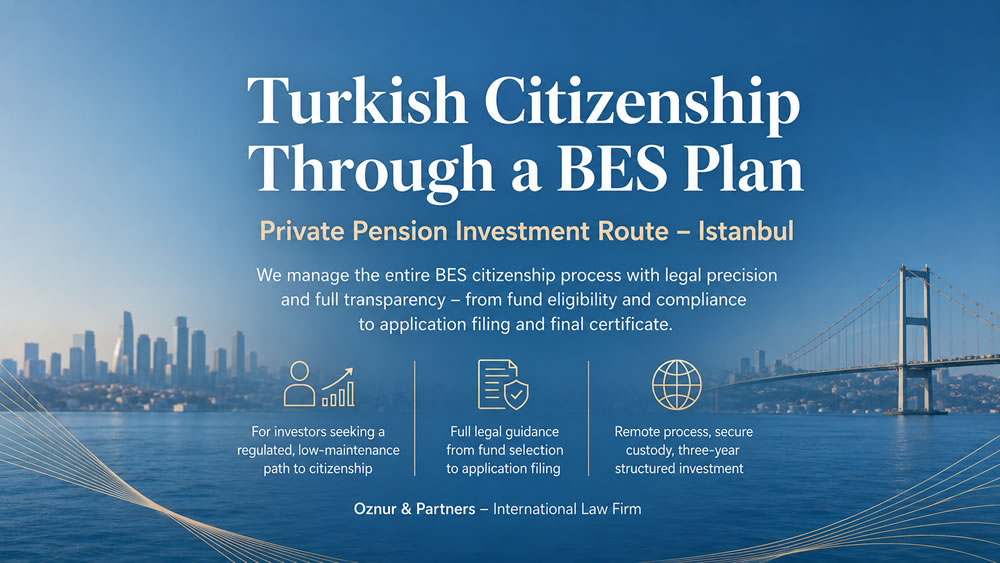
As a professional law firm operating in Istanbul, we manage the full BES citizenship process end to end, from fund eligibility confirmation to the final citizenship certificate, while keeping the investor’s financial exposure and legal exposure separate concerns that are handled with equal precision.
What makes this route worth a dedicated page, rather than a paragraph inside a broader citizenship-by-investment overview, is how differently it behaves from every other qualifying path. Real estate carries physical risk and market risk. Bank deposits carry no growth potential at all. Government bonds carry sovereign exposure without professional fund management. The pension route sits apart from all three, combining regulated custody, professional fund management, and a fixed, predictable qualifying threshold, and it rewards an investor who takes the time to understand its mechanics rather than treating it as a variation on a familiar theme. This page exists to provide that understanding in full, not as a summary that sends the reader elsewhere for the details that actually matter.
⚖️ The Legal Basis Behind the BES Citizenship Route
The BES citizenship option did not exist when Turkey first introduced its citizenship by investment program. It was added through an amendment to the Regulation on the Implementation of the Turkish Citizenship Law, published in the Official Gazette on 13 May 2022, which extended Article 20, second paragraph, subparagraph (f) to include private pension contributions among the qualifying investment categories. Before that date, foreign investors seeking citizenship through investment were limited to real estate, capital investment, employment generation, bank deposits, and government debt instruments.
Following the regulatory amendment, SEDDK issued its own operational circular, “Esas ve Usuller” (Principles and Procedures), setting out exactly how a pension company must structure the qualifying contract, what documentation must accompany an application, and how eligibility certificates are issued and forwarded to the relevant authorities. This circular remains the operational backbone of the process, and it is the document our team references directly when confirming that a given fund and plan structure will actually satisfy the citizenship condition, rather than relying on a pension company’s own marketing description of its product.
A separate but related clarification came from SEDDK afterward, addressing a point of confusion that had spread among prospective applicants: that the standard state contribution paid into ordinary BES accounts, a feature that makes Turkey’s domestic pension system attractive to its own citizens, does not apply to contributions made specifically to qualify for citizenship. This distinction, though a narrow regulatory point, has outsized practical importance, since it directly affects how investors should evaluate the net financial return of this route compared to simply depositing the same capital elsewhere.
⚖️ Why Istanbul Investors Choose the Pension Route Over Real Estate
Turkey’s citizenship by investment program did not begin with pension funds. It began with real estate, and for years that remained the default route for most applicants. The BES option was added later, through an amendment published in the Official Gazette on 13 May 2022, and it changed the calculus for a specific type of investor: one who wants the citizenship outcome without taking on property management, tenant risk, or the illiquidity that comes with owning a physical asset in a foreign country.
Istanbul remains the operational center of this route, not because the law requires it, but because the licensed pension companies, the regulatory bodies, and the legal infrastructure that supports foreign applicants are concentrated here. A foreign investor in Dubai, London, or Riyadh can complete the entire process without setting foot in Turkey, but the paperwork, the fund selection, and the compliance checks still run through Istanbul-based institutions.
The geography matters for a second reason. Turkey sits at the intersection of European, Middle Eastern, and Central Asian capital flows, and its citizenship program was designed with that positioning in mind. An investor is not just buying a passport; they are buying a foothold in a jurisdiction that bridges three regions, with visa-free or visa-on-arrival access that extends well beyond what many comparable programs offer.
The BES amendment itself did not appear in isolation. It followed a broader pattern in Turkey’s citizenship program, where the government periodically widens the range of qualifying instruments to match how international capital actually wants to move. Real estate suited investors who wanted a physical, income-generating asset. Bank deposits suited the most risk-averse profile. The pension route filled a gap between the two: an investor who wanted professional fund management without the illiquidity of property, and without the zero-growth profile of a static deposit sitting in an account for three years.
We have watched this shift play out directly with clients. An investor based in the Gulf who might have defaulted to a property purchase two years ago now asks about the pension route first, often because they already hold real estate elsewhere and do not want a second illiquid asset on their balance sheet. A European client relocating a family for schooling reasons increasingly asks the same question. The route did not exist as an option a few years ago; now it shapes a meaningful share of the citizenship conversations we have in an initial consultation.
There is also a quieter reason Istanbul retains its centrality here, one that has less to do with regulation and more to do with information flow. Fund performance data, SEDDK circulars, and pension company product updates move faster through firms physically present in the market than they do through intermediaries operating at a distance. An investor abroad relying on a foreign advisor for BES-specific guidance is often working from information that is several months stale by the time it reaches them, particularly around fund eligibility, which SEDDK updates periodically without significant public fanfare.
⚖️ How the Pension Route Differs From the Other Investment Paths
Turkey’s citizenship by investment program offers several qualifying routes, and each one carries a different risk profile, liquidity profile, and administrative burden. The comparison below reflects what we see repeatedly in client consultations, not a marketing preference for one route over another.
It is worth being explicit that “minimum investment” in this table does not mean equivalent cost of ownership. A 400,000 USD real estate purchase often carries additional transaction costs, agency fees, and notary charges that push the effective outlay meaningfully above the headline figure, along with ongoing property tax and maintenance obligations that continue for as long as the asset is held. A 500,000 USD BES contribution, by contrast, carries fund management fees deducted from the invested capital itself, but no separate ownership costs layered on top. Comparing the two routes purely on the headline minimum understates how differently they behave once the full three-year period is taken into account.
| Route | Minimum Investment | Holding Period | Liquidity Risk | Management Burden |
|---|---|---|---|---|
| BES Pension Fund | 500,000 USD | 3 years | Low, regulated fund custody | Low, professionally managed |
| Real Estate | 400,000 USD | 3 years | Higher, market-dependent resale | High, property maintenance and tenancy |
| Bank Deposit | 500,000 USD | 3 years | Low, but no growth potential | Low |
| Government Bonds | 500,000 USD | 3 years | Low, sovereign-backed | Low |
The pension route sits in an unusual middle ground. It carries the liquidity comfort of a bank deposit, but it retains the fund-management upside that a static deposit cannot offer. This is the reason we see a specific investor profile gravitate toward it: someone who wants the citizenship outcome secured with minimal operational involvement, but who still wants their capital exposed to professionally managed market instruments rather than sitting idle.
Consider two investors who approach us in the same week, both with 500,000 USD and both wanting Turkish citizenship within the same general timeframe. The first buys an apartment in Istanbul. Over the next three years, they field questions about tenants, property tax filings, and maintenance costs, and when the three years end, converting the property back into liquid capital takes months of marketing and negotiation. The second enrolls in a citizenship-designated BES plan. Over the same three years, they receive periodic fund statements, make no operational decisions beyond the initial fund selection, and at the end of the period, the exit is administrative rather than commercial. Both investors obtain the same citizenship. Only one of them spent three years managing an asset instead of simply holding one.
This is not an argument that real estate is the wrong choice. Many investors want the property, independent of the citizenship benefit, and for them the dual purpose justifies the operational load. The distinction matters only for the investor who wants citizenship as the primary objective and views the underlying investment as a means to that end rather than an asset they intend to use personally.
⚖️ Common Mistakes and the Risks Behind Them
Foreign investors rarely fail the BES citizenship process because of the law itself. They fail because of assumptions carried over from other investment routes, or from how pension products work in their home country. Pension systems vary enormously across jurisdictions, and an investor who has spent years contributing to a workplace pension in Germany, the UK, or the Gulf brings a mental model of how those systems behave that does not map cleanly onto Turkey’s citizenship-specific BES structure. The five mistakes below are the ones we correct most often in initial consultations, before they have a chance to become expensive.
✅ Assuming the Balance Must Stay Above 500,000 USD
This is the single most common source of anxiety we encounter, and it is based on a misunderstanding. The qualifying condition is the contribution amount at the time it enters the designated citizenship plan, not a running minimum balance that must be defended against currency fluctuation. If the Turkish Lira equivalent of the contribution drops below 500,000 USD later, due to exchange rate movement, this does not affect the citizenship application or the citizenship already obtained. Investors who track their fund balance daily, worried about a threshold breach, are tracking the wrong number.
✅ Believing the Government Adds a Contribution Bonus
Turkey’s standard BES system includes a state contribution mechanism for ordinary domestic savers, and this detail travels with the product’s reputation even into the citizenship context, where it does not apply. The Insurance and Private Pension Regulation and Supervision Agency (SEDDK) has confirmed that the amount deposited specifically to qualify for citizenship does not receive this state contribution. The fund itself may still perform well through its underlying investments, but the government bonus that applies to regular BES savers is not part of this route.
✅ Choosing an Ineligible Fund or Wrong Plan Category
Not every pension product offered by a licensed company automatically qualifies. Under the citizenship regulation, the contract must be established under a plan whose title specifically includes the word “Citizenship” (Vatandaşlık Emeklilik Planı), and the funds must be held within the categories designated by SEDDK. An investor who opens a standard retirement contract, without this specific plan designation, will not have created a qualifying investment, regardless of the amount contributed.
✅ Underestimating the Three-Year Discipline
The three-year holding period is not negotiable, and early withdrawal or transfer breaks the qualifying condition entirely. Some investors treat this period as a formality once the application is submitted; it is not. The obligation continues to run in the background, and premature access to the funds, or transfer between different pension companies in a way that resets the contract, can undo years of an otherwise correctly managed application.
✅ Treating the Application as a One-Time Event
The paperwork submitted at the start of the process is not the end of the obligation, and investors who file the initial documents and then disengage entirely often miss developments that matter. SEDDK periodically updates its list of eligible fund categories, and a fund that qualified at the time of enrollment can, in rare cases, be affected by later regulatory adjustments. An investor who is not tracking this, or who has no one tracking it on their behalf, discovers the issue only when it becomes a problem rather than while it is still a manageable adjustment.
✅ Confusing Fund Performance With Citizenship Eligibility
Some investors spend disproportionate energy comparing projected returns across different pension companies, as though the fund’s investment performance were the primary variable in the citizenship decision. It rarely is. The qualifying threshold is fixed regardless of which fund is chosen, and the difference between a strong-performing fund and a weaker one, over three years, is financially relevant but has no bearing on whether citizenship is granted. Investors who over-optimize for fund performance sometimes under-invest in the compliance and documentation work that actually determines whether the application succeeds.
⚖️ The Protective Mechanisms Behind BES Funds
Part of what makes this route attractive to conservative investors is the layered regulatory oversight that sits behind it, oversight most applicants never see directly but that determines how safe their capital actually is.
SEDDK acts as the primary regulator, authorizing which pension companies and which fund categories can accept citizenship-qualifying contributions. Alongside it, the Capital Markets Board (SPK) supervises the fund structures themselves, and the Pension Monitoring Center (Emeklilik Gözetim Merkezi, EGM) tracks contract status and reports eligibility data to the Directorate General of Migration Management once the three-year condition is confirmed.
Custody is a separate layer again. Fund assets are held at Takasbank, Turkey’s state-owned central clearing institution, which segregates client assets from the pension company’s own balance sheet. This segregation matters in a very concrete way: if the pension company managing the fund were to face financial difficulty, the investor’s assets remain protected because they were never commingled with the company’s operational capital in the first place. Units are also traded and listed on TEFAS, adding a layer of price transparency that a private, uncustodied investment vehicle would not offer.
Which of these protections actually matters if the investor never needs to test them? All of them, because the value of a protective structure is measured by what it prevents, not by how often it is invoked; an investor who never faces a pension company’s insolvency still benefits from the fact that the structure made that scenario irrelevant from the start.
This layered structure also explains why the BES route tends to attract a more conservative investor profile than real estate does. A property purchase exposes the investor to a single counterparty risk, the developer or the seller, and to market risk on resale. A BES contract exposes the investor to fund performance risk, but the custody and regulatory layers around it are designed specifically to prevent the kind of institutional failure that would put the principal itself at risk. The two forms of risk are not comparable in nature, and conflating them is a common error we correct in early consultations.
One detail that surprises many investors is how the reporting obligation runs during the three years. Licensed pension companies are required to provide periodic statements showing contribution levels, fund performance, and compliance status, typically delivered through digital channels rather than paper correspondence. An investor abroad receives the same visibility into their fund as a domestic Turkish saver would, which is part of why the process translates so well to a remote structure. There is no information asymmetry built into the system that specifically disadvantages a foreign applicant.
⚖️ Standard Citizenship BES Plan or Participatory Citizenship BES Plan
Investors choosing the pension route face one internal decision: which type of qualifying plan to enroll in. Both plans require the same 500,000 USD threshold and the same three-year holding period, and both lead to the same citizenship outcome. The difference lies entirely in the underlying financial philosophy of the fund.
The standard Citizenship BES Plan invests through conventional financial instruments, including interest-bearing government debt and standard fund structures. The Participatory Citizenship BES Plan (Katılım Esaslı Vatandaşlık BES Planı) restricts investment to interest-free instruments, such as sukuk (participation certificates) and other participation banking products, aligning with Islamic finance principles.
Neither plan is legally superior; the choice reflects the investor’s own financial and ethical preferences. We see clients from Gulf jurisdictions gravitate toward the participatory structure specifically for this reason, while investors from Europe and the Americas more often default to the standard plan without a strong preference either way.
The practical difference shows up in the underlying fund composition rather than in the application process itself. Both plan types are held at Takasbank, both are traded through TEFAS and BEFAS, and both are subject to the same SEDDK eligibility confirmation. An investor switching from one category to the other before the contract is finalized faces no additional friction; the complication arises only if the switch is attempted after the three-year clock has already started, since this can be treated as a contract change requiring fresh legal review.
We are occasionally asked whether the participatory structure carries lower returns than the standard plan, given that it excludes interest-bearing instruments. The honest answer is that performance varies by fund manager and by market cycle, not by category alone, and neither plan type has demonstrated a consistent long-term performance advantage over the other in the years since the citizenship route was introduced. The decision is better made on the basis of the investor’s own financial philosophy than on a performance prediction that neither we nor anyone else can make reliably in advance.
❓ When Should You Bring in Legal Representation?
The honest answer is before the pension contract is signed, not after. Once a contract is established under the wrong plan category, or before eligibility documents are confirmed, correcting the error means starting a new three-year clock. We are typically consulted at one of two moments: before fund selection, when the investor still has flexibility to choose correctly, or after a problem has already surfaced, when the options are narrower and the fix is slower.
The stages where legal input changes the outcome most are fund eligibility confirmation, contract review against the citizenship-specific plan requirements, document preparation for the Directorate General of Migration Management, and the final application filing itself. An investor who treats these as purely financial or administrative steps, without legal oversight, is often the same investor who discovers a defect only when the three-year period is already nearing its end.
There is a version of this consultation we wish happened more often and rarely does: an investor calling before they have contacted any pension company at all, wanting to understand the legal framework first and the financial products second. Most calls run in the opposite order, with the investor having already spoken to a pension company representative, sometimes already having signed preliminary paperwork, and seeking legal confirmation after the fact rather than before. Reversing that order, even by a single conversation, tends to produce a noticeably smoother three years.
⚖️ How We Select and Verify the Right Fund
Our role begins before the pension contract exists. We confirm that the target pension company is licensed to accept citizenship-qualifying contributions, that the specific plan carries the required “Citizenship” designation, and that the fund categories fall within SEDDK’s approved list. We then review the contract terms directly, checking that the effective date, the fund allocation, and the beneficiary details are structured correctly from day one.
Throughout the three-year holding period, we monitor compliance status rather than leaving the investor to track it independently. When the holding period concludes, we prepare the full application file for the Directorate General of Migration Management, including the eligibility certificate from SEDDK, the pension contribution records, and the supporting personal documentation, and we manage the submission and follow-up through to the citizenship certificate.
We also maintain direct working relationships with the compliance departments of the licensed pension companies active in this space, rather than communicating exclusively through client-facing representatives whose primary role is sales rather than regulatory detail. This distinction matters more than it might appear. A sales representative can confirm that a product exists and describe its features; a compliance officer can confirm exactly how a specific fund’s eligibility status is tracked internally and flag in advance if any adjustment is anticipated. We route our fund verification work through the latter wherever possible.
An investor comparing this custody structure to what a domestic pension system in their home country offers will often find the Turkish framework more heavily layered than they expected. Many countries rely on a single regulator overseeing pension products directly, without the additional segregation of custody at a separate clearing institution. Turkey’s structure, by routing custody through Takasbank independently of both the pension company and SEDDK, adds a layer that most foreign investors do not encounter in their own jurisdictions, and it is worth explaining plainly rather than assuming the investor already understands why it matters.
⚖️ Documents Required for a BES Citizenship Application
The following documents form the core of a BES citizenship file. Missing or inconsistent documentation is the most common source of processing delays we encounter.
- Original and certified copy of a valid passport
- BES participation certificate confirming the citizenship-designated plan
- Proof of contribution of at least 500,000 USD or equivalent foreign currency, with bank transfer receipts
- SEDDK eligibility certificate confirming compliance with citizenship requirements
- Valid Turkish residence permit or entry visa status
- Criminal record certificate for foreign applicants
- Completed citizenship application form
- Recent passport-style photograph
- Power of attorney, where the application is filed through legal representation
Applications filed through a lawyer allow the entire submission, correction, and follow-up process to be managed remotely, without the investor needing to be physically present in Turkey at any stage beyond the initial fund transfer.
A detail that often catches investors off guard is the requirement for name consistency across every one of these documents. The name on the passport, the pension contract, the bank transfer records, and the application form must match exactly, including transliteration of names that do not use the Latin alphabet in their original form. A minor inconsistency, such as a middle name appearing on one document and not another, or a transliteration variant between a passport and a bank receipt, can trigger a request for clarification from the Directorate General of Migration Management that adds weeks to an otherwise straightforward file. This is a mechanical issue rather than a legal one, but it is exactly the kind of mechanical issue that legal oversight catches before submission rather than after a rejection notice arrives.
The SEDDK eligibility certificate deserves particular attention because it functions as the bridge document between the financial side of the process and the immigration side. Without it, the Directorate General of Migration Management has no verified confirmation that the pension contribution actually satisfies the citizenship-specific requirements, regardless of how much documentation the investor submits directly. The certificate is issued only after the pension company itself forwards the file to SEDDK following its own five-business-day internal review, and delays at this stage are almost always a function of incomplete initial submission rather than any backlog on SEDDK’s part.
⚖️ Rights Extended to Family Members
Citizenship acquired through a BES plan extends to the investor’s spouse and to children under the age of 18, without requiring a separate qualifying investment for each family member. Once granted, family members hold the same rights as any other Turkish citizen: children attend public schools without additional fees, the family accesses public healthcare on equal terms with citizens, and the need for a separate work permit disappears entirely for adult family members who wish to work or start a business in Turkey.
Property acquisition rights also transfer automatically. A family that later decides to purchase real estate in Turkey, entirely separate from the original citizenship investment, does so under the same conditions as any Turkish citizen, without the restrictions that apply to foreign nationals purchasing property in certain zones.
A question we hear often from families is whether a child who turns 18 during the three-year holding period, before the citizenship application is actually filed, still qualifies under the family provision. The answer depends on the child’s age at the point the application is submitted, not at the point the pension contract began, which means families approaching this boundary should plan the filing timeline with particular care. We have handled cases where a matter of months made the difference between a child qualifying automatically as a dependent or needing to pursue a separate application path later, and this is precisely the kind of timing detail that benefits from legal planning well before the three-year period concludes.
Family members added under this provision also inherit the same permanence as the primary applicant. Turkish citizenship, once granted, is not conditioned on the pension funds remaining invested indefinitely; the three-year holding requirement is a qualifying condition for the grant, not an ongoing condition for retention. A family that later decides to withdraw the pension funds entirely, once citizenship has been formally granted to every family member, does so without affecting citizenship status already obtained.
❓ Why This Firm for a Pension-Based Application?
Pension-based citizenship files are frequently the ones law firms in Turkey handle the least, precisely because real estate remains the more commonly requested route. We chose to build dedicated capacity in this specific area because the fund-selection and compliance work involved rewards specialization rather than general practice familiarity. Our team tracks SEDDK’s fund eligibility list directly, rather than relying on a pension company’s own representations about which of its products qualify.
We are often consulted after an investor has already opened the wrong type of pension contract elsewhere, discovered only when the citizenship application stalls. Correcting that kind of structural error is harder than preventing it, and it shapes how carefully we approach the fund-selection stage for every new client.
Part of what distinguishes fund-based citizenship work from real estate work is that the fund side involves a second regulated industry, insurance and private pensions, sitting alongside immigration law. A firm that only handles the immigration filing, without direct familiarity with how SEDDK evaluates fund eligibility or how pension companies structure their citizenship-designated products, is working with an information gap that surfaces exactly when a client needs certainty the most. We built our BES practice specifically to close that gap, coordinating directly with pension companies during fund selection rather than treating that stage as the investor’s independent responsibility.
This also shapes how we price and structure our involvement. Because the three-year holding period is a long engagement rather than a single transaction, we structure our fee arrangement around the distinct phases of the process, fund selection and contract review, ongoing compliance monitoring, and final application filing, so that clients understand exactly what they are paying for at each stage rather than facing a single opaque retainer for a process that unfolds over years.
⚖️ How the Remote Process Works
Most of our BES citizenship clients complete the entire process without visiting Turkey more than once, if at all. The fund transfer itself typically requires the investor’s participation through their chosen pension company’s digital or international banking channels. From that point, document collection, power of attorney execution, and application filing are handled remotely, with our office serving as the point of contact for the Directorate General of Migration Management and the relevant pension company.
Communication runs in the investor’s preferred language throughout, and status updates are provided at each stage of the three-year holding period, not only at the beginning and end of the process.
The single in-person requirement most clients encounter, when there is one at all, relates to biometric data collection for the residence permit or citizenship application itself, which in some cases must be completed at a Turkish consulate abroad or during a brief visit to Turkey. Even this step has become increasingly flexible in recent years, with several consulates now equipped to handle the biometric requirement without the investor needing to travel to Turkey specifically for that purpose. We coordinate this scheduling directly with clients as part of the overall timeline planning, rather than leaving it as a late-stage surprise.
Power of attorney documents used in this process are typically prepared in the investor’s country of residence, notarized locally, and apostilled or legalized according to the requirements of the country of origin’s relationship with Turkey. We provide the exact template required for BES citizenship purposes specifically, since a generic power of attorney drafted for a different type of transaction often lacks the specific authority needed to act on the client’s behalf before SEDDK and the Directorate General of Migration Management.
⚖️ Who This Route Suits Best
The BES pension route tends to suit a specific investor profile: someone who wants Turkish citizenship secured with minimal ongoing operational involvement, who is comfortable with a three-year commitment horizon, and who prefers a professionally managed financial instrument over direct asset ownership. We see this route chosen frequently by investors based in the Gulf, by professionals in Europe who want the outcome without managing a second property abroad, and by families who have already completed other investments in Turkey and want a lower-maintenance option for extending citizenship benefits to additional family members.
It suits less well an investor who wants a tangible asset they can visit, rent out, or sell independently of the citizenship process; for that profile, the real estate route generally remains the more natural fit.
There is a third profile worth naming separately: the investor who has already been rejected, or discouraged, from another route for reasons unrelated to their finances. Some real estate transactions stall over title deed disputes, unclear zoning status, or a seller unwilling to complete a sale within the investor’s timeline. For an investor in that position, the pension route offers a genuine reset, a path that does not depend on a specific property, a specific seller, or a specific market condition holding steady long enough to complete a transaction. The qualifying event is a contribution to a regulated financial product, and regulated financial products are considerably less prone to the kind of transactional friction that can derail a real estate purchase midway through.
⚖️ Tax Considerations Investors Ask About First
Tax questions surface early in almost every BES citizenship consultation, usually before the investor has fully committed to the route. The pension contribution itself is not treated as taxable income at the point of deposit, and the citizenship outcome is not a taxable event under Turkish law. What does carry tax relevance is the treatment of any withdrawal or fund performance gain once the three-year period concludes, and this is where the standard and participatory plans can diverge slightly depending on the specific instruments held. Investors planning to withdraw the full balance immediately after the holding period, rather than leaving it invested, benefit from reviewing the applicable withdrawal tax treatment before, not after, the three-year period ends. A closer look at the fiscal side of this route, including how it compares to the tax treatment of real estate or bank deposit routes, is covered separately, since the details depend on individual circumstances that a general overview cannot responsibly resolve.
⚖️ What a Complete Application Timeline Looks Like
Investors frequently ask for a realistic timeline, and the honest answer has three distinct phases rather than one continuous process. The first phase, fund selection and contract establishment, typically takes a matter of weeks once the investor has decided on a pension company and plan category, assuming documentation is complete and the fund transfer proceeds without banking delays. The second phase is the three-year holding period itself, during which the investor’s active involvement is minimal but not zero, since compliance monitoring continues throughout. The third phase, application filing after the three years conclude, typically resolves within several months, depending on the completeness of the file and the current processing volume at the Directorate General of Migration Management.
The temptation is to think of this as a three-year wait followed by a quick final step. In practice, the quality of what happens in the first phase determines how smooth the third phase turns out to be. An application file assembled carelessly at the start, with an eligibility certificate that does not perfectly match the contribution records, creates friction three years later that a small amount of diligence at the outset would have avoided entirely.
Investors sometimes ask whether the checkpoint schedule below is a formal legal requirement or simply our own working method. It is the latter, built from years of watching where files run into trouble, and firms structure this differently. We share the specific checkpoints here because the underlying logic, catching small discrepancies while they are still small, applies regardless of which legal team an investor ultimately works with.
We recommend clients think of the three-year period in terms of checkpoints rather than as a single undifferentiated waiting period. At roughly the one-year mark, we confirm that fund eligibility status remains unchanged and that no regulatory adjustment has affected the specific fund category held. Around the eighteen-month mark, we review whether the investor’s personal circumstances, such as a change in marital status or the birth of a child, require any adjustment to the family provisions that will eventually be included in the application. In the final months before the three-year anniversary, we begin assembling the application file in advance, so that the moment the holding period concludes, submission can proceed without delay rather than starting the document-gathering process from scratch.
This checkpoint approach also gives investors a natural moment to raise questions as their circumstances evolve, rather than accumulating uncertainty silently for three years and arriving at the filing stage with a backlog of unresolved concerns. A process built around periodic check-ins, rather than a single point of contact at the beginning and another at the end, tends to surface small issues while they are still small.
❓ Frequently Asked Questions
✅ How much do I need to invest to qualify for Turkish citizenship through BES?
A minimum of 500,000 USD, or the equivalent in another convertible currency, deposited into an approved citizenship-designated BES plan.
✅ Does the three-year holding period start from the application date?
No. It starts from the effective date of the pension contract itself, the date the qualifying contribution is confirmed inside the designated plan.
✅ What happens if the exchange rate causes my fund balance to drop below 500,000 USD?
Nothing affecting your citizenship. The qualifying condition is met at the point of contribution, not maintained as a running balance requirement afterward.
✅ Does the government add a bonus contribution to my BES citizenship deposit?
No. SEDDK has confirmed that the state contribution applicable to ordinary domestic BES savers does not apply to funds deposited specifically for citizenship purposes.
✅ Can I choose any pension company for this route?
Only companies licensed by SEDDK to accept citizenship-qualifying contributions, and only under a plan whose title includes the “Citizenship” designation.
✅ What is the difference between the standard and participatory BES citizenship plans?
The standard plan invests through conventional instruments including interest-bearing debt. The participatory plan restricts investment to interest-free instruments such as sukuk. Both require the same investment amount and holding period.
✅ Does citizenship extend to my spouse and children?
Yes, to your spouse and to children under 18, without requiring a separate qualifying investment for each family member.
✅ Can I withdraw the funds early once citizenship is granted?
No. Early withdrawal before the three-year period concludes breaks the qualifying condition and can jeopardize the citizenship already obtained.
✅ Do I need to be physically present in Turkey for this process?
No, in most cases. The process can be completed remotely through power of attorney, aside from the initial fund transfer, which typically runs through international banking channels.
✅ Is my capital protected if the pension company faces financial difficulty?
Yes. Fund assets are held in custody at Takasbank, segregated from the pension company’s own balance sheet, and listed on TEFAS for price transparency.
✅ How long does the citizenship application take once the three years conclude?
Processing timelines vary by case complexity and documentation completeness, typically resolved within several months of a complete, correctly filed application.
✅ Can I transfer my BES contract between pension companies during the three years?
Transfers can disrupt the continuity of the qualifying contract and should only be done with legal review beforehand to confirm the three-year clock is not reset.
✅ Is real estate or BES the better route for citizenship?
Neither is universally better. BES suits investors who prefer a professionally managed financial instrument with lower operational burden; real estate suits investors who want a tangible, independently usable asset.
✅ Do I need a lawyer for a BES citizenship application?
It is not legally mandatory, but fund eligibility errors and plan category mistakes are difficult to correct once a three-year holding period has begun, which is why legal review before contract signing is strongly advised.
✅ What documents does SEDDK require for the eligibility certificate?
Passport copies, the pension participation certificate, contribution proof, and supporting identification documents submitted through the licensed pension company, which forwards the file to SEDDK for review.
⚖️ Related Legal Resources
For a closer look at the documentation stage of this process, see our guide on documents required for a BES citizenship application. Investors weighing the two plan categories in more depth can review our comparison of the Citizenship BES Plan and the Participatory Citizenship BES Plan. Family members preparing to join an existing application should see family rights under BES citizenship. Investors still deciding whether legal representation changes the outcome can read why legal support matters for a BES citizenship application, and those weighing the fiscal side of the investment can review tax advantages of BES citizenship in Turkey.
If a pension fund contract already looks correct on paper but something about the plan category or timing feels unresolved, that feeling is usually correct. Speak with our team before the three-year clock starts, not after.
⚖️ Conclusion: A Regulated Path, Not a Shortcut
The BES route to Turkish citizenship is not faster than real estate, and it is not cheaper. What it offers instead is a different kind of certainty: a regulated financial structure, custody protections that sit outside the pension company’s own solvency, and a process that can run almost entirely without the investor setting foot in Turkey. The risks that do exist are not hidden in the law; they sit in fund selection, plan category, and the discipline of the three-year holding period, and every one of them is manageable with the right oversight from the start.
Investors who approach this route with the same level of preparation they would bring to any regulated financial commitment tend to find the process unremarkable in the best possible sense: no surprises, no last-minute rejections, and no confusion about what was required at each stage. The investors who struggle are almost always the ones who treated the pension contract as a formality rather than as the foundation the entire citizenship outcome rests on. That distinction, more than any single legal technicality, determines how the three years actually unfold.
For investors who value a professionally managed instrument over a physical asset, this remains one of the more quietly reliable paths into Turkish citizenship, and one whose regulatory backbone rewards exactly the kind of careful, early attention this page has tried to lay out in full.